


A peace bond is a protective court order under the Criminal Code of Canada, not a criminal conviction. It’s a formal agreement you make with the court to ‘keep the peace and be of good behaviour’ for a specific time, usually 12 months. This preventative tool is a common-sense way to resolve certain criminal charges without going through a full-blown trial, protecting you from a permanent criminal record.
Understanding the Purpose of a Peace Bond
Imagine a heated argument between neighbours that leads to a minor assault or threat charge. Instead of gearing up for a costly and stressful trial, the justice system offers a practical off-ramp: a peace bond. This is an incredibly common and effective resolution, particularly for people in Brampton who are facing a first-time charge for a less serious offence.
The core idea here is to prevent future conflict, not to punish past actions. When you agree to a peace bond, you are not admitting guilt. What you are doing is acknowledging that someone has a reasonable fear of you, and you’re agreeing to follow specific rules to help ease that fear.
A Path to Withdrawing Your Charges
For many people, understanding what is a peace bond in Canada is the first step toward putting a criminal charge behind them for good. By entering into this court-ordered agreement, the Crown Prosecutor will withdraw the original criminal charge. For any skilled Brampton criminal lawyer, securing this outcome is often the top priority.
The benefits of this approach are crystal clear:
- No Criminal Record: Once you successfully complete the terms of the peace bond, you walk away without a criminal conviction.
- No Admission of Guilt: You never have to plead guilty to the original offence.
- Efficient Resolution: It brings a much faster and less stressful end to your case than a trial would.
A peace bond acts as a legal off-ramp from the criminal justice system. It resolves a charge based on a promise of future good conduct, preserving a person’s clean record.
At Badesha Law, a leading criminal lawyer in Brampton, our team strategically negotiates these outcomes every day. We dive deep into the Crown’s case, identify its weaknesses, and advocate for a peace bond as a just and sensible resolution, protecting our clients from the lifelong consequences of a criminal record. Unlike diversion programs that often require community service or donations, a peace bond focuses purely on preventative conditions. You can learn more about the diversion program in our article to see how the two resolutions differ.
The Legal Framework of Section 810 Peace Bonds
To really get what a peace bond is in Canada, we need to look at its legal DNA: Section 810 of the Criminal Code. This specific law is the engine behind the entire peace bond process, giving judges the authority to step in and take preventative action before a crime ever happens. It’s the rulebook a skilled criminal lawyer in Brampton uses to navigate these types of resolutions.
At its core, Section 810 lets a judge issue a court order—officially called a recognizance—if there are “reasonable grounds” to fear someone might hurt another person or damage their property. That court order is what we all call a peace bond.
What Does “Reasonable Grounds” Actually Mean?
“Reasonable grounds” can sound a bit fuzzy, but it’s a critical legal standard. Think of it like a smoke alarm. The alarm doesn’t mean your house is burning down, but it signals enough evidence of smoke to justify taking immediate, preventative action. You don’t wait to see flames before you act.
In the same way, the court doesn’t need proof that an offence is guaranteed to happen. It just needs enough credible evidence to believe the person’s fear is reasonable. This is a much lower bar to clear than the “beyond a reasonable doubt” standard needed for a criminal conviction. You can learn more about the burden of proof in criminal trials to see just how big that difference is.
This is exactly where legal expertise becomes so important. An experienced lawyer can poke holes in the informant’s fear, arguing that the grounds they’ve presented just aren’t reasonable when you look at them closely.
The Role of a Brampton Criminal Lawyer
At Badesha Law, our deep understanding of Section 810 of the Criminal Code of Canada is the backbone of our strategy. We dig into the informant’s claims and the police evidence to figure out if the Crown can actually meet the “reasonable grounds” test.
A peace bond hearing isn’t about proving past guilt. It’s about assessing future risk. An effective defence involves demonstrating that the alleged fear is either exaggerated or not supported by credible evidence.
This preventative focus is what makes a peace bond such a powerful tool for resolving criminal matters. When you’re facing charges for threats, harassment, or a minor assault, the whole case often boils down to how credible the complainant’s fear really is. By agreeing to a peace bond, you’re essentially saying, “I will follow these rules to eliminate that fear,” which gives the Crown a reason to withdraw the criminal charge and close the file without a trial.
How a Criminal Lawyer Secures a Peace Bond
Getting a peace bond isn’t something that just happens; it’s the result of a strategic negotiation where legal experience is everything. There are really two ways to get one, and each requires a different game plan from a skilled criminal lawyer in Brampton.
The most common route involves direct negotiation with the Crown Prosecutor. In these cases, a peace bond is put on the table as a way to resolve an existing criminal charge, like a minor assault or uttering threats. This is a particularly frequent outcome for first-time offenders or when the Crown’s case isn’t exactly rock-solid.
The Role of Negotiation and Disclosure
The second, less common path is a private application under Section 810 of the Criminal Code. This is where an individual (the informant) goes directly to the court to ask for a peace bond against someone else, because they fear they might be harmed. But no matter which path we take, your defence lawyer’s goal is the same: to show that a peace bond is a smarter, more just outcome than a full-blown criminal trial.
At Badesha Law, our work starts with a deep dive into the Crown’s evidence, a file known as “disclosure.” This package contains all the police notes, witness statements, and every other piece of evidence they have against you. We comb through this material looking for weaknesses, inconsistencies, or any violations of your Charter rights.
A strong defence is built on the details found in disclosure. By identifying flaws in the Crown’s case, a lawyer creates leverage to persuade the prosecutor that a peace bond is the most appropriate resolution, saving court time and resources.
This process illustrates how reasonable grounds are assessed, leading from initial concern to court action.
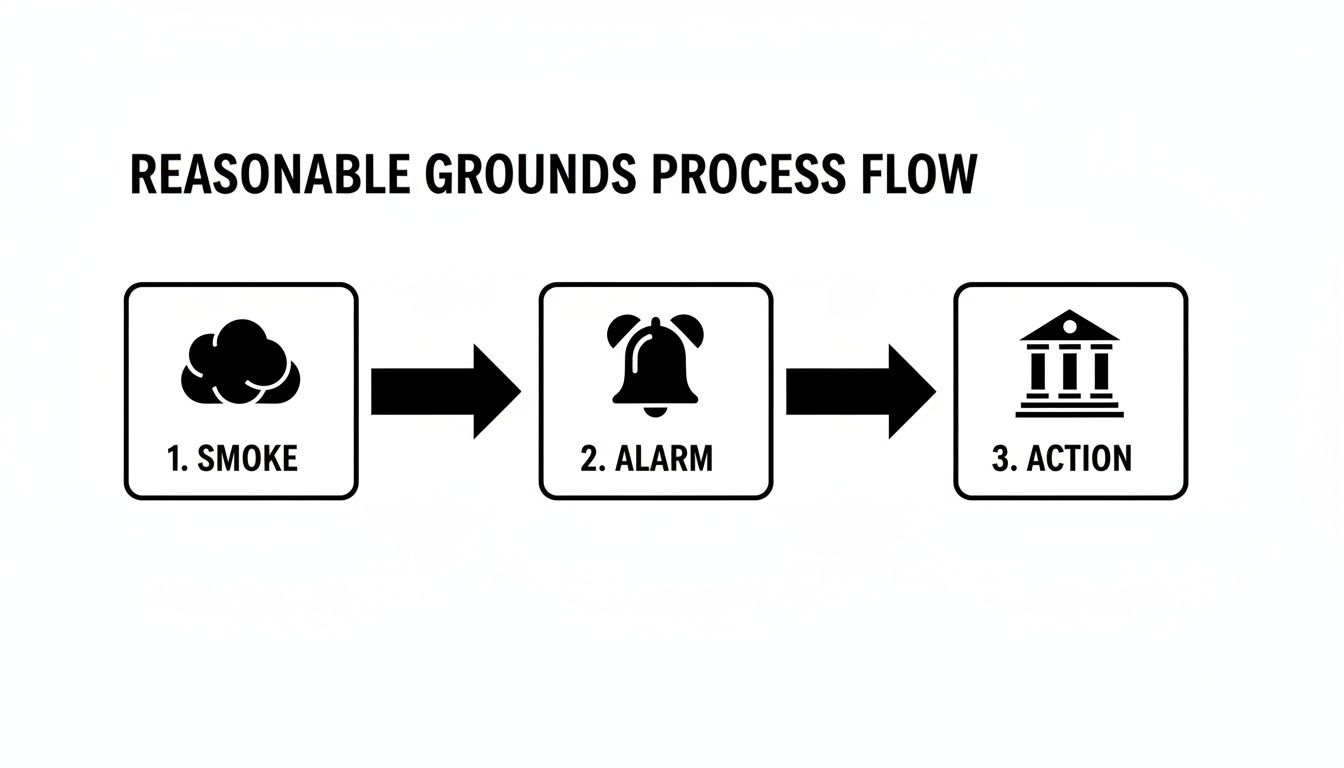
This visual breaks it down perfectly: a mere suspicion (smoke) has to grow into a credible fear (alarm) before the court will even consider taking preventative measures (action). Armed with a detailed analysis of the evidence, your Brampton criminal lawyer can argue that the Crown’s case is unlikely to hold up at trial, making a peace bond a very sensible alternative. We fight for your future by framing the peace bond not as a punishment, but as a proactive step that protects everyone involved without saddling you with a criminal record.
Understanding Your Peace Bond Conditions and Duration

When you agree to a peace bond, you are essentially signing a formal contract with the court. This agreement, officially called a recognizance, comes with a specific set of rules—or conditions—that you must follow to the letter for a set period. Think of it as a list of promises you make to a judge to ensure everyone’s safety.
The conditions attached to a peace bond aren’t random. They are directly tied to the original fear that led to the court order in the first place. The entire goal is to prevent any future conflict or concern from cropping up.
Common Peace Bond Conditions
While the terms can be customized for each case, a Brampton criminal lawyer will tell you there’s a core set of standard conditions we see all the time. Your lawyer at Badesha Law will fight to ensure these conditions are fair and not overly restrictive, but you can generally expect to see some of the following:
- Keep the Peace and Be of Good Behaviour: This is the foundational condition of every single peace bond. It’s a broad promise to not break any federal, provincial, or municipal laws.
- No Contact: You will likely be ordered to have no direct or indirect contact with the person who feared you (the informant). This means no phone calls, texts, emails, social media, or even passing messages through friends or family.
- Stay Away From Specific Locations: You may be required to stay a certain distance away from the informant’s home, workplace, or other places they frequently visit.
- No Weapons: A standard condition is a prohibition on possessing any firearms, ammunition, or other weapons as defined by the Criminal Code.
- Attend Counselling: In some cases, particularly in domestic matters, the court may order you to attend counselling for issues like anger management or substance abuse.
Duration and Consequences of a Breach
The standard length for a Section 810 peace bond is 12 months. Once that year is up, the order expires, and you are no longer bound by its conditions. It’s absolutely crucial to understand, however, that breaking any of these rules before the expiry date is a very serious matter.
A breach of a peace bond is not a minor slip-up; it is a separate criminal offence under Section 811 of the Criminal Code. This means violating a no-contact order or any other condition can land you with a brand-new criminal charge.
If you’re convicted of breaching a peace bond, you could face fines, probation, or even jail time. Worse, you could end up with the very criminal record the peace bond was designed to help you avoid. Given these high stakes, it’s essential to have a crystal-clear understanding of your obligations. For those wondering about the flexibility of these orders, you can learn more about if a peace bond can be removed in certain situations.
Peace bonds are a widely used resolution in the Canadian justice system. For instance, in a recent fiscal year in British Columbia, peace bonds accounted for roughly 5-6% of all concluded prosecutions, showing they are a common alternative to conviction. Discover more insights about these statistics on gov.bc.ca.
When you’re facing a criminal charge, your life can fork into two very different paths. The outcome of your case doesn’t just affect today—it defines what your life looks like one, five, or ten years from now. The difference between resolving a case with a peace bond versus a criminal conviction is like the difference between a temporary detour and a permanent roadblock.
A criminal conviction creates a criminal record. It’s a lifelong barrier that can follow you everywhere.
This record can slam the door on job opportunities, especially in fields that require vulnerable sector checks. It often creates serious, sometimes insurmountable, hurdles for travelling to the United States and can put immigration applications or professional certifications in jeopardy. Beyond these practical roadblocks, a conviction carries a lasting social stigma.
The Clear Advantage of a Peace Bond
A peace bond, on the other hand, is a fundamentally different result. Because it is not a finding of guilt, it doesn’t create a criminal record. Once you successfully complete the term of the bond—usually 12 months—it effectively vanishes. The police file gets closed, the charge is withdrawn, and you can move forward with a clean slate.
Let’s use a simple scenario to show just how different these two outcomes are.
Example: The Two Paths
Imagine two neighbours in Brampton, Alex and Ben, both charged with the same minor assault offence after a heated argument over a fence.
- Alex decides to represent himself, goes to trial, and is found guilty. He now has a criminal record for assault. Months later, he’s passed over for a promotion at work because he fails the company’s background check. His family’s vacation plans to the U.S. are ruined when he’s denied entry at the border.
- Ben, however, hires an experienced Brampton criminal lawyer from Badesha Law. His lawyer negotiates with the Crown and secures a peace bond. Ben agrees to have no contact with his neighbour for 12 months. After the year is up, the bond expires. He later applies for a new job, passes the background check without any issues, and travels freely with his family.
The outcome of a criminal case defines your future opportunities. A peace bond preserves them; a criminal record limits them. Choosing the right legal strategy is an investment in your freedom and mobility.
This example shows how two people facing identical charges can end up on dramatically different life paths. While a peace bond avoids a conviction, other resolutions like discharges can also protect you from a criminal record. To better understand all the tools available, you can read our guide on what an absolute discharge is and how it compares.
Ultimately, hiring a skilled criminal lawyer in Brampton is about more than just managing a current legal problem—it’s about actively protecting your future.
Why You Need a Lawyer for Peace Bond Negotiations
It’s a common and costly mistake to think agreeing to a peace bond is a simple handshake deal. In reality, it’s a complex legal negotiation where the terms will control major parts of your life for the next year. Trying to handle this yourself is a huge risk because the Crown’s first offer is almost never their best offer.
A skilled Brampton criminal lawyer doesn’t just take what’s on the table. They meticulously pick apart the Crown’s evidence looking for holes, use their deep knowledge of local court procedures, and fight to get you the least restrictive conditions possible. In these negotiations, the details are everything.
The Strategic Advantage of Legal Counsel
At Badesha Law, we zero in on the critical questions that can make or break your agreement. Can a strict no-contact order be tweaked to allow essential family communication, like arranging to see your kids? Can a geographic ban be narrowed so it doesn’t get you fired from your job?
These aren’t minor details; they are fundamental to preserving your freedom. An experienced criminal lawyer in Brampton advocates for terms that are actually fair and manageable, which prevents you from accidentally breaching a condition and ending up with a new set of criminal charges.
Entering into a peace bond without a lawyer is like trying to navigate a maze blindfolded. Your lawyer is your guide, making sure you get to the best possible exit without stepping into hidden legal traps.
Peace bonds are versatile tools in Canada’s justice system, and how they’re used can be highly specific. For example, a terrorism peace bond under section 810.011 of the Criminal Code comes with extremely strict conditions because of the perceived threat. While most cases aren’t nearly this severe, it shows why you need to understand every single detail, as these court orders are designed to prioritize public safety through strict supervision. Discover more insights about these specialized legal tools on ppsc-sppc.gc.ca.
If you’re asking yourself what is a peace bond in Canada and if it’s the right move for your case, don’t leave it to chance. Protecting your rights requires a professional advocate. Read also: our guide on choosing the right criminal defense lawyer to see what sets expert legal help apart. Contact our Brampton law firm for a consultation.
Common Questions About Peace Bonds in Ontario
Facing the justice system brings up a lot of questions. Getting clear answers is the first step toward regaining some control over your situation. Here are the answers to some of the most common concerns we hear from our clients in Brampton.
Do I Have to Admit Guilt to Get a Peace Bond?
Absolutely not, and this is one of the biggest advantages of this resolution. When you agree to a peace bond, you are not pleading guilty or admitting you did anything wrong.
You’re simply acknowledging that another person has a reasonable fear and agreeing to follow a few court-ordered rules to help resolve the situation. In exchange for that promise, the Crown withdraws the criminal charge completely.
Will a Peace Bond Show Up on a Background Check?
During its active term, which is typically 12 months, a peace bond might appear on a highly detailed police screening, like a vulnerable sector check. However, it’s critical to understand that it is not a criminal record.
Once the term ends and you’ve followed all the conditions, the bond is removed from the national police database (CPIC). It will not show up on future employment or general background checks.
Can I Travel to the USA with a Peace Bond?
Generally, a peace bond itself shouldn’t stop you from entering the United States because it is not a criminal conviction. That said, U.S. border agents have a lot of discretion.
They can ask questions about the original—and now withdrawn—charge that led to the bond. It is highly recommended that you speak with an experienced criminal lawyer in Brampton about your specific situation before you make any travel plans.
What Happens If I Refuse to Sign a Peace Bond?
If the Crown offers a peace bond to resolve your case and you turn it down, your case will continue toward a trial. That means the prosecutor will have to try and prove the original criminal charge against you beyond a reasonable doubt.
Refusing an offer like this is a major strategic decision. It’s one you should only make after getting a full, detailed analysis of your case from your lawyer at a firm like Badesha Law.
Navigating the complexities of a peace bond requires expert legal guidance. If you are facing criminal charges in Brampton or the Peel Region, contact Badesha Law for a free, confidential consultation to protect your rights and your future. Visit us at https://criminallawyerinbrampton.com to get the help you need.
No comment