


The short answer is yes, a peace bond can be removed in Ontario before its term expires. People often agree to a peace bond to resolve criminal charges like uttering threats or domestic assault without getting a criminal record, but the conditions can seriously disrupt daily life. If you're wondering, "can a peace bond be removed?" this guide provides the answers you need.
This guide from Badesha Law, a criminal defence law firm in Brampton, will explain how you can reclaim your freedom sooner if your situation has materially changed. We will walk through the two main legal avenues available in the Brampton courts: modifying the bond's terms (varying) or asking to have it cancelled entirely (revoking). Knowing your options is the first step toward getting your life back to normal.
Yes, a Peace Bond Can Be Removed—Here’s How

While many people simply wait for the bond to expire, you don’t have to be stuck with restrictive conditions. A formal court application is required to either change the terms or end the bond early.
Your goal is to persuade a judge in an Ontario court that the original conditions are no longer necessary to protect the complainant or the public. A peace bond can be removed, including here in Peel Region, but only with a court-ordered cancellation backed by solid evidence. This is a critical process, especially for clients whose cases started with assault or domestic allegations.
To succeed, you'll need to prove there has been a significant change in circumstances since the bond was signed. Common examples include:
-
Reconciliation: You and the complainant have genuinely reconciled, and they now support removing the bond.
-
Changed Living Situations: A condition, like a no-go to a specific address, is no longer practical because someone has moved.
-
Completed Counselling or Programs: You’ve successfully finished anger management, substance abuse counselling, or other relevant programs, demonstrating positive personal change.
The legal team at Badesha Law can help you understand the entire journey—from assessing your odds of success to preparing the evidence and arguing your case in a Brampton court.
What Exactly Is a Peace Bond?
Before diving into how to remove a peace bond, it’s important to understand what it is. A peace bond is not a criminal conviction.
Under Section 810 of the Criminal Code, a peace bond is a formal undertaking you make to a judge to "keep the peace and be of good behaviour" for a specific time, usually 12 months. It's a preventive tool used by the courts, not a punishment for a crime.
Not a Conviction, But Still Legally Binding
The good news is that a peace bond doesn’t leave you with a criminal record. This is a key reason why defence lawyers and Crowns in Brampton often use them to resolve certain criminal charges—especially those involving domestic disputes or neighbourhood conflicts—without a trial.
However, the conditions of the peace bond are legally binding. If you breach even a minor condition, you face a new criminal charge, which could lead to fines, probation, or even jail time.
Common conditions in an Ontario peace bond include:
-
No Contact: A strict order not to communicate with the complainant, directly or indirectly.
-
Area Restrictions: You may be barred from going near the other person’s home, school, or workplace in Brampton or elsewhere in Peel Region.
-
Weapons Ban: A standard clause prohibiting you from owning or possessing any weapons as defined in the Criminal Code.
-
Reporting: Less common, but sometimes you may have to report to a probation officer.
A peace bond is a court-supervised truce. The court isn't finding you guilty. Instead, it acknowledges that someone has reasonable grounds to fear you might cause them or their property harm, and it puts rules in place to prevent that.
How Peace Bond Conditions Affect Your Life
These conditions can significantly impact your daily life. A no-contact order can make co-parenting difficult. Area restrictions could force you to change your commute or even put your job at risk. For people dealing with specific allegations, it's vital to know how these rules apply—our guide to domestic assault charges in Ontario offers more context.
It’s because of these real-world consequences that people so often ask, "can a peace bond be removed?" If the situation that led to the bond has fundamentally changed, you shouldn't have to live with these limitations. At Badesha Law, we know that getting your life back to normal is what matters most.
Varying vs. Revoking: Your Two Paths to Relief
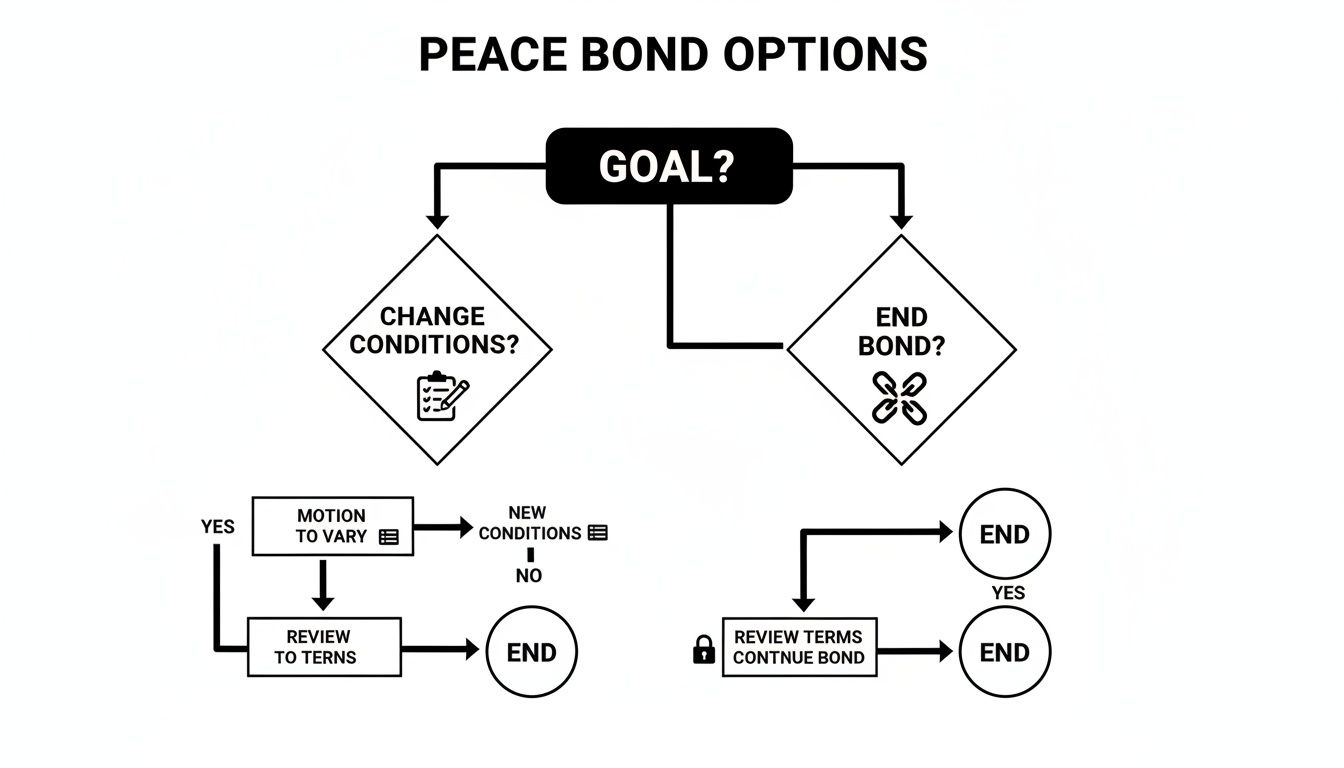
If a peace bond's conditions are making your life difficult, you have two legal options to seek relief before it expires. The best strategy depends on your specific goal.
Option 1: Asking to Vary the Peace Bond
The first path is to apply to vary the peace bond. This means asking the court to edit one or more specific conditions, not to cancel the entire order.
This is often the best route when a condition is preventing something important or necessary. For example, if a "no-contact" clause stops you from discussing your children's needs with an ex-partner, you could apply to vary the bond to allow communication only for co-parenting matters. The core of the peace bond remains, but it's adjusted to fit your current reality.
Option 2: Asking to Remove the Peace Bond Entirely (Revocation)
The second, more ambitious option is to apply to revoke the peace bond. This means asking the court to terminate the order completely before its original end date. This is the goal when you believe the entire basis for the bond no longer exists.
To succeed, you must convince a judge that the complainant’s original fears are no longer reasonable. The court's priority is public safety, so you must prove a significant, positive shift in your circumstances with strong evidence.
Varying vs Removing a Peace Bond: Key Differences
| Aspect | Varying a Peace Bond | Removing a Peace Bond (Revocation) |
|---|---|---|
| Primary Goal | To modify or adjust specific impractical or overly restrictive conditions. | To terminate the entire peace bond before its scheduled expiry date. |
| What You're Arguing | "A specific rule needs to be changed to accommodate a new, necessary situation (e.g., co-parenting, work)." | "The original reasons for the bond no longer exist, and the complainant's fear is no longer reasonable." |
| Evidence Required | Proof that the requested change is reasonable, necessary, and won't compromise safety. | Compelling evidence of a significant change in circumstances, proving the bond is no longer needed. |
| Potential Outcome | The original peace bond remains active, but with altered conditions. | The entire peace bond is cancelled, freeing you from all conditions. |
| Common Scenarios | Needing to communicate about children, accessing a shared property, or a new work requirement. | Reconciliation with the complainant, completion of extensive counselling, or a major life change that removes all risk. |
Choosing between varying and revoking is a strategic decision that depends on factors like the original allegations, the complainant's position, and the evidence you can provide. The legal team at Badesha Law can analyze the details of your Peel Region case and explain what to expect when charged in Brampton, Ontario.
Your Step-by-Step Guide to Removing a Peace Bond in Brampton
The process of changing or removing a peace bond in Peel Region follows a clear path. Understanding these steps can make the court process feel much more manageable.
Step 1: Building a Persuasive Case
Your application's success depends on strong evidence. Your lawyer will gather proof demonstrating a significant change in your circumstances since the peace bond was issued.
Effective evidence can include:
-
Sworn Affidavits: Formal written statements from you—and sometimes the original complainant—explaining what has changed.
-
Character Reference Letters: Letters from employers, community leaders, or family members who can speak to your good character.
-
Proof of Counselling: Certificates or reports showing completion of relevant programs like anger management or substance abuse treatment.
Step 2: Filing the Formal Court Application
Once your evidence is ready, your lawyer will draft and file a formal application with the Ontario Court of Justice in Brampton. This legal document clearly states whether you are asking to vary or revoke the bond and outlines the legal reasons why the judge should agree.
Step 3: Serving Notice to All Parties
After filing with the court, the legal documents must be formally delivered, or "served," to the Crown Attorney's office for Peel Region and the complainant. This step ensures fairness and transparency, giving all parties a chance to respond before the hearing.
Step 4: The Court Hearing in Brampton
At the hearing, your lawyer will represent you before a judge at the Brampton courthouse. They will present your evidence and make legal arguments to convince the judge that the original fear is no longer reasonable and that public safety is not at risk.
If the Crown or the complainant opposes your application, your lawyer will be prepared to challenge their arguments. This hearing is your chance to be heard, and having a skilled advocate from Badesha Law makes a significant difference.
What Happens to Your Police Record After Removal
Getting a peace bond revoked is a major victory, but there is one final step. Many people in Brampton mistakenly believe that a judge's order to cancel a bond automatically clears their police record.
While a peace bond is not a criminal conviction, a record of the original incident remains in police databases like CPIC. This information can appear on certain advanced police checks, such as a Vulnerable Sector Check, which is often required for jobs or volunteer positions involving children or the elderly.
The Final Step: File Destruction
The crucial final step is to request file destruction. This is a separate, formal request made to the relevant police forces (e.g., Peel Regional Police, RCMP) to permanently destroy all information related to the incident, including:
-
Police reports and officer's notes
-
Photographs and fingerprints
-
The peace bond court documents
Securing a file destruction is the only way to truly clear your record. Without it, the original incident could still complicate employment, travel to the U.S., or future interactions with law enforcement. The goal is the same as with a conditional discharge in Canada: to prevent long-term negative consequences.
Why a Brampton Criminal Lawyer Is Your Strongest Ally

While you can technically file an application to remove a peace bond yourself, the legal system is complex, and the court's priority is always public safety. An experienced Brampton criminal defence lawyer does more than fill out forms; they build a persuasive legal argument that a judge will take seriously.
A skilled lawyer knows how to gather the right evidence, negotiate with the Crown Attorney, and frame your case effectively in front of a judge at the Brampton courthouse.
The Advantage of Local Expertise
Having a legal team with deep roots in the Peel Region community is a significant advantage. The lawyers at Badesha Law are in these courtrooms daily. We understand local procedures, know the Crown Attorneys, and understand what judges look for when assessing risk.
This process is about strategic advocacy. A seasoned criminal lawyer in Brampton can anticipate potential problems, counter objections, and clearly explain why ending your bond is both fair and safe.
Common Questions About Removing a Peace Bond
How soon can I apply to have my peace bond removed?
There is no set waiting period in the Criminal Code. What matters is your ability to demonstrate that a reasonable amount of time has passed during which you have fully complied with the conditions, and that there has been a significant change in your circumstances. Applying too soon without proof of change is unlikely to succeed.
What if the other person fights the application?
If the complainant opposes your application, the hearing becomes more complex. The burden is on you to prove their fear is no longer reasonable. A skilled criminal lawyer from Badesha Law is essential in this scenario to cross-examine the complainant and present your evidence persuasively.
Will this peace bond stop me from going to the U.S.?
It can. While a peace bond isn't a criminal conviction, the original charge (e.g., assault) often remains visible in police databases. U.S. border agents may see this and deny you entry. That's why the final step of file destruction is crucial to protect your ability to travel.
Is it possible to remove a peace bond from a domestic case?
Yes, but judges are extremely cautious in domestic matters. You will face a higher standard of proof and must present compelling evidence that the situation has fundamentally changed and any risk is eliminated. This may include proof of extensive, separate counselling and other concrete steps demonstrating a stable, non-threatening environment. These sensitive cases require a careful legal strategy.
Get Your Life Back on Track
Living with the restrictions of a peace bond can be challenging, but you may not have to wait for it to expire. The answer to "can a peace bond be removed?" is yes, with the right legal strategy and evidence. Protecting your freedom and future is not a DIY project.
If you are in Brampton or the Peel Region and want to explore your options, contact Badesha Law for a consultation. We can discuss your situation and build a plan to help you move forward.
No comment