


If you’re facing a criminal charge in Brampton, the fear of getting a permanent criminal record is likely overwhelming. It’s a heavy burden. But there is a sentencing option called a conditional discharge that can offer a path forward. Understanding what is conditional discharge in Canada is the first step, as it means being found guilty of an offence without receiving a formal criminal conviction.
At Badesha Law, a criminal defence law firm in Brampton, we know that this outcome can be a second chance. The court allows you to avoid a criminal record on the condition that you follow specific rules for a set period. This guide will explain how this process works in Ontario, who qualifies, and how a skilled lawyer can help secure this favourable result for you.
Your Path to Avoiding a Criminal Record: What is Conditional Discharge in Canada?
When you’re caught up in the justice system, the primary goal for most people is to walk away without a conviction that will negatively impact their life for years to come. This is exactly why a conditional discharge is such a critical option in Ontario criminal law.

A conditional discharge is not a “not guilty” verdict. Instead, it’s a specific sentence a judge can impose after you have either pleaded guilty or been found guilty of a criminal offence. The court then releases you on a probation order with a list of conditions you must follow, usually for a period of one to three years.
What This Means for You
Everything hinges on successfully completing that probation period. If you follow every one of the court’s rules, the discharge becomes absolute. The most significant benefit is that no criminal conviction for that offence will appear on your record.
This legal path is a game-changer for avoiding the lifelong challenges that come with a criminal record, which can interfere with your:
- Employment: A vast number of jobs require a clean criminal background check.
- Travel: A conviction can prevent you from entering other countries, especially the United States.
- Immigration Status: If you are not a Canadian citizen, a criminal record can create serious problems for your status in Canada.
Getting a conditional discharge is not automatic; it requires a strong legal strategy and a compelling argument in court. An experienced criminal lawyer in Brampton at Badesha Law can build the case needed to protect your future from the shadow of a criminal conviction.
Conditional vs. Absolute Discharge: Understanding Your Options
When a court grants a discharge, it is a significant victory. It means you’ve been found guilty of an offence but get to avoid a formal conviction on your criminal record. However, not all discharges are the same, and it’s vital to understand the two different paths a court can take: an absolute discharge versus a conditional discharge.
An absolute discharge is the best possible outcome after a finding of guilt. It is immediate and unconditional. The case is closed, and you are free to go without probation or any lingering legal obligations. While a finding of guilt is noted, the record is automatically sealed after just one year.
The Role of Probation
A conditional discharge, on the other hand, comes with specific requirements. The “condition” is that you must follow a set of rules laid out in a probation order. This is essentially an agreement with the court: you comply with the terms for a specified period, and in return, you avoid a criminal conviction.
This probation period typically lasts between 12 and 36 months. If you breach any of the rules during that time, the court can revoke the discharge, enter a conviction, and re-sentence you for the original offence. Only after you successfully complete every requirement of your probation does the discharge become final. After that, the record is sealed in three years.
A judge in a Brampton courthouse doesn’t make this decision lightly. They carefully weigh factors like the seriousness of the offence, your personal circumstances, and whether you have a criminal history before deciding which type of discharge, if any, is appropriate.
To clarify, let’s compare the key differences side-by-side.
Conditional vs. Absolute Discharge at a Glance
This table compares the key features of conditional and absolute discharges in Ontario, including probation requirements, record sealing timelines, and typical use cases.
| Feature | Conditional Discharge | Absolute Discharge |
|---|---|---|
| Probation Required? | Yes, for a set period (12-36 months). | No, it is immediate and unconditional. |
| Record Sealing | Sealed 3 years after probation ends. | Sealed automatically after 1 year. |
| Typical Use Case | For first-time, minor offences where the court wants to ensure good behaviour. | For very minor offences where the public interest doesn’t require supervision. |
| Consequences of a Breach | Can be revoked, resulting in a conviction and a new sentence. | Not applicable. |
While both options help you avoid a lifelong criminal record, the conditional discharge requires active participation and compliance over a longer period.
Common Conditions You Might Face
Every probation order is tailored to the specifics of the case, but most include standard conditions designed to ensure good behaviour. Here in the Peel Region, you can often expect to see:
- Keep the Peace: This is the baseline—stay out of trouble with the law.
- Report to a Probation Officer: You’ll likely have to check in regularly.
- Complete Community Service: The judge might order a certain number of volunteer hours.
- Attend Counselling: This could be for anger management, substance abuse, or other relevant issues.
- No-Contact Orders: You might be legally required to stay away from specific people or places.
Understanding these legal details is crucial. While discharges function differently from driving offences, you can see how specific rules apply in other legal contexts by reading our guide on careless driving vs dangerous driving. The legal team at Badesha Law can help you understand what conditions you might face and fight for the most reasonable terms in your case.
Who Is Eligible for a Conditional Discharge in Ontario?
Not everyone charged with a crime in Ontario can receive a conditional discharge. It’s a specific outcome reserved for situations where a judge believes a second chance is warranted without burdening the individual with a permanent criminal record. Before this outcome is possible, your case must clear significant legal hurdles.
The court focuses on two main factors from Ontario’s criminal law: the seriousness of the crime and the public interest. A judge will not consider a discharge if the offence has a mandatory minimum sentence (like a DUI) or carries a potential sentence of 14 years or more in prison.
This framework ensures discharges are used only for relatively minor offences, not serious crimes.
What Kinds of Charges Often Lead to a Discharge?
While there are no guarantees, conditional discharges are most often granted in cases involving first-time offenders in the Peel Region for charges on the lower end of the criminal spectrum.
Common examples include:
- Theft Under $5,000 (e.g., shoplifting)
- Mischief Under $5,000 (e.g., minor property damage)
- Simple Assault (where injuries are minimal)
- Possession of a controlled substance for personal use
Ultimately, the decision rests with the judge, who must be convinced that granting a discharge is the right call for everyone involved.
It’s Not Just About the Crime—It’s About You
Beyond the legal rules, a Brampton judge will assess you as an individual. The court needs to be satisfied that giving you a discharge is not only a benefit to you but also serves the public’s interest in rehabilitation and fair justice.
A conditional discharge is a sentencing option under section 730 of the Criminal Code that allows an accused found guilty of certain offences to avoid a formal criminal conviction by complying with probation conditions. This measure applies only to offences without mandatory minimum sentences and those punishable by less than 14 years imprisonment, ensuring it’s reserved for less serious matters. Discover more about the laws governing discharges in Canada.
This is where a strong legal argument is critical. A criminal defence lawyer at Badesha Law doesn’t just present the facts; we build a compelling narrative for the court. We focus on the human elements that paint a complete picture, such as:
- Your background, character, and personal history
- Whether you have any previous criminal record
- The unique circumstances that led to the charge
- Any steps you’ve taken to show remorse or make amends
- The significant negative impact a criminal record would have on your job, family, or future
Persuading a judge that you are a good candidate for a conditional discharge requires skill and experience. The team at Badesha Law knows how to frame your story in the most compelling way, which can make all the difference in securing this life-changing outcome.
Navigating the Court Process and Probation Conditions
Securing a conditional discharge is the result of a carefully planned legal strategy within the Ontario court system. The process often begins long before you appear before a judge, starting with critical negotiations between your defence lawyer from Badesha Law and the Crown prosecutor.
The ideal outcome of these discussions is a joint submission, where both your lawyer and the Crown agree to recommend a conditional discharge to the judge. While a judge is not bound by this recommendation, a joint position from both sides carries significant weight in a Brampton courtroom. If an agreement cannot be reached, the sentencing hearing becomes a contested matter, and your lawyer must make a persuasive case on your behalf.
The Sentencing Hearing
At the sentencing hearing, your lawyer’s role is to convince the judge that granting a discharge serves your best interests without undermining the public’s. This involves presenting evidence of your good character, showing proactive steps toward rehabilitation (like counselling), and explaining how a criminal record would be a disproportionately severe consequence for you. Success requires an intimate knowledge of the local courts in the Peel Region—the kind of experience the Badesha Law team possesses.
This flowchart breaks down the key factors a court weighs when deciding if someone is eligible for a discharge.
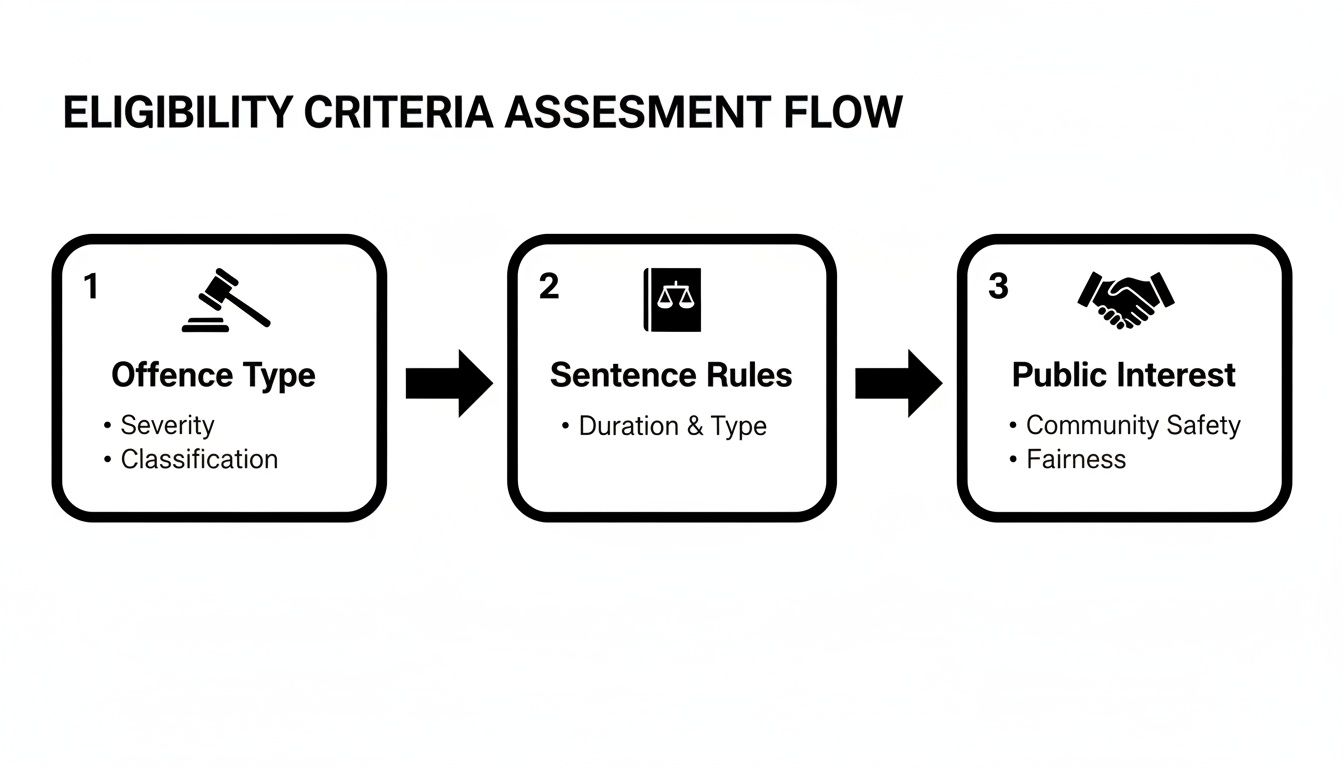
As you can see, the decision is a thorough evaluation that considers the crime, sentencing laws, and the wider public good.
Understanding Your Probation Conditions
If the judge grants a conditional discharge, you will be placed on a probation order. This is a legally binding contract with the court outlining the rules you must follow for a specific time, usually between 12 and 36 months. Adhering to these rules is the final step to avoiding a criminal conviction.
Probation conditions are tailored to your case but typically include a mix of standard and personalized terms.
Common Probation Conditions:
- Keep the Peace and Be of Good Behaviour: This is a fundamental requirement to stay out of any further legal trouble.
- Report to a Probation Officer: You will have regularly scheduled meetings with a probation officer.
- Reside at an Approved Address: You must keep your probation officer informed of your address.
- Complete Community Service Hours: A judge may require you to perform volunteer work.
- Attend Counselling or Treatment: This could include programs for anger management, substance abuse, or mental health.
- No-Contact Orders: You may be ordered to avoid contact with certain individuals, such as the victim.
It is impossible to overstate the importance of following every single one of these conditions. A single breach can undo all the hard work that went into securing the discharge in the first place.
Failing to comply is a serious matter. If you breach your probation, the Crown can charge you and bring you back to court. If the judge finds you violated a condition without a valid excuse, they can cancel the discharge, register a conviction for the original crime, and impose a new—and likely tougher—sentence. Your second chance will be gone, leaving you with a permanent criminal record. The process is very different from the initial stages of a criminal case, which you can learn more about by reading our guide on what happens at a bail hearing.
How a Discharge Affects Your Record, Travel, and Career
When you’re facing a criminal charge, the biggest question is often, “What does this mean for my future?” A conditional discharge is specifically designed to minimize long-term damage. However, you need to understand exactly how it affects your criminal record, ability to travel, and job prospects.

Most importantly, if you successfully complete your conditional discharge, you will not have a criminal conviction for that offence. That said, the court’s finding of guilt does not vanish immediately. It exists in a kind of legal limbo for a few years, which has real-world consequences.
The Three-Year Sealing Period
Canadian law is very specific about this timeline. According to RCMP policy, the record of the finding of guilt remains on the national police database (CPIC) for three years from the sentencing date. Once your probation is complete and those three years have passed, the RCMP automatically seals the record. You can learn more about the official process for a conditional discharge record here. This means it will not appear on most routine police checks.
However, during that three-year period, the record is not completely hidden and can still appear on more in-depth background checks.
Real-World Hurdles During the Waiting Period
That three-year window can be challenging. Even without a conviction, the existence of a recent finding of guilt can create temporary roadblocks.
- Employment and Professional Licensing: Many jobs, especially those involving vulnerable individuals (children, the elderly), require a Vulnerable Sector Check. Your discharge will likely appear on this check during the three-year period. Professional bodies may also require disclosure, which could complicate licensing.
- Travel to the United States: U.S. border agents have access to Canadian police databases and may view a finding of guilt—even without a conviction—as grounds to deny entry. They have full discretion at the border.
- Immigration Status: If you are not a Canadian citizen, any finding of guilt can create complications for permanent residency or citizenship applications until the record is sealed.
Despite these temporary hurdles, a discharge is infinitely better than a conviction. A conviction creates permanent barriers; a discharge creates temporary ones that eventually disappear. The key is to manage this waiting period carefully.
The team at Badesha Law can guide you through these nuances and offer practical advice. If you’re worried about what a charge means for your future, your best option is to get clear answers for your specific case by booking a free consultation with a Brampton criminal defence lawyer.
Why You Need an Experienced Brampton Defence Lawyer
A conditional discharge can change the course of your life, but it is never guaranteed. It is not a lenient sentence that Brampton judges hand out easily. It must be earned through a strong, persuasive legal argument that demonstrates how a discharge is in your best interest and serves the public good. This is where having an experienced criminal defence lawyer becomes absolutely critical.
Discharges are an exception, not the rule. They make up less than 1% of all guilty findings in federal cases, which highlights their rarity. You can explore these justice system statistics for more information. Faced with those odds, the expertise of a firm like Badesha Law is your greatest advantage.
Advocating for Your Second Chance
At Badesha Law, our role extends far beyond court appearances. We are your advocate at every step. Here’s what that looks like:
- Negotiating with the Crown: We proactively engage with Peel Region prosecutors to make the case for a discharge early on, often working toward a joint submission.
- Gathering Evidence: We help you build a compelling narrative by gathering character letters, evidence of rehabilitation, and other documentation that presents a full, human picture to the court.
- Making a Powerful Case: In the courtroom, we clearly articulate why a criminal conviction would be a disproportionately harsh consequence given the unique facts of your situation.
Being charged with a crime is stressful. Whether you need to know if a discharge is possible or require immediate help from a bail lawyer, the most important thing you can do is act quickly.
Conclusion: Securing Your Future After a Criminal Charge
Understanding what is conditional discharge in Canada reveals it as a powerful legal tool that offers a second chance after a criminal charge. By successfully completing a period of probation, you can avoid a permanent criminal record and protect your future employment, travel, and immigration prospects. However, this outcome is never guaranteed and requires a strategic defence.
If you or a loved one is facing a criminal charge in Brampton or the Peel Region, do not leave your future to chance. The stakes are too high. Contact Badesha Law today for a confidential consultation with an experienced Brampton criminal lawyer to discuss your case and explore your legal options.
Frequently Asked Questions About Conditional Discharges
When facing a criminal charge, the idea of a conditional discharge can bring up many questions. Here are clear, practical answers to some of the most common ones we hear from our clients in Brampton.
Will a conditional discharge show up on a criminal record check in Ontario?
Yes and no. While you are on probation, a conditional discharge can appear on certain high-level police checks, like a Vulnerable Sector Check. However, once you successfully complete your probation, the record is automatically sealed by the RCMP three years after the judge’s decision. After that, it will not appear on a standard criminal record check. A lawyer at Badesha Law can explain what this means for your specific situation.
Can I get a conditional discharge for a DUI in Ontario?
No. Impaired driving (DUI) offences in Canada have mandatory minimum sentences under the Criminal Code. This means a judge cannot grant a discharge for a DUI. A conviction will result in a criminal record, fines, and a driving prohibition.
What happens if I breach my probation conditions?
Failing to follow your probation conditions is a critical mistake. If you breach any term, the Crown can bring you back to court and ask the judge to revoke the discharge. If the court agrees you violated the rules without a valid excuse, the discharge will be cancelled, you will be convicted of the original offence, and you will be re-sentenced, likely more harshly. This results in a permanent criminal record. It is crucial to follow every condition precisely.
For more answers to common legal questions, please review our criminal law FAQ page.
No comment