


When you're facing a criminal charge in Canada, especially for the first time, the entire experience can feel overwhelming. The good news is that the justice system sometimes offers an off-ramp before you get to a full-blown trial. This is often called a diversion program—think of it as a second chance agreement offered by the Crown to resolve a minor case without a conviction or a criminal record. The principle is straightforward: if you successfully complete certain conditions, the Crown will withdraw the charges against you.
Your Path to Withdrawn Charges

The traditional court process is a daunting path, one that can end with a conviction that follows you for the rest of your life. Diversion offers a completely different route. It’s a constructive resolution focused on accountability and making things right, rather than on punishment alone.
This approach, formally known as "alternative measures" under section 717 of the Criminal Code of Canada, is a cornerstone of the Canadian justice system's strategy for certain offences. It provides a more balanced and rehabilitative solution. For anyone in Peel Region, understanding what to expect when charged in Brampton, Ontario is the first step toward finding a proactive solution like this.
What is the Goal of a Diversion Program?
The goal isn't just about being lenient; it's about addressing the root behaviour that led to the charge while helping you avoid the lifelong consequences of a criminal record. It’s a pragmatic approach that recognizes that for some offences, a better outcome can be achieved outside the formal trial process.
The key objectives are to promote:
- Accountability: Taking concrete steps to acknowledge your actions and make amends.
- Rehabilitation: Using tools like counselling or educational programs to address underlying issues.
- Restoration: Repairing the harm done, whether through a letter of apology, community service, or a donation to a local charity.
- Efficiency: Freeing up valuable court resources to focus on more serious criminal matters.
Common Offences Eligible for Diversion
Diversion is typically reserved for less serious offences where the public interest is better served by rehabilitation than by a full prosecution. The final decision always rests with the Crown Attorney reviewing your file, but some of the most common charges that may qualify include:
- Theft Under $5,000 (e.g., shoplifting)
- Mischief Under $5,000 (e.g., minor property damage)
- Causing a Disturbance
- Fraud Under $5,000
- Minor Assaults (in very specific circumstances)
By successfully navigating the program, you can ensure a single mistake doesn't define your future.
How Diversion Programs Work in Canadian Law
When you hear the term "diversion program," you might picture an informal slap on the wrist. But in Canadian law, it's a highly structured legal process. It gives a person facing a minor criminal charge a genuine second chance—a way to take responsibility without ending up with a lifelong criminal record. The whole point is to find a constructive outcome that benefits both the accused and the community.
This isn’t some loophole; it’s a formal pathway built right into the Criminal Code of Canada. Sections 716 and 717 give Crown prosecutors the power to use alternative measures—the official legal name for diversion—to resolve a case outside of the traditional court system, but only if specific conditions are met.
The goal isn't just leniency. It's a strategic decision by the justice system acknowledging that a formal conviction isn't always the most effective or just result. By focusing on repairing the harm and addressing the behaviour behind the charge, diversion aims to reduce reoffending without the crushing weight of a criminal record. It's a completely different route than other court outcomes, and it’s helpful to understand how it compares to things like a diversion and a conditional discharge in Canada, which you can learn about in our related guide.
The Philosophy Behind Alternative Measures
Think of the diversion process like a performance improvement plan at work. Imagine you made a mistake that could get you fired. Instead of immediately terminating you (the equivalent of a criminal conviction), your boss gives you a set of clear, manageable tasks to complete over a few months to prove you’ve learned from the error.
If you complete every task successfully, you keep your job and everyone moves on. Diversion works the same way. By completing the conditions of your program—like community service or counselling—you demonstrate your accountability, and in return, you get to keep your clean record.
This modern approach to justice shifts the focus from a purely punitive model to a restorative one. It asks, "How can we repair the harm and prevent this from happening again?" rather than simply asking, "What punishment fits the crime?"
Diversion vs. The Traditional Court Path
To really get why a diversion offer is such a big deal, you need to see how it stacks up against the standard court process. The two paths lead to dramatically different places, affecting not just the immediate outcome but your entire future. The stress, financial cost, and long-term consequences are worlds apart.
Below is a clear, side-by-side comparison of what to expect down each road.
Diversion Program vs. Traditional Court Process
| Aspect | Diversion Program (Alternative Measures) | Traditional Court Process (Plea or Trial) |
|---|---|---|
| Initial Step | Defence counsel negotiates with the Crown to secure a diversion offer. | The accused enters a plea (guilty or not guilty) in open court. |
| Key Activity | Completing pre-approved conditions like community service or counselling. | Preparing for trial, cross-examining witnesses, or proceeding to sentencing. |
| Public Record | The process is confidential and does not result in a finding of guilt. | Court proceedings are public, and a guilty plea or verdict is on the public record. |
| Final Outcome | The criminal charges are formally withdrawn by the Crown. | A potential conviction, leading to a sentence such as a fine, probation, or jail. |
| Criminal Record | No criminal record of conviction is created from the charge. | A permanent criminal record is created if convicted. |
| Future Impact | Minimal impact on employment, travel, and immigration opportunities. | Significant barriers to employment, international travel, and citizenship applications. |
Ultimately, a diversion program is a legislated pathway that offers a responsible way out of the criminal justice system for eligible individuals. It emphasizes personal growth and restitution over punishment, ensuring that a single mistake doesn't have to derail a person's entire life.
Who Qualifies for a Diversion Program
Getting an offer for a diversion program isn’t automatic. It’s a discretionary call made by the Crown Attorney, who acts as a gatekeeper, carefully weighing each case to see if this alternative path makes sense. Not every person or every charge will clear the bar.
The Crown looks at a few key factors to decide if you’re a good candidate. They’ll consider the nature of the offence, your personal history, and, most importantly, your willingness to take responsibility for what happened. For diversion to work, all these pieces have to fit together in a way that serves the public interest.
The Nature of the Offence
The first and most important factor is the criminal charge you’re facing. Diversion is almost always reserved for less serious offences.
We’re usually talking about summary conviction offences here—charges that carry lower maximum penalties. Think of things like:
- Minor theft or shoplifting (Theft Under $5,000)
- Causing a disturbance in a public place
- Mischief Under $5,000, like minor property damage
On the other hand, serious indictable offences—like robbery, aggravated assault, or drug trafficking—are almost never considered for diversion. The justice system sees these crimes as too severe to be resolved outside of a formal court process. Diversion is designed to address minor missteps, not serious criminal behaviour.
Your Personal and Criminal History
The Crown will also take a close look at your background. A diversion program is, at its heart, a second chance. That makes it a perfect fit for people who have had little or no previous contact with the justice system.
Ideally, a candidate for diversion is a first-time offender. This signals to the Crown that the alleged behaviour was out of character, not part of a recurring pattern. If you already have a criminal record, getting into a diversion program becomes much harder, though not always impossible. A very old, minor, and unrelated conviction might get a pass, but any recent or relevant history will likely disqualify you.
Acceptance of Responsibility
This part is non-negotiable and often misunderstood. To be eligible for diversion, you must accept responsibility for the actions that led to the charge.
This doesn't mean you have to plead guilty in court. A guilty plea leads to a formal finding of guilt and a criminal record. Instead, accepting responsibility is an acknowledgment to the Crown that you had a role in the incident. It’s a sign of remorse and a genuine willingness to make things right.
Without a clear and genuine acceptance of responsibility, the Crown will not offer diversion. It is the foundational principle of the program—you cannot be diverted from the court process if you deny any wrongdoing.
This is a critical distinction. You aren't admitting criminal guilt in a way that can be used against you later if diversion falls through. You're simply showing the Crown that you understand what happened and are ready to complete the required steps to earn the withdrawal of your charges. For example, in a minor assault case, accepting responsibility might be a key step, as discussed in our guide to handling a first-time assault charge in Canada.
Special Considerations for Young Persons
The legal landscape is completely different for youth. The Youth Criminal Justice Act (YCJA) puts a massive emphasis on rehabilitation and avoiding the formal court system whenever possible.
For young people (ages 12 to 17), the YCJA uses the term extrajudicial measures for diversion. The law actually directs police and Crowns to consider these measures as the default response for less serious offences. The focus is on giving young people the support and tools they need to avoid future conflict with the law, recognizing their reduced level of maturity.
Navigating the Diversion Process Step-by-Step
Understanding the journey from the moment you're charged to the final withdrawal of those charges can take a lot of the stress and uncertainty out of facing the justice system. The diversion process isn’t instant; it's a structured path with clear milestones. Seeing the roadmap ahead helps you understand what’s happening at each stage and why every step matters.
This process transforms a frightening legal challenge into a manageable series of actions. It begins with your lawyer’s first moves in court and ends with you walking away with no criminal record.
The First Appearance and Disclosure Review
The journey officially kicks off at your first court appearance. This isn't a trial. It's an administrative hearing where your defence counsel appears for you and gets the initial disclosure package from the Crown Attorney. Think of this package as the cornerstone of your entire defence.
Disclosure contains all the evidence the police and prosecution have gathered against you, including things like:
- Police officer notebooks
- Statements from any witnesses
- Video or audio recordings
- Photos of the scene or evidence
Your lawyer will meticulously comb through this material, sizing up the strengths and weaknesses of the Crown’s case. This critical analysis is what all future negotiations are built on. It’s where your lawyer finds the key facts they’ll use to argue for a diversion program on your behalf.
Strategic Negotiations with the Crown
Once the disclosure has been reviewed, the most important phase begins: negotiation. A diversion program isn't a right; it's a discretionary offer from the Crown. This is where your lawyer’s skill and experience become absolutely essential.
Your lawyer will prepare a compelling, persuasive submission for the Crown. This involves highlighting all the reasons you are an ideal candidate for diversion. They’ll emphasize mitigating factors like your lack of a prior criminal record, your stable job or school enrolment, your genuine remorse, and your readiness to take responsibility and make things right.
The goal here is to paint a complete picture of you as a person, not just as an accused individual. It’s about showing the Crown that the public interest is better served by rehabilitation and a withdrawn charge rather than a formal, drawn-out prosecution.
This timeline shows the key milestones a person must clear to be considered for a diversion program.
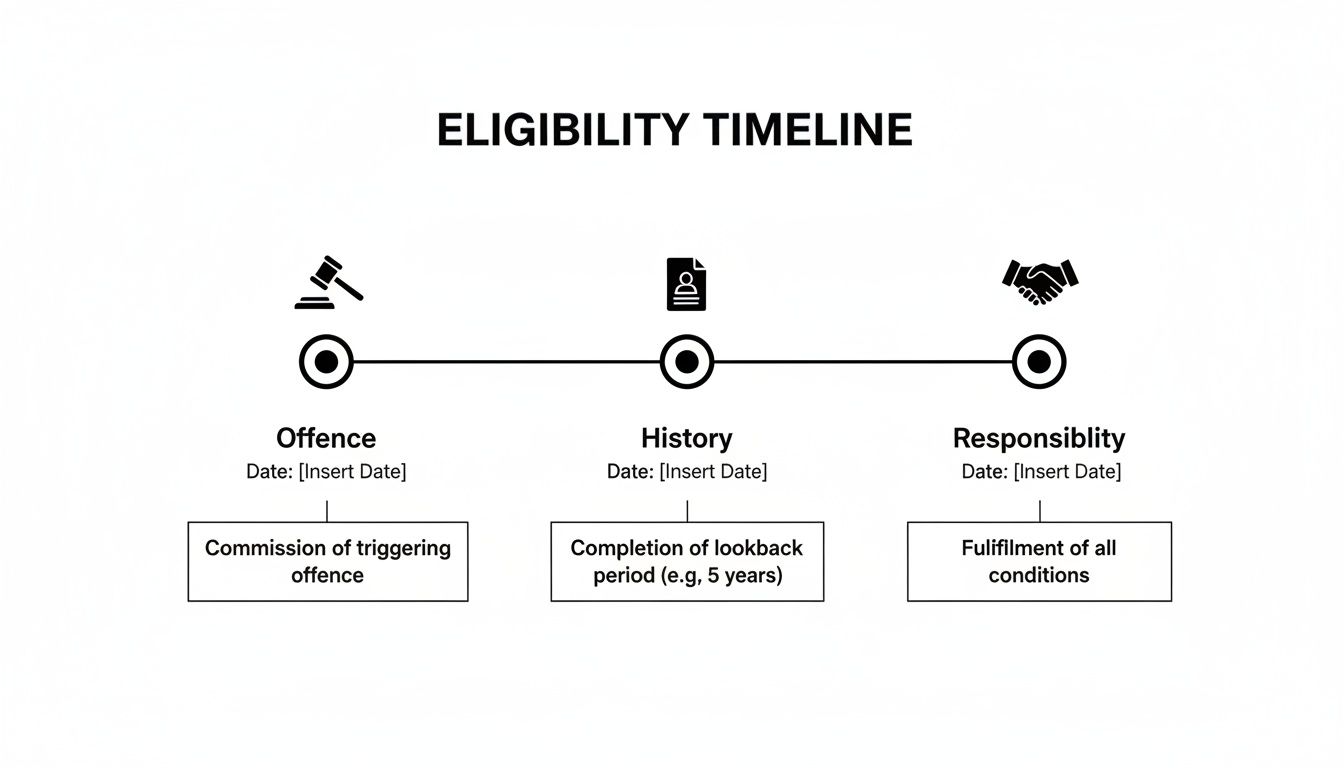
As you can see, eligibility is essentially a three-part test that looks at the nature of the offence, your personal history, and your willingness to accept responsibility.
From Offer to Completion
If the negotiations are successful, the Crown will extend a formal diversion offer. This document will clearly spell out the specific conditions you need to complete. Once you and your lawyer accept these terms, you’ll be referred to a designated community agency, like the John Howard Society or the Salvation Army, to get started.
From there, the steps are straightforward but require your full commitment:
- Complete All Conditions: You must diligently finish every task you’ve been assigned, whether it’s community service hours, counselling sessions, or writing a letter of apology.
- Submit Proof of Completion: Once you've successfully completed everything, the agency will give you a confirmation letter or report. Your lawyer then forwards this proof directly to the Crown Attorney.
- Final Court Appearance: With proof of completion on file, your lawyer attends the final court date. The Crown informs the judge that diversion is complete and formally withdraws the charges. This is the final step—your case is officially over.
The entire process, from that first court appearance to the final withdrawal of charges, typically takes somewhere between three to six months. While it demands patience and effort, the reward is the best possible outcome you can get in the criminal justice system: a complete withdrawal of your charges and the preservation of your clean record.
What to Expect from Diversion Program Conditions
Once the Crown Attorney agrees to a diversion program, the focus shifts away from the courtroom. Now, it's about completing a few specific, agreed-upon tasks. These aren't punishments meant to make you suffer; they are constructive conditions designed to show accountability and help you get back on track.
Think of it as the "work" part of your second-chance agreement. The whole idea is to address the behaviour that led to the charge and, if possible, repair any harm that was done. Successfully completing these tasks is the final step to earning a full withdrawal of your charges.
Common Diversion Conditions and Their Purpose
While the exact terms will depend on the specifics of your case, most diversion conditions fall into a few common categories. They are designed to be meaningful and directly related to the principles of restorative justice.
Here are some of the most frequent conditions you might encounter:
- Charitable Donation: This is often used in cases like minor theft where paying back a large corporation is impractical. Making a donation to a registered local charity is a symbolic way of making amends and giving back to the community.
- Letter of Apology: If there was a direct victim, you might be required to write a thoughtful and sincere apology. This isn't just about saying sorry; it’s a powerful exercise that requires you to acknowledge the specific impact your actions had on another person.
- Community Service Hours: Performing a set number of volunteer hours allows you to make a tangible, positive contribution. This condition replaces the negative act that led to the charge with productive, helpful work for a non-profit organization.
- Counselling or Educational Programs: This is a key rehabilitative tool. If the offence was related to issues like anger, substance use, or poor impulse control, attending counselling is a proactive step toward addressing the root cause of the behaviour.
The philosophy here is simple: true accountability is about more than just a penalty. It requires action, reflection, and a genuine effort to make things right. This approach helps ensure that the incident remains a one-time mistake.
It Is Not a Punishment
It’s essential to get the mindset right. A fine or probation ordered by a judge after a conviction is a punishment. The conditions of a diversion program, on the other hand, are part of an agreement you voluntarily accept to avoid that outcome altogether.
This distinction is crucial. While completing the conditions takes effort and commitment, the result is far better than any sentence. It leads to the complete withdrawal of the charge, which is a fundamentally different and more positive result than an absolute discharge, where a finding of guilt is still made. You can learn more in our guide that explains what an absolute discharge is.
Ultimately, these conditions provide a structured path to show your remorse and commitment to moving forward responsibly. By embracing them as a constructive opportunity, you take control of the situation and work directly toward leaving the criminal justice system behind for good.
How a Lawyer Can Secure a Diversion Outcome

It’s a common myth that diversion is an automatic pass for any first-time, minor offence. The truth is, diversion is a discretionary decision made entirely by the Crown Attorney. There's no automatic right to it, which is exactly why the skill and proactive approach of an experienced criminal defence lawyer are so crucial.
An effective lawyer doesn't just show up to court and hope for a good offer. We get to work from day one, building a strategic case for why diversion is the most just and appropriate resolution for you. Our job is to turn a mere possibility into a reality, protecting your future and your record.
Meticulous Review of Evidence
The foundation of any strong negotiation begins with a deep dive into the evidence. The very first step for your lawyer is to meticulously review the police disclosure—every officer’s note, witness statement, and piece of video evidence. We’re hunting for weaknesses, inconsistencies, or potential violations of your Charter rights.
Finding these issues gives us critical leverage. For example, a weak witness statement or a procedural error made by the police can make the Crown’s case much harder to prove at trial. This reality makes them far more open to considering an alternative like diversion, rather than risking a long and uncertain court battle.
An experienced defence lawyer knows that the strength of the negotiation often comes from the weaknesses in the Crown's case. By presenting a well-reasoned critique of the evidence, we shift the balance of power in your favour.
Building a Compelling Personal Narrative
Beyond the legal technicalities, we need to build a compelling narrative about you. The Crown Attorney needs to see more than a name on a charge sheet; they need to understand who you are and why you deserve this second chance.
We gather and present key mitigating factors in a persuasive package. This often includes:
- Your Background: Information about your employment, education, family responsibilities, and positive ties to the community.
- Genuine Remorse: Demonstrating that you understand the seriousness of the situation and truly regret your actions.
- Proactive Steps: Highlighting any voluntary steps you've already taken, like enrolling in counselling or starting community service, to show you’re committed to making things right.
By presenting you as a whole person, we show the Crown that this incident was an out-of-character mistake, not a true reflection of your character. The skill involved in choosing the right criminal defence lawyer often comes down to their ability to tell your story effectively. Our deep familiarity with Crown policies and local courthouse practices allows us to advocate effectively, maximizing your chances of securing a diversion outcome and protecting your future.
Frequently Asked Questions About Diversion in Canada
Navigating the Canadian justice system brings up a lot of questions. When you're thinking about a diversion program and what it means for your future, it’s completely normal to want clear, straight answers. Here are some of the most common queries we get from our clients in Brampton and across Peel Region.
Will Diversion Show Up on a Police Background Check?
This is the big one for most people, and the answer is reassuring. Once you successfully complete your diversion conditions and the Crown formally withdraws the charge, there is no criminal conviction. A standard criminal record check (CPIC check) will come back clear for that offence.
It's important to know, however, that police services often keep their own internal records of the initial arrest. While this isn't a conviction, that information could show up on a more detailed "vulnerable sector" check. Your lawyer can guide you on applying for a file destruction to have these local police records purged after a waiting period.
What Happens If I Fail My Diversion Conditions?
Think of a diversion agreement as a contract with the Crown. If you fail to complete the conditions by the deadline, the deal is off. The Crown will cancel the agreement, and your case gets put right back into the regular court stream for prosecution.
This means you lose the chance for a withdrawal. Your options go back to either pleading guilty and facing a sentence or setting a date for a trial. That’s why it is absolutely essential to take the conditions seriously and complete them on time.
Do I Have to Admit Guilt for Diversion?
This is a critical distinction. For diversion, you do not plead guilty in court. A guilty plea creates a finding of guilt, which is exactly what diversion helps you avoid.
However, you do have to accept responsibility for the actions that led to the charge. This is a non-negotiable requirement for the Crown to even offer diversion. It’s an acknowledgment of your part in what happened, showing the remorse and accountability the program is built on.
Can I Get Diversion for a DUI Charge in Canada?
In Canada, the answer is almost always no. Crown policy right across the country treats impaired driving offences with extreme seriousness because of the significant risk to public safety.
Because of this firm stance, diversion and alternative measures are generally not on the table for charges like Impaired Driving, Over 80, or Refusal to Provide a Sample. These cases are almost always prosecuted through the traditional court process.
Understanding your options is the first step toward protecting your future. If you are facing a criminal charge in Brampton or Peel Region, the experienced team at Badesha Law is here to provide the clear guidance and strategic defence you need. We can help determine if a diversion program is a possible outcome for your case. For a free, confidential consultation, contact us 24/7 at https://criminallawyerinbrampton.com.
No comment