


When you’re facing a criminal charge in Canada, understanding the potential outcomes is the first, most critical step. For many, an absolute discharge is the best possible result if found guilty. It’s a unique sentencing outcome where a Canadian court finds you guilty but makes the crucial decision not to impose a criminal conviction.
Think of it as a second chance, a legal mechanism that allows you to move forward without the heavy burden of a criminal record following you for years to come. For anyone facing charges, especially with the help of a criminal lawyer in Brampton, achieving this outcome can be life-altering.
Understanding Absolute Discharge in Canadian Law
In the Canadian justice system, an absolute discharge is a specific legal outcome where a judge finds an individual guilty of an offence—either through a guilty plea or a finding of guilt at trial—but chooses not to register a conviction. This distinction is the single most important part of what is an absolute discharge.
It is not an acquittal; an acquittal means you are found “not guilty.” An absolute discharge acknowledges that an offence occurred, but the judge determines that imposing a formal conviction would be unduly harsh given the specific circumstances of the offence and the offender. For individuals in Brampton and the Peel Region, securing this result is often the primary goal.
The Core Benefit: No Criminal Record
The principal advantage of an absolute discharge is straightforward: you will not have a criminal record resulting from the finding of guilt. This is a significant benefit, as it helps you avoid the substantial, often permanent, roadblocks that a conviction creates, affecting everything from your career path to your ability to travel internationally.
It’s a sentencing option tailor-made for situations where the offence is on the minor end of the spectrum and the court is convinced the person does not pose a risk to the community.
An absolute discharge is granted under specific provisions in Canada’s Criminal Code, specifically Section 730. For anyone facing criminal charges in Brampton and the Greater Toronto Area, it provides a clear path to avoiding a permanent criminal record. As per the law, these discharges are automatically purged from the Canadian Police Information Centre (CPIC) database after one year from the date of the order. During that first year, it only shows up as a non-conviction on a police check.
To get a sense of how the process of record sealing works in Canada, you can explore more insights at Second Chances, a helpful resource on the topic.
How It Works in Practice
When a judge grants an absolute discharge, your case is concluded immediately. There are no probation conditions to follow and no community service hours to complete. You walk out of the courthouse, and the matter is resolved.
After a one-year waiting period, the record of the discharge is automatically removed from the national police database (CPIC). This automatic removal means you can legally and honestly state that you have not been convicted of a crime, which is a powerful advantage for your future.
An absolute discharge effectively wipes the slate clean. It acknowledges a legal misstep but ensures it doesn’t define the rest of your life, allowing you to pursue employment, education, and travel opportunities without the shadow of a criminal conviction.
For anyone trying to navigate the justice system, understanding these sentencing nuances is vital. To get a clearer picture of what to expect from the very beginning, you might want to read our guide on what to expect when charged in Brampton, Ontario.
An absolute discharge sets the stage for a positive future, making it the most sought-after result for those facing minor charges. A skilled criminal lawyer in Brampton can assess your case and determine if this is a realistic goal to pursue.
Could You Be Eligible for an Absolute Discharge?
Not every criminal charge can result in this favourable outcome. The eligibility for an absolute discharge is governed by specific rules in Canadian law and the judge’s assessment of the facts. Determining if a discharge is a potential option for your case is a critical first step.
This is not an automatic sentence; it is a discretionary one. A judge must be convinced it is the appropriate disposition. To arrive at this decision, the court applies a specific two-part legal test derived directly from Section 730 of the Criminal Code of Canada.
The Two Core Legal Tests for a Discharge
For a judge to grant an absolute discharge, two conditions must be met: the sentence must be both “in the best interests of the accused” and “not contrary to the public interest.” This legal standard creates a balancing act, where the court weighs your personal circumstances against the community’s need for justice and safety.
A skilled criminal lawyer in Brampton knows how to build a case that addresses both of these pillars, creating a powerful argument for why a conviction is not necessary.
- Best Interests of the Accused: This part of the test focuses on you. The court examines the tangible negative impact a criminal conviction would have on your life. For instance, would a conviction result in your termination from employment, prevent you from pursuing your chosen career, or create significant immigration consequences?
- Not Contrary to the Public Interest: This requires the judge to consider the broader societal impact. They must ask whether granting a discharge would undermine public confidence in the justice system. Factors such as the gravity of the offence and the need for deterrence are weighed heavily here.
This decision tree illustrates the critical fork in the road after a guilty finding—one path leads to a conviction, and the other to a non-conviction outcome like a discharge.
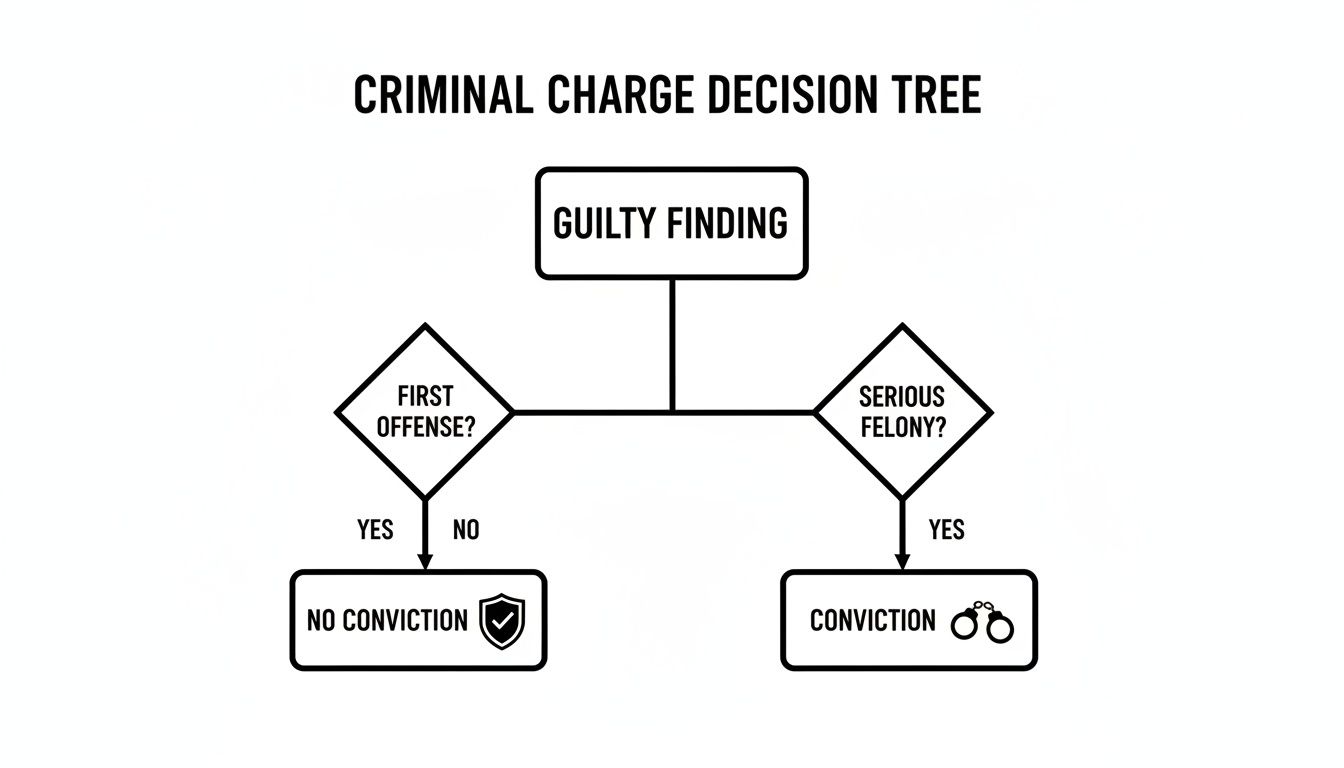
This image simplifies a complex legal moment, clarifying that a finding of guilt does not automatically result in a registered conviction.
Practical Factors the Court Considers
To apply these two legal tests, judges examine several practical factors related to you and the offence itself. While every case is unique, certain factors consistently influence the outcome. Your lawyer’s job is to gather and present evidence on these points to tilt the scales in your favour.
Key factors include:
- Your Character and Background: Is this your first interaction with the law? Do you have a history of being a contributing member of the community, stable employment, or strong family support? Character reference letters can be incredibly persuasive.
- The Nature of the Offense: Discharges are generally reserved for less serious offences. A minor, uncharacteristic lapse in judgment, such as a minor theft charge, is far more likely to receive a discharge than a more calculated or violent offence. The type of charge matters immensely; learn more about the differences between a summary vs indictable offence in our article.
- Your Personal Circumstances: The court considers your age, health, and family responsibilities. They aim to see the whole person, not just the charge, and understand how a conviction would impact you in a way that is disproportionate to the offence.
A judge considers whether the consequences of a conviction would be “unduly harsh” for the individual. If losing a professional licence over a minor, isolated mistake seems excessive, a discharge becomes a much more likely outcome.
Ultimately, securing an absolute discharge comes down to a strategic presentation of your life and circumstances. The objective is to demonstrate to the court that you are not a threat to the public and that the lifelong consequences of a criminal record would far outweigh any public benefit of imposing one.
Absolute Discharge vs. Other Criminal Outcomes
When you’re facing a criminal charge in Canada, the court’s decision on guilt is only half the story. What comes next—the sentence—is what truly shapes your future. It’s essential to understand the different paths a case can take, because they lead to vastly different places.
Navigating these outcomes can be daunting. In essence, it boils down to three main possibilities following a finding of guilt: an absolute discharge, a conditional discharge, or a conviction. Each carries its own weight and dramatically changes what your life looks like moving forward.
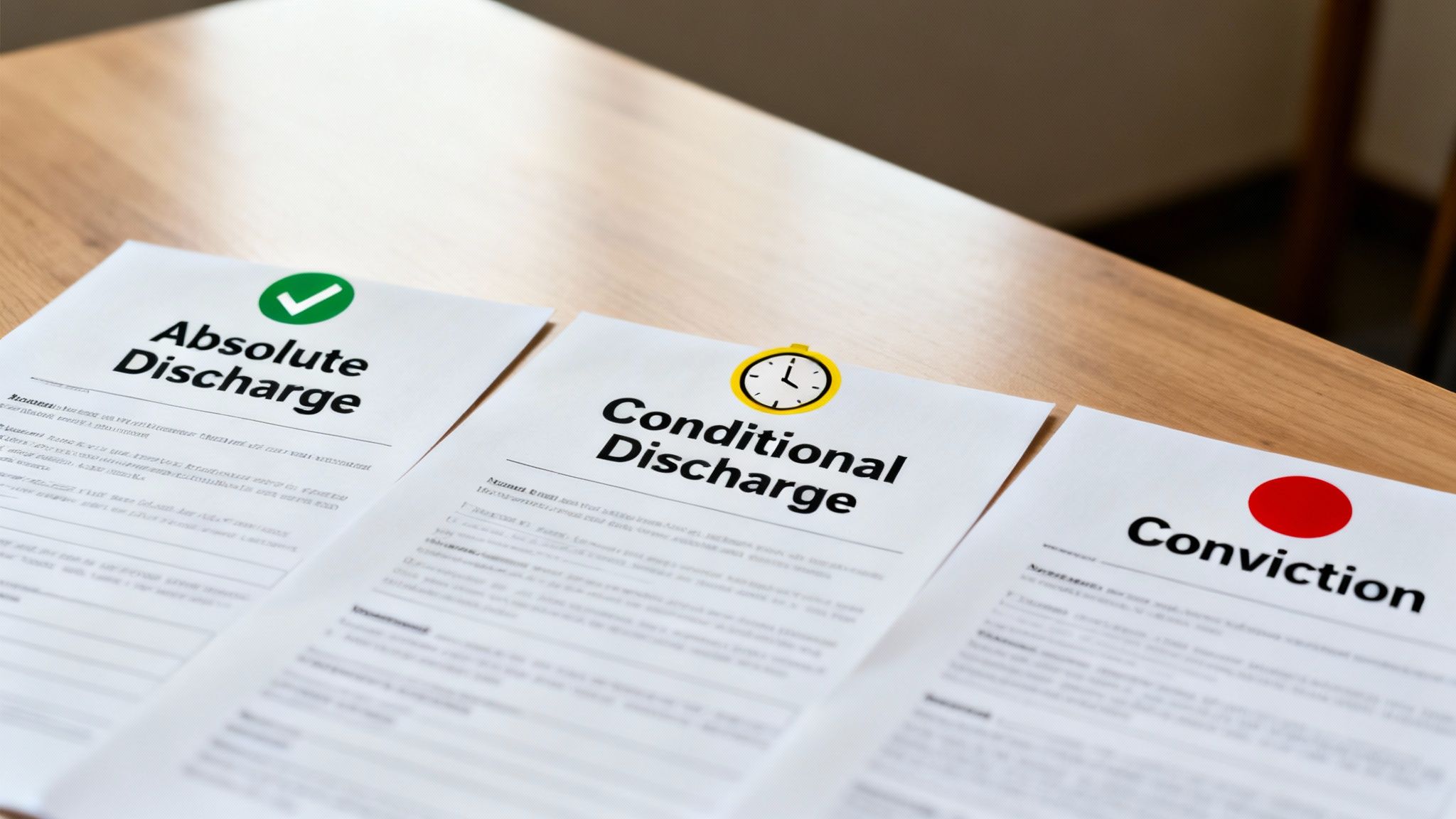
The Absolute Discharge: A Clean Break
As we’ve covered, an absolute discharge is the best-case scenario if you are found guilty of an offence. The court acknowledges what happened but makes the crucial decision not to register a criminal conviction.
You walk out of the courthouse that day with no probation to follow, no conditions hanging over your head, and no fines to pay. After just one year, the record of the discharge is automatically purged from the national CPIC database. It’s a clean slate, and the fastest way back to normal life.
The Conditional Discharge: A Path to a Clean Record
A conditional discharge is closely related to an absolute one. It also allows you to avoid a formal criminal conviction, but it comes with conditions. You receive a “deferred” clean slate, which you must earn by complying with court-ordered rules for a specified period.
If you receive a conditional discharge, you’ll be placed on probation, typically for one to three years. During that time, you must adhere to specific conditions, which might include:
- Reporting to a probation officer regularly.
- Completing community service hours.
- Attending counselling or treatment programs for issues like anger management or substance use.
- Paying restitution to a victim to cover a financial loss.
Once you have successfully completed all your probation conditions, the discharge becomes final. The finding of guilt is then purged from the CPIC database three years after the date the order was made. However, if you fail to comply with the conditions, the Crown can bring you back to court, and the judge can revoke the discharge and enter a conviction instead. To dive deeper into this topic, you can read our guide on what is conditional discharge in Canada.
The Criminal Conviction: A Permanent Mark
A criminal conviction is the most serious and lasting outcome. Unlike a discharge, a conviction results in a permanent criminal record. It follows you for life unless you successfully apply for a record suspension (formerly known as a pardon).
A conviction creates significant barriers to employment, housing, volunteering, and international travel, especially to the United States. It is a formal, enduring mark on your name that can limit your opportunities for years, if not decades.
“The fundamental difference is the presence of a conviction. With both types of discharges, the end goal is the same: no criminal record. With a conviction, the record is the sentence’s primary, lasting consequence.”
It’s also important to know that these outcomes aren’t predetermined. The justice system is dynamic. The proportion of completed cases in Canada resulting in a guilty finding has dropped by 22% over the last decade. This trend, highlighted in the latest Corrections and Conditional Release Statistical Overview, shows that the right legal strategy can genuinely influence the result of a case.
Understanding this hierarchy is the first step. An experienced criminal lawyer in Brampton always begins by fighting to have the charges withdrawn. If that is not possible, arguing for an absolute discharge becomes the top priority, as it offers the cleanest and quickest path back to a life free from the weight of a criminal record.
Life After an Absolute Discharge
For many clients, the moment a judge grants an absolute discharge is one of profound relief. The legal battle is over, and the future suddenly looks much brighter. However, it’s normal to have questions about what happens next. Understanding the short-term realities and long-term benefits is key to moving on with confidence.
The most important takeaway is this: an absolute discharge means you do not have a criminal conviction. This single fact is the foundation for everything that follows, from job applications to crossing the border. Still, there is a brief transitional period you need to be aware of.
The One-Year Waiting Period
For a period of one year following the judge’s decision, a record of the absolute discharge exists on the national police database, the Canadian Police Information Centre (CPIC). This is a crucial detail that can be a source of confusion.
While it is not a conviction, the record of the finding of guilt and the discharge itself can appear on certain high-level police background checks during this 12-month window. The good news is that after exactly one year from your sentencing date, the RCMP automatically purges this record from the CPIC database. This automatic process is a key feature of an absolute discharge—it’s designed to wipe the slate clean without you needing to hire a lawyer or file additional paperwork.
While a discharge is meant to provide a fresh start, this initial one-year period is a temporary phase where the event is still documented in federal systems. A knowledgeable criminal lawyer in Brampton can provide clear, practical advice on how to navigate this time.
This temporary record has specific implications for different areas of your life.
How an Absolute Discharge Affects Employment
For most job applications, you can legally and truthfully state that you have never been convicted of a criminal offence. This is a significant advantage.
However, if a potential employer requires a vulnerable sector check—which is common for jobs involving children or vulnerable adults—the discharge may be disclosed during that first year.
After the one-year mark, the record is gone permanently. It will not show up on standard criminal record checks or even on vulnerable sector checks. This means that for the vast majority of career paths, an absolute discharge will have no long-term negative impact on your employment prospects.
Navigating International Travel, Especially to the USA
Travel is another area where an absolute discharge offers significant protection. Because it is not a conviction, most countries will not view it as a reason to deny you entry.
The United States, however, operates under its own laws. U.S. border officials have access to CPIC data and can see the record of the finding of guilt during that initial one-year period. Even though an absolute discharge is not a conviction under Canadian law, American immigration authorities may interpret the finding of guilt differently based on their own legislation.
- During the First Year: Attempting to cross into the U.S. can be risky. A border agent might see the discharge, refer you for secondary inspection, and ask questions. It is always advisable to seek legal advice before attempting to cross during this period.
- After One Year: Once the discharge is purged from CPIC, U.S. border agents will no longer see it. This dramatically reduces the risk of being denied entry because of that specific offence.
Immigration Status and Sponsorship
For anyone who is not a Canadian citizen, a criminal conviction can be devastating. It can lead to deportation, render you inadmissible, or prevent you from sponsoring family members to come to Canada. This is where an absolute discharge serves as a critical safeguard.
Because it is not a conviction, an absolute discharge generally does not make you criminally inadmissible to Canada. This outcome protects your immigration status and preserves your ability to live, work, and build a future here. For many of our clients, protecting their status is the number one priority, making an absolute discharge the most important goal in their case.
How a Brampton Criminal Lawyer Argues for Your Discharge
Securing an absolute discharge isn’t a matter of luck—it is the direct result of a carefully constructed legal strategy. This is where the experience of a criminal lawyer in Brampton becomes your most powerful asset. We take the details of your life and transform them into a persuasive legal argument, showing the court exactly why a conviction is both unnecessary and unjust.
The real work starts long before we step into a courtroom. It’s about building a narrative that highlights your character, your genuine remorse, and the disproportionate harm a criminal record would inflict on your future. Our role is to meticulously assemble this case and present it with conviction.

Building a Strong Foundation with Character Evidence
One of the first and most critical steps is gathering powerful evidence of your good character. A judge needs to see you as a whole person, not just as someone who committed an offence. This is where compelling character reference letters are invaluable.
Your lawyer will guide you on who to ask—employers, community leaders, mentors, or family members—and what these letters should contain. They must be more than generic praise; they need to paint a vivid picture of your positive contributions, your strong work ethic, and your otherwise law-abiding life. This evidence directly supports the argument that the offence was an isolated, uncharacteristic mistake.
Strategic Negotiations with the Crown Prosecutor
Long before a sentencing hearing, your lawyer will engage in crucial negotiations with the Crown prosecutor. In many cases, a discharge can be secured through a “joint submission,” where both the defence and the Crown agree to recommend it to the judge.
An experienced Brampton lawyer knows the local Crown’s office and understands which arguments are most effective. They might highlight factors such as:
- Rehabilitative Steps You’ve Taken: Have you voluntarily attended counselling, made restitution to a victim, or completed community service? Proactive steps demonstrate genuine remorse and a commitment to making amends.
- Minimal Harm Caused: If the offence was minor and resulted in little to no harm, your lawyer will emphasize this to show that a conviction would be an excessive response.
- Weaknesses in the Crown’s Case: Sometimes, weaknesses in the prosecution’s evidence can be used as leverage to negotiate a discharge as part of a plea agreement.
This behind-the-scenes advocacy is often where the most important work is done. A successful negotiation can pave the way for a smooth and positive outcome in court.
Presenting Persuasive Arguments to the Judge
If the case proceeds to a contested sentencing hearing, your lawyer’s advocacy in court is paramount. They will craft a submission that directly addresses the two key legal tests for what is an absolute discharge: that it is in your best interests and not contrary to the public interest.
To prove a conviction is not in your best interest, your lawyer will present concrete evidence of the severe and disproportionate impact it would have on your life. This could involve:
- Employment: Submitting a letter from your employer stating that a criminal conviction will result in termination.
- Professional Licensing: Providing evidence from a professional body that they would revoke your license to practice.
- Immigration Status: Demonstrating how a conviction would lead to deportation or prevent you from sponsoring family members.
To argue that a discharge is not contrary to the public interest, your lawyer will emphasize that you pose no threat to society. They will also argue that the principles of denunciation and deterrence have already been satisfied by the stress and expense of the court process itself.
The art of a successful sentencing submission lies in balancing personal mitigation with public safety concerns. A skilled lawyer shows the court that granting a discharge is not an act of leniency, but a just and appropriate sentence that allows a deserving individual to remain a productive member of society.
Ultimately, a criminal lawyer in Brampton acts as your storyteller, advocate, and strategist. We take the raw facts of your case and your life and shape them into a compelling argument for a second chance, fiercely protecting your future every step of the way.
The Judge’s Role and Key Legal Precedents
While the Criminal Code provides the legal framework for sentencing, the final decision to grant an absolute discharge rests with the judge. This authority, known as judicial discretion, is not arbitrary. Judges in Brampton and across Ontario are guided by a deep history of legal principles and landmark court cases that have shaped how this decision is made.
Understanding these precedents is where a sharp legal strategy moves beyond the facts of your case. A skilled criminal lawyer in Brampton knows how to position your circumstances within this established legal framework, showing the judge that granting you a discharge is consistent with how similar situations have been handled before.
Judicial Discretion and Guiding Principles
At its core, a judge’s role during sentencing is a balancing act. They must weigh the specific, human details of your situation—your character, the nature of the offence, and the real-world harm a conviction would cause—against the public’s interest in safety and faith in the justice system.
This is where legal precedents become critical. Major rulings from higher courts, particularly the Supreme Court of Canada, establish the standards that all lower court judges must follow. These cases provide a roadmap for applying the law, such as determining if a discharge is “not contrary to the public interest.”
Landmark Cases Shaping Discharge Decisions
Over the years, several key court decisions have refined how judges approach discharges. These cases are vital because they clarify when an absolute discharge is the most just and fitting outcome, which helps ensure sentencing is applied consistently across Canada.
One influential case is the Supreme Court of Canada’s decision in R. v. Winko. While dealing with the forensic mental health system, this ruling profoundly impacted how courts consider absolute discharges. It shifted the judicial mindset towards rehabilitation and reintegration over pure punishment in certain circumstances by clarifying the test for “significant risk.” You can read more about these findings and their impact on the justice system. This precedent demonstrates that judicial thinking evolves to favour reintegration when the situation warrants it.
A judge’s decision is a complex blend of statutory law, binding precedents, and the unique human elements of the case before them. Your lawyer’s job is to show how these three streams converge to make an absolute discharge the only logical and just conclusion.
Ultimately, the judge’s role is to ensure the sentence fits both the crime and the individual. Your lawyer’s ability to build a case on a solid foundation of these established legal principles is crucial. The strength of those arguments often comes down to a deep understanding of legal history and knowing how to frame concepts like the burden of proof in a criminal case.
Common Questions About Absolute Discharges
Navigating the justice system raises many practical, real-world questions. Even with a positive outcome like an absolute discharge, you may still feel uncertain about what comes next. Here are straightforward answers to the most common concerns we hear from our clients in Brampton.
Will a Discharge Show Up on a Vulnerable Sector Check?
For the first year after sentencing, yes, the finding of guilt and the discharge can show up on a vulnerable sector check. These are highly detailed background checks required for jobs or volunteer positions involving work with children or other vulnerable individuals.
However, after that one-year period is over, the record is automatically purged from the national police database (CPIC). From that point forward, it will no longer appear.
Do I Have to Tell Employers I Was Found Guilty?
This is a significant point of confusion, but the answer is clear. Legally, you have not been convicted of a crime.
Therefore, when a job application asks if you have a criminal conviction, you can honestly and legally answer “no.” An absolute discharge is specifically designed to avoid that lifelong label. The “finding of guilt” is a legal fact from the court proceeding, but it is not the same as a conviction.
While you were found guilty, the key takeaway is that an absolute discharge is not a conviction. This distinction is critical for your employment, travel, and future opportunities, allowing you to move forward without the stigma of a criminal record.
Can I Travel to the USA After an Absolute Discharge?
This can be complicated. While Canada does not consider an absolute discharge a conviction, U.S. border officials operate under their own laws and have access to Canadian police databases.
During the initial one-year period, they may be able to see the record of your charge and the finding of guilt. This could lead to difficult questions at the border or even a denial of entry. Once the record is purged after a year, the risk drops significantly, but it is never zero. U.S. border law is complex, and caution is always advised.
For a deeper look at other legal outcomes and how they compare, you might find our guide on what is a peace bond in Canada helpful.
If you are facing criminal charges and have questions about what an absolute discharge is and whether it’s an option for you, don’t hesitate. Contact a criminal lawyer in Brampton for a confidential consultation to protect your future. Visit us at https://criminallawyerinbrampton.com.
No comment