


If you have been charged with a crime in Brampton, one of the first things you need to understand is how your charge is classified. In Ontario criminal law, the entire legal path ahead—from the court process to the potential penalties—depends on whether the charge is a summary, indictable, or hybrid offence. This guide will explain the critical difference between summary and indictable offences and what it means for your case.
Understanding this distinction is the first step in building your defence. Summary offences are less serious, while indictable offences are reserved for the most severe crimes. Badesha Law, a criminal defence law firm in Brampton, is experienced in handling all types of criminal charges and can help you navigate this complex system.
Understanding Your Charge: What It Means for Your Case

When you’re facing a criminal charge in Brampton, that classification is the first step toward building a real defence. The distinction between a summary vs indictable offence shapes everything that follows, including your rights, the court you will appear in, and the severity of potential penalties.
Summary conviction offences are handled more quickly and always stay within the Ontario Court of Justice, carrying lighter penalties. On the other hand, indictable offences are for serious crimes like murder or robbery. This classification often gives you the right to a jury trial but also exposes you to life-altering consequences, like long prison sentences. To figure out where your charge fits, your best bet is to speak with a criminal lawyer in Brampton, Ontario.
Quick Comparison: Summary vs Indictable Offence at a Glance
For a quick reference, it helps to see the main differences side-by-side. This table breaks down the essentials of how these two categories operate in Ontario's justice system.
| Feature | Summary Offence | Indictable Offence |
|---|---|---|
| Severity | Less serious (e.g., causing a disturbance) | Most serious (e.g., murder, robbery) |
| Court Venue | Ontario Court of Justice | Superior Court of Justice (often) |
| Trial by Jury | Not available | Often an option for the accused |
| Maximum Penalty | Two years less a day & $5,000 fine | Can be up to life in prison |
| Statute of Limitations | 12 months to lay a charge | Generally, no time limit |
| Fingerprinting | Not always required | Mandatory upon being charged |
| Legal Process | Streamlined and faster process | More complex, with preliminary inquiries |
Looking at this, you can see just how different the journey through the legal system is depending on the charge. The stakes, procedures, and even your rights can change dramatically. The criminal defence lawyers at Badesha Law can explain exactly what these differences mean for your specific situation.
Understanding Summary Conviction Offences
In the landscape of Canadian criminal law, charges are broken down into different categories of seriousness. Summary conviction offences sit on the less severe end of that spectrum. If you're facing this kind of charge in Brampton, it's crucial to understand what it means for you, because even a "minor" charge can have major consequences.
Think of summary offences as crimes that are handled more swiftly by the justice system. The entire process takes place in the Ontario Court of Justice, and there's no option for a jury trial. While the procedure is more streamlined, a conviction still lands you with a permanent criminal record. You can find more details by reading further into Canadian criminal offence classifications.
What Kinds of Charges are Summary Offences?
You’d be surprised at how many common charges fall into this category. Here in Peel Region, we see these types of allegations frequently:
- Causing a Disturbance: This covers everything from shouting and swearing to fighting or being drunk in a public place.
- Trespassing at Night: Being on someone's private property without a lawful reason between 9 p.m. and 6 a.m.
- Theft Under $5,000: Shoplifting from a store is the classic example.
- Mischief Under $5,000: This involves intentionally damaging property valued at less than $5,000.
- Public Nudity: Being inappropriately exposed in a public place or in public view.
Even though these might not sound as serious as other crimes, a conviction can still throw a wrench into your plans for years to come.
The Penalties and a Critical Deadline
The good news, if there is any, is that the penalties for summary convictions are capped by the Criminal Code of Canada. This provides some predictability. Generally, the maximum punishment you could face is:
- A fine of up to $5,000.
- Jail time of up to two years less a day.
Now for a critical detail: the statute of limitations. The police are on a clock. They have exactly 12 months from the day the incident allegedly happened to lay a charge. If they miss that deadline, the charge is invalid, period. Any sharp criminal lawyer in Brampton will immediately check this date—it can be the key to getting a case thrown out before it even begins.
It’s a huge mistake to think a summary charge isn't a "real" criminal charge. It absolutely is. A conviction will leave you with a criminal record that can haunt you, creating roadblocks for jobs, travel to the U.S., and immigration applications.
How a Criminal Defence Lawyer at Badesha Law Can Help
Our goal is always to prevent a conviction and protect your clean record. While the penalties are lower than for more serious offences, the stakes are still high. At Badesha Law, we have handled countless summary conviction cases at the Brampton courthouse, and our strategy always starts with proactive, early-stage defence.
We dig into the police evidence, looking for holes, inconsistencies, and any violations of your Charter rights during the investigation or arrest. For many of our clients, especially those with no prior record, the best path forward is negotiating directly with the Crown prosecutor for an alternative outcome. This often involves:
- Diversion Programs: You complete specific conditions—like community service hours or counselling—and in return, the Crown withdraws the charge.
- Peace Bonds: This is essentially a promise to the court to keep the peace and be on good behaviour for a set time. Once that period ends, the charge disappears.
Securing one of these resolutions means you walk away without a criminal record. Even what seems like a minor shoplifting charge deserves a robust legal defence, and the team at Badesha Law is ready to provide the skilled guidance you need to get the best possible outcome.
Understanding the Severity of Indictable Offences

While summary offences are on the lower end of the criminal spectrum, indictable offences are the most serious crimes in Canada. Getting charged with one isn't just a minor legal problem; it's a major event that triggers a much more complex and serious legal process, with potentially life-changing consequences. If you're facing an indictable charge in Brampton, the stakes couldn't be higher, and getting expert legal help right away is non-negotiable.
These are the charges reserved for criminal acts that society considers the most damaging. They aren't processed quickly like lesser offences. Instead, the court system gears up for a rigorous, lengthy, and far more formal fight. We know that a charge like this is a crisis, and it demands a powerful, strategic defence from the moment you're arrested.
Common Examples of Indictable Offences
The Criminal Code sets out a long list of offences that are strictly indictable. This means the Crown has no discretion—they must pursue them as the most serious types of crimes. These are often the cases you hear about in the news, and they carry the harshest penalties under the law.
Some of the most common examples we see in Peel Region courts include:
- Murder, Manslaughter, and Attempted Murder: The most grave offences against a person.
- Aggravated Assault and Aggravated Sexual Assault: These involve serious injuries or the use of a weapon. You can learn more about what to expect if you're dealing with a first-time assault charge in Canada.
- Robbery and Extortion: Taking property through violence or credible threats.
- Trafficking of hard drugs like cocaine, fentanyl, or heroin.
- Kidnapping and Forcible Confinement: Unlawfully taking and holding someone against their will.
For any of these offences, the procedure involves mandatory fingerprinting. And unlike summary matters, there is generally no statute of limitations, meaning charges can be laid many years after the alleged crime took place.
Penalties and Procedural Rights
The potential penalties for indictable offences are severe, reflecting how seriously the justice system takes them. A conviction can easily result in a long prison sentence in a federal penitentiary (which means two years or more), and many of these charges come with mandatory minimum sentences. For the most serious crimes, the maximum penalty is life in prison.
Because the stakes are so high, the law gives people accused of indictable offences significant procedural rights that aren't available in summary cases. One of the most important is the right to choose how you want to be tried. For many indictable offences, you have an election and can choose to have your case heard by:
- A judge alone in the Ontario Court of Justice.
- A judge alone in the Superior Court of Justice.
- A judge and jury in the Superior Court of Justice.
The choice between a judge or a jury is one of the most critical strategic decisions you'll make in your defence. It’s not a simple guess. It requires a deep analysis of the evidence, the legal arguments, and even the local court dynamics—a call that should only be made with advice from an experienced criminal lawyer in Brampton.
Another crucial right is the preliminary inquiry. This is a hearing where the Crown has to put its cards on the table and show a judge there's enough evidence to even go to trial. For the defence, this is an invaluable opportunity to test the Crown's case, cross-examine their main witnesses, and lock them into their story long before a jury hears it. A skilled defence lawyer uses the preliminary inquiry to find the weak spots in the prosecution's case, which can lead to charges being withdrawn or put you in a much stronger position for trial.
The gap between a summary vs indictable offence is never clearer than when you look at these powerful procedural rights.
The Critical Role of Crown Discretion in Hybrid Offences
Sitting between the clear lines of summary and indictable offences is a huge, critical middle ground: hybrid offences. The simple truth is that most criminal charges laid in Brampton and across Ontario—things like impaired driving, assault, and fraud under $5,000—all fall into this unique category.
For any hybrid charge, the Crown prosecutor holds a tremendous amount of power. They get to decide, or "elect," whether to treat your case as a less serious summary matter or a much more serious indictable one. This decision, usually made early on, is one of the most important moments in a criminal case. It sets the entire tone, determining everything from the court you're in to the potential penalties you face.
How the Crown Makes Its Election
The Crown’s choice isn’t made on a whim. Prosecutors in Peel Region look at a specific set of factors when deciding how to proceed with a hybrid offence. If you’re facing a charge, knowing what they’re looking for is the first step toward building a strong defence.
Here’s what they consider:
- The Severity of the Allegations: There's a world of difference between an assault that leaves a minor bruise and one that causes a serious injury. The facts of what allegedly happened matter immensely.
- Your Criminal Record: Are you a first-time offender? If so, you have a much better chance of the Crown choosing the summary route than someone with a history of similar offences.
- Public Interest Considerations: Sometimes, the Crown feels a need to send a strong message of deterrence to the community. A high-profile or particularly troubling case might push them toward an indictable election.
- Aggravating and Mitigating Factors: Was a weapon involved? Was the alleged victim particularly vulnerable? On the other hand, did you show remorse right away or cooperate with the police? These details can tip the scales.
The Crown weighs all these elements to figure out which path best serves the administration of justice. The difference between the two options is night and day, making this decision a major turning point.
The Power of Proactive Legal Defence
This is exactly where an experienced criminal defence lawyer in Brampton becomes absolutely essential. That window of time before the Crown makes its election is your best opportunity to influence the outcome. At Badesha Law, we don't just sit back and wait for that decision—we get to work trying to shape it.
Our strategy is to get in front of the Crown prosecutor as early as possible. We put together a comprehensive package of mitigating information about you and the case. This could include letters of reference, proof of your employment, or evidence that you’ve already started counselling or treatment. We also make legal arguments that point out any weaknesses in the police’s case.
The goal is simple: to persuade the Crown that proceeding by summary conviction is the most appropriate and just course of action. A successful argument here can drastically reduce your legal exposure, potentially saving you from facing years in prison and a far more complex court battle.
Comparing Court Procedures and Your Legal Rights
When you're charged with a criminal offence in Brampton, the label—summary vs. indictable—does a lot more than just hint at the potential penalty. It completely changes the legal road ahead of you, dictating which courthouse you'll be in and what rights you have along the way. Getting a handle on these procedural differences is the first step to effectively navigating your case.
The journey through the Ontario justice system splits into two very different paths based on this classification. A summary conviction case moves quickly and stays entirely within the Ontario Court of Justice. In contrast, an indictable case is a much more involved, multi-stage process that can climb all the way to the Superior Court of Justice, bringing with it legal rights you simply don't have with lesser charges.
Arrest, Release, and Bail Hearings
The first fork in the road appears the moment you're arrested. If you're facing a summary offence, the police are far more likely to release you right from the station with a piece of paper—an undertaking—telling you when your first court date is. The bar for keeping someone in custody for a minor charge is set pretty high.
For indictable offences, it's a different story. A bail hearing becomes a much more probable reality. The Crown prosecutor will often fight to keep you in custody, especially on serious charges, arguing it's necessary for public safety or to make sure you show up for court. This leads to a formal what happens at a bail hearing where a Justice of the Peace makes the call. For the most severe indictable crimes, there’s even a "reverse onus," which flips the script and forces you to prove why you should be released.
This flowchart shows how the Crown's early decision-making in hybrid cases directs the entire flow of the proceedings.
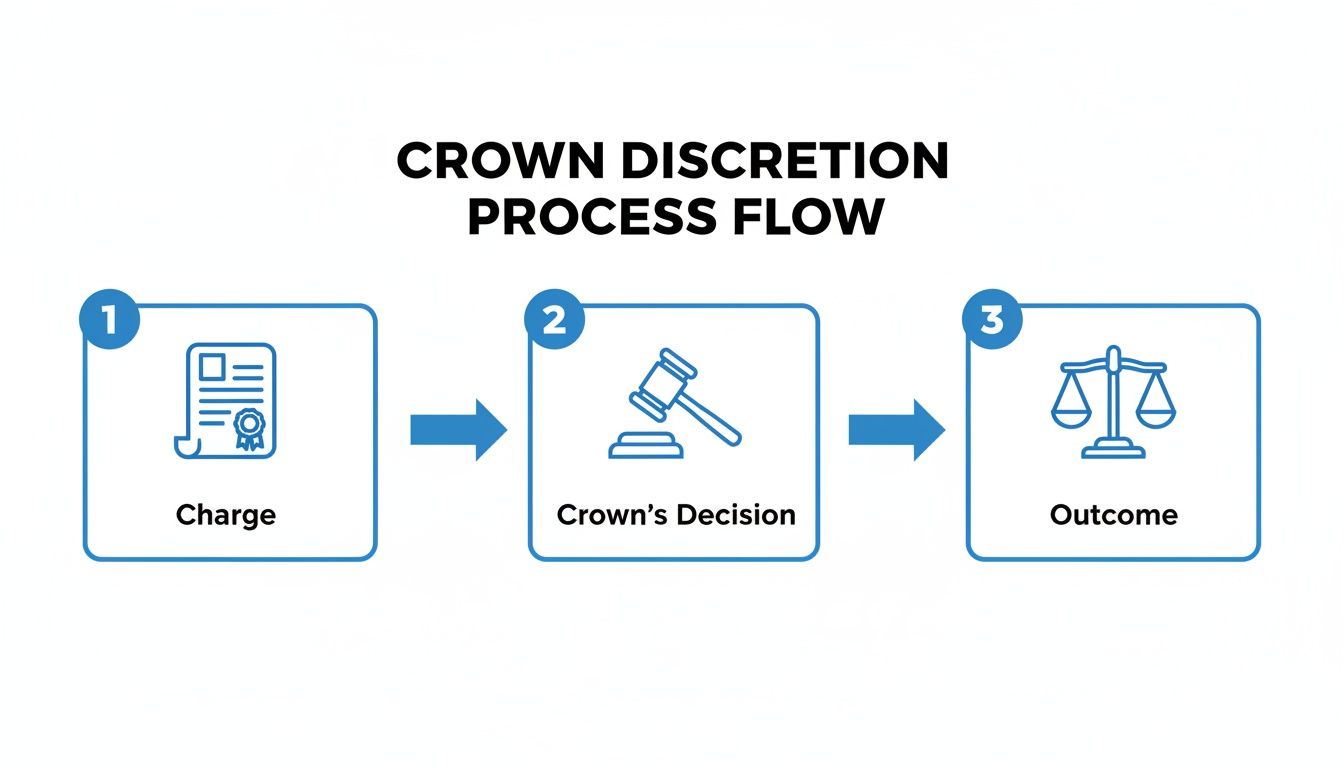
As you can see, the Crown's election is a critical moment that sends a case down either the straightforward summary path or the more complex indictable route.
Trial Venue and Your Right to a Jury
One of the most powerful rights that comes with an indictable offence is the choice of how you want to be tried. This "election" isn't just a formality; it's a crucial strategic decision that a lawyer at Badesha Law will explore with you in depth.
- Summary Offences: The case is always heard in the Ontario Court of Justice by a judge sitting alone. A jury is not an option.
- Indictable Offences: For most serious charges, you get to choose your "mode of trial." You can elect to be tried by:
- A judge alone in the Ontario Court of Justice.
- A judge alone in the Superior Court of Justice.
- A judge and jury in the Superior Court of Justice.
This right to have your case heard by a jury of your peers is a bedrock principle of Canadian justice, but it's a right reserved for those facing the most significant charges and life-altering consequences.
Key Procedural Steps: Summary vs Indictable Offences
To lay it all out clearly, this table contrasts the main procedural stages for each type of offence within the Ontario court system. It highlights the distinct rights and timelines you can expect.
| Procedural Stage | Summary Offence Process | Indictable Offence Process |
|---|---|---|
| Fingerprinting | Not always required. | Mandatory upon being charged. |
| Bail/Release | Often released from the station; bail hearing is less common. | Bail hearing is common; may involve a reverse onus. |
| Preliminary Inquiry | Not available. | A right for many offences; used to test the Crown's evidence. |
| Trial Court | Exclusively in the Ontario Court of Justice. | Can be in Ontario Court or Superior Court of Justice. |
| Trial Mode | Judge alone only. | Accused often has the right to choose judge alone or judge and jury. |
| Timeline | Typically resolves within 6-12 months. | Can take 18 months or longer, especially if proceeding to trial. |
This table shows just how different the two experiences can be, from the very first steps after an arrest to the ultimate trial itself.
A key strategic tool in an indictable case is the preliminary inquiry. This is a hearing where the Crown must present enough evidence to justify a full trial. For the defence, it's an invaluable chance to cross-examine Crown witnesses and find weaknesses in their case before it ever reaches a jury.
In the end, every single step—from your initial interaction with police to a potential trial—is fundamentally shaped by whether the charge is summary or indictable. A skilled criminal lawyer in Brampton will protect your rights at every turn, using the specific rules of your case's procedure to build the strongest defence possible.
How a Conviction Impacts Your Future

The fallout from a criminal charge doesn't just end when you leave the Brampton courthouse. A conviction leaves a permanent stain, and the type of offence—summary vs. indictable—massively affects your ability to find work, travel, and simply get on with your life. You need to understand these long-term stakes from the very beginning.
No matter if it's summary or indictable, a conviction means a criminal record. This record can slam doors shut for years, creating serious problems for everything from your career to your freedom to cross the border.
Criminal Records and Employment
A criminal record can be an instant deal-breaker for many jobs. If you're looking for work that requires a vulnerable sector check—think teaching, nursing, or caring for the elderly—a record can disqualify you immediately. For employers, an indictable offence is a particularly loud alarm bell, often viewed as a sign of major risk.
Even for roles without these formal checks, a conviction for something like theft, fraud, or assault makes it incredibly tough to earn an employer's trust. At Badesha Law, we know that protecting your ability to earn a living is a top priority.
Travel and Immigration Consequences
Forget spontaneous trips across the border. A criminal record can make travelling internationally, especially to the United States, a nightmare. U.S. border officials have a lot of power and can turn you away for a long list of offences. An indictable conviction all but guarantees you'll be considered inadmissible, forcing you through a complicated and expensive waiver process just for a chance to enter.
For anyone who isn't a Canadian citizen, the situation is even more dire. A serious indictable offence conviction can trigger deportation proceedings, and it doesn't matter how long you've called Canada home. The difference between offence types is absolutely critical here.
The real goal of a strong defence is not just to beat the charge but to protect your future. An outcome that avoids a criminal record—like a withdrawal, peace bond, or discharge—is often the best possible result, and this is where our strategic negotiations with the Crown are most valuable.
How Badesha Law Protects Your Future
Our strategy at Badesha Law looks past the courtroom battle. We're focused on finding resolutions that prevent these lifelong consequences. We fight for outcomes that help you avoid a formal conviction altogether, like a peace bond or a discharge. By exploring every avenue, such as a conditional discharge in Canada, we often find a way to keep your record clean. This proactive approach is designed to protect your future—your ability to work, travel, and live without the weight of a criminal record.
FAQ: Navigating Summary vs Indictable Offences
When you're facing a criminal charge, things can get confusing fast. Here are straightforward answers to some of the most pressing questions we hear from our clients in Brampton about the distinction between a summary vs indictable offence.
Will a summary offence leave me with a criminal record?
Yes, a conviction for any criminal offence, summary included, results in a permanent criminal record in Canada. That record can cause significant problems with employment, travel, and immigration. However, a skilled criminal defence lawyer can often negotiate an alternative resolution, such as a diversion program or peace bond, which allows you to avoid a conviction and a criminal record.
Can a summary charge be upgraded to an indictable one?
For a straight summary offence, no. Once laid as a summary charge, it cannot be changed. For hybrid offences, the Crown prosecutor must "elect" whether to proceed by summary conviction or by indictment. Once they choose the summary route, they are locked into that path. This is a critical early moment where a lawyer from Badesha Law can advocate on your behalf to influence that decision.
Is there a time limit for the police to lay a summary charge?
Absolutely. For a summary offence, the police have a strict 12-month deadline from the date of the alleged incident to lay a charge. If they miss that deadline, the charge is invalid and can be thrown out. This is one of the first things a good Brampton criminal lawyer will check. For most indictable offences, there is no statute of limitations.
How long does a summary case usually take in Brampton?
Summary cases are designed to be resolved more quickly than indictable matters. You can generally expect a case at the Brampton courthouse to conclude within 6 to 12 months. Indictable cases are far more complex and can easily take 18 months or longer to resolve, especially if they proceed to a trial in the Superior Court. The specific timeline depends on the details of your case, and we can provide a clearer estimate during a consultation.
If you’ve been charged with a criminal offence in Brampton or the Peel Region, understanding the difference between summary and indictable offences is the first step in building a strong defence. The stakes are high, but you do not have to face this process alone.
The team at Badesha Law has the experience to provide clear advice and strong advocacy. We are here to protect your rights and fight for the best possible outcome for your case. Contact us today for a free, confidential consultation with a Brampton criminal lawyer to start planning your defence.
No comment