


Being charged with assault for the first time is a jarring experience. One minute, life is normal; the next, you're tangled in the Canadian criminal justice system. It's confusing and frankly, terrifying. This guide explains what a first time assault charge in Canada means, what happens in the Brampton court process, and how a strong legal defence can protect your future. But it's vital to remember that a charge is not a conviction. What you do in these first few hours and days is critical and can dramatically change the path your case takes.
What To Do Immediately After an Assault Charge
When you or someone you care about is charged, it feels like the world is spinning out of control. The legal system moves fast at the beginning, and every decision—or indecision—matters. Your job right now is to breathe, get a handle on your legal obligations, and find an expert to guide you. This is precisely where Badesha Law, a criminal defence law firm in Brampton, comes in, offering a steady hand to navigate the complexities of the Peel Region courts.
Understand Your Release Conditions
After an assault charge in Ontario, you'll either be held for a bail hearing or released directly from the station with a document called an Undertaking or a Release Order. Think of this document as a set of legally binding rules you must live by until your case is over. They aren't suggestions.
You'll almost always see conditions like these:
-
No-Contact Orders: This is the big one. You will be ordered to have zero contact with the complainant (the person who made the complaint). That means no calls, no texts, no social media DMs, and no asking a friend to "just pass on a message." Any breach is a new criminal charge.
-
Geographic Restrictions: You might be barred from being within a certain distance of specific places, like the complainant's home or workplace.
-
Weapons Prohibitions: A ban on possessing any weapons is standard.
Following these conditions to the letter is non-negotiable. If you slip up, you can be arrested again, and getting bail a second time becomes incredibly difficult. If you're heading to court for bail, our guide on what happens at a bail hearing can shed more light on the process.
The Importance of Remaining Silent
You have the right to remain silent. Use it. It’s the single most important piece of advice anyone can give you at this stage.
Don't try to explain your side of the story to the police or anyone else without your lawyer present. Anything you say can and will be twisted and used against you by the Crown prosecutor. The only thing you need to say is, "I want to speak with my lawyer."
An experienced assault lawyer from Badesha Law will take over all communication with the police and the Crown. We become your shield, making sure you don't accidentally say something that jeopardizes your defence down the road.
Navigating these first steps correctly sets the foundation for your entire defence strategy. The table below breaks down these crucial first moves.
Your Immediate Priorities After an Assault Charge
| Priority Action | Why It Is Critical | How Badesha Law Can Help |
|---|---|---|
| Secure Your Release | Remaining in custody adds immense stress and makes it harder to participate in your own defence. Prompt release is key. | We can represent you at your bail hearing, arguing for your release on the most reasonable terms possible. |
| Preserve Your Record | A criminal record for assault can block employment, travel, and immigration opportunities for life. | Our primary goal is to find a path to get the charges dropped, withdrawn, or secure a "not guilty" verdict to protect your clean record. |
| Protect Your Rights | From the moment of arrest, your constitutional rights are at stake. You need an advocate to ensure they are protected. | We ensure police and Crown follow proper procedure and challenge any violations of your Charter rights. |
| Understand the Process | The legal system is a maze. Knowing what's coming next reduces anxiety and helps you make informed decisions. | We explain every step in plain English, from disclosure to trial, so you are never in the dark. |
These initial actions are about damage control and setting yourself up for the best possible outcome. Acting quickly and strategically with the right legal partner is everything.
What an Assault Charge in Canada Actually Means
If you're facing a first time assault charge in Canada, it's important to understand what "assault" really means in the eyes of the law. It’s a word that gets thrown around a lot, but its legal definition is much broader than most people think. It isn't just about getting into a fistfight.
In Ontario criminal law, assault boils down to the non-consensual application of force. Sometimes, you don't even have to make physical contact—the threat of force can be enough to land you in serious trouble. At Badesha Law, we often see clients in Brampton who are completely shocked that a minor act, like a shove in a heated moment or even an aggressive gesture, has resulted in a criminal charge. The Crown prosecutor's entire job is to prove you intentionally applied that force, and that the other person didn't consent to it. That’s the core of every assault case.
The Three Levels of Assault
Not all assault charges carry the same weight. The Criminal Code of Canada breaks them down into three distinct levels, and the penalties get progressively more severe as you move up the ladder.
-
Level 1: Simple Assault (Section 266): This is the most common type of assault charge, and it's the one we see most often for a first offence. It covers any intentional use of force without consent, where no significant injury occurs.
- Think of things like: A push during an argument, an unwanted touch, spitting at someone, or even raising a fist and threatening to hit them.
-
Level 2: Assault with a Weapon or Causing Bodily Harm (Section 267): The stakes get higher here. This charge is laid when a weapon is involved or when the incident results in "bodily harm." The term "weapon" is surprisingly flexible; it can be anything from a beer bottle to a car if it's used to threaten or injure. "Bodily harm" simply means an injury that's more than trivial and interferes with the person's health or comfort.
- Real-world examples include: Hitting someone with an object, causing a cut that needs stitches, or breaking their nose.
-
Level 3: Aggravated Assault (Section 268): This is the most serious level of assault. It involves acts that wound, maim, disfigure, or endanger the life of the other person. A conviction here almost always leads to significant jail time.
- This covers scenarios like: An attack that leaves permanent scars, causes serious internal damage, or puts someone's life at risk.
The very first thing an assault lawyer in Brampton from our firm will do is analyze exactly which level of assault you’re facing, because that single detail dictates the entire strategy for your defence.
How the Crown Builds Its Case
To get a conviction for any type of assault, the Crown has to prove three things beyond a reasonable doubt:
-
Intent: You meant to do the act. It wasn't just an accident.
-
Application of Force: You either made physical contact—no matter how minor—or you made a gesture that made the other person believe contact was imminent.
-
Lack of Consent: The other person did not agree to the contact.
These three points might look straightforward, but proving them in court can be incredibly complex. Our role is to pick apart the evidence and expose the weak spots in the Crown's argument on each and every one of them.
The Special Case of Domestic Assault
It's critical to understand that "domestic assault" isn't a separate charge in the Criminal Code. It’s a regular assault charge—simple, with a weapon, or aggravated—that just happens to take place between people in a domestic relationship, like spouses, partners, or family members. But here's the key difference: the justice system, especially in Peel Region, treats these cases with extreme seriousness.
The Crown has specialized "zero tolerance" policies for prosecuting domestic violence matters. This makes them much more difficult to resolve quietly. Bail conditions are almost always stricter, and the Crown is far less likely to simply withdraw the charges without a fight.
This context adds a huge layer of complexity, and navigating it successfully requires a very specific legal strategy.
National data shows just how common these charges are. Simple assault is often the first and only time many Canadians interact with the criminal justice system. It accounted for over 30,000 of 300,000 total criminal charges in a recent year—a figure right up there with impaired driving and theft. We see this play out especially with young adults aged 18-24, where minor disputes can quickly escalate. Learn more about recent crime data and trends in Canada. This statistic is a stark reminder of how easily one bad moment can lead to a first time assault charge in Canada.
Navigating the Brampton Court Process Step by Step
For anyone facing a first-time assault charge in Canada, the court system can feel like an overwhelming and confusing maze. The best way to manage the stress is to understand the road ahead. This guide breaks down the criminal court process at the A. Grenville and William Davis Courthouse in Brampton, walking you through the journey from your first appearance to the critical decisions that will define your future.
It's important to first understand that not all assault charges are the same. The law treats them differently based on the level of harm involved, which directly impacts everything from potential penalties to the complexity of your case.
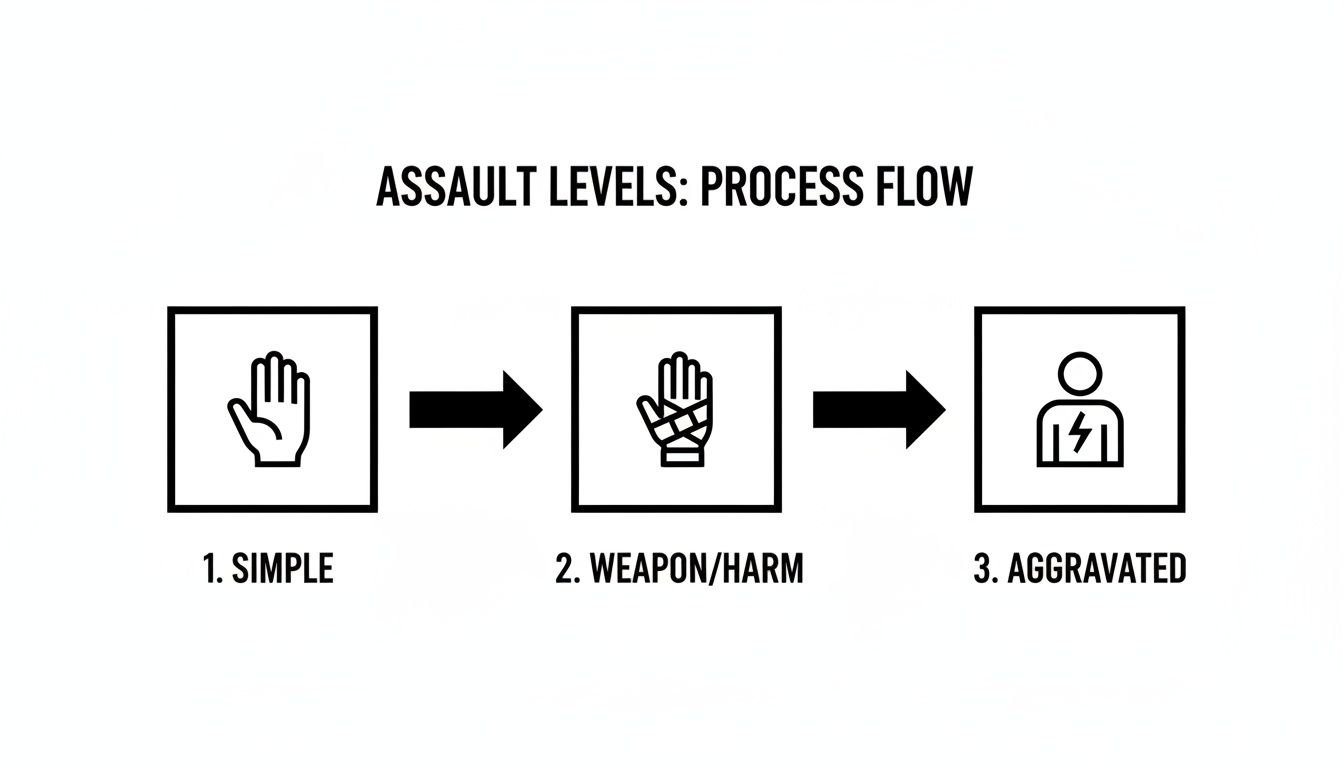
As you can see, the charges escalate, and knowing where your case falls on this spectrum is the first step in building a defence.
The First Appearance and Getting Disclosure
Your journey through the court system starts with the First Appearance. Don't worry, this isn't your trial. It's really just a brief, administrative court date where you or your lawyer officially check in with the court.
The most important thing that happens here is receiving the “disclosure.” This is the initial package of evidence the police and Crown have gathered against you. It's the foundation of your entire defence.
Inside the disclosure package, you’ll typically find:
-
The police summary of what they believe happened (the "synopsis").
-
The handwritten notes from the investigating officers.
-
Statements taken from any witnesses, including the person who made the complaint.
-
Any photos or video evidence, if it exists.
When you hire an experienced assault lawyer in Brampton from Badesha Law, we handle this for you. You won’t even have to show up. We get the disclosure and start dissecting it immediately, looking for the strengths and, more importantly, the weaknesses in the Crown's case right from day one.
Crown Pre-Trial and Resolution Meetings
Once we've thoroughly reviewed the disclosure, the next critical phase is the Crown Pre-Trial. Think of this as a negotiation session between your lawyer and the Crown Attorney handling your file. It's our first real opportunity to advocate for you and see if we can get the case resolved without ever stepping into a trial courtroom.
During this private meeting, we might:
-
Challenge the evidence, pointing out legal flaws or factual inconsistencies we found in the disclosure.
-
Highlight your personal story, especially if you have no prior record, a steady job, or family responsibilities.
-
Propose a better path forward, such as having the charge withdrawn completely in exchange for you attending counselling or agreeing to a peace bond.
This is where a lawyer's reputation and skill really come into play. Our job is to persuade the Crown that taking you to trial isn't in the public interest, opening the door for a result that keeps your criminal record clean.
A successful Crown Pre-Trial can be the difference between your case ending quietly and a long, stressful, and expensive trial. Our goal at Badesha Law is to explore every avenue for an early resolution that achieves your best possible result.
Judicial Pre-Trial
If we can't reach an agreement with the Crown directly, the next step is often a Judicial Pre-Trial (JPT). This is a more formal meeting that includes your lawyer, the Crown, and a judge. The focus here shifts from pure negotiation to planning for a potential trial.
The judge will want to get a clear picture of the case from both sides, pinpoint the key legal arguments, and figure out how long a trial might take. Sometimes, a judge will offer their own perspective on the evidence, which can nudge both sides toward a resolution. Even if a trial is unavoidable, the JPT helps ensure it runs smoothly.
Having the right criminal defence lawyer in Brampton for this meeting is crucial. Their experience and credibility in front of a judge can set a positive and strategic tone for the rest of your case.
Each of these steps is a strategic opportunity. By understanding the process and the role your lawyer plays, you can feel less like a passenger and more in control of your situation. The path through the Brampton courts is complex, but with proactive and skilled legal work, it can be navigated successfully.
What You're Up Against: Penalties and Consequences of a Conviction
It’s one thing to be charged, but it's another thing entirely to be found guilty. Understanding what a conviction for a first time assault charge in Canada really means is critical, because the consequences go far beyond a simple fine or a few days in jail. A conviction creates a ripple effect that can permanently change the course of your life. The specific outcome will always depend on the severity of the assault, but even for a basic "simple assault," the stakes are incredibly high.
The good news is that the justice system has a range of sentencing options. For a first-time, less serious offence, a skilled assault lawyer in Brampton can often negotiate an outcome that keeps a criminal record out of the picture.
Some of these resolutions might include:
-
Absolute or Conditional Discharge: This is the best possible outcome if you are found guilty. A discharge means that even though the court found you committed the offence, you won't be formally convicted and won't end up with a criminal record. An absolute discharge is immediate. A conditional discharge, on the other hand, comes with strings attached—you’ll have to follow probation-like rules for a while (like attending counselling or doing community service) before the discharge is final.
-
Fines: The court might simply order you to pay a financial penalty.
-
Probation: This is a more serious step. You could be supervised in the community for up to three years, and you'll have to live by a strict set of rules. This often includes reporting to a probation officer, staying away from certain people (no-contact orders), and attending specific programs.
Could I Actually Go to Jail?
Yes. For more serious assaults, or even simple assaults that have "aggravating factors" (like the vulnerability of the victim), jail time is a very real possibility.
A conviction for simple assault can lead to a sentence of up to two years in jail. If the charge is assault causing bodily harm, that number jumps to a maximum of ten years. For aggravated assault, the most serious category, you could face up to fourteen years behind bars. While a first-time offender is unlikely to get the absolute maximum, any jail sentence is a devastating and life-altering event.
The Hidden Costs of a Criminal Record
Beyond the immediate sentence handed down by a judge, a criminal record for assault carries lifelong baggage that most people don't think about until it's too late. These "collateral consequences" can often be far more damaging than the official penalty.
A conviction can slam the door on your future by impacting your:
-
Employment: So many jobs now require a criminal record check, especially if you want to work in a position of trust, with children or vulnerable adults, or in security. An assault conviction can instantly get your application tossed in the trash.
-
Travel: The United States is particularly strict about who it lets in. A criminal record for a violent offence could mean you are permanently barred from crossing the border, whether it's for a family vacation or a critical business trip.
-
Immigration Status: If you are not a Canadian citizen, an assault conviction can completely derail your life here. It could lead to deportation and make it impossible to ever gain permanent residency or citizenship.
-
Family Law Matters: A record for a violent offence can be used as a weapon against you in child custody or access disputes, making it significantly harder to maintain your relationship with your children.
This isn't just a theoretical problem. Recent data shows a worrying trend in Canada, with police-reported major assaults climbing to a rate of 195 incidents per 100,000 population in 2023. This rise, mostly in level 2 assaults (assault with a weapon or causing bodily harm), means more and more first-time offenders are facing these exact consequences. You can learn more about recent crime trends from Statistics Canada.
The true cost of an assault conviction is rarely just the sentence. It’s the closed doors, the lost opportunities, and the permanent stigma that follows you. This is why the primary goal at Badesha Law is to fight for an outcome that keeps your record clean.
The context of the alleged assault also matters immensely. For instance, when an incident involves intimate partners, the legal landscape becomes even more complicated due to specific Crown policies. Our guide on what to do when facing domestic harassment charges offers more detailed information on this sensitive topic.
Given how severe and permanent the impact of a conviction can be, getting advice from the best assault lawyer in Brampton isn't a luxury—it's an absolute necessity for protecting your future.
How a Strong Legal Defence Is Built
When you’re facing a first time assault charge in Canada, it’s easy to feel like the system has already made up its mind about you. That feeling is understandable, but it's not the reality. A charge is just one side of the story—the Crown’s side. A strong legal defence is how we tell your side and challenge the narrative they’ve built.
This process isn't about courtroom theatrics. It’s a painstaking, detailed job that starts the minute you hire a lawyer. At Badesha Law, our first step is to take the Crown’s case apart, piece by piece. We pore over every document in the police disclosure—officer notes, witness statements, photos, you name it—searching for the weak spots. We're looking for inconsistencies, procedural mistakes, and legal cracks that we can use to your advantage.
Common and Effective Defence Strategies
Every assault case is different, but over the years, we’ve found that a few core defence strategies prove incredibly effective. The key is knowing which one—or which combination—fits the specific facts of your situation.
Here are three of the most common defences we explore:
-
Self-Defence: The law is clear: you have the right to protect yourself. To make this argument stick, we need to show that you had a reasonable belief you were about to be harmed and that the force you used was a necessary and proportionate response to that threat. It's a delicate balance, but a powerful defence when the facts line up.
-
Defence of Others or Property: This works just like self-defence. You are legally allowed to use reasonable force to stop someone from hurting another person or to protect your property from being damaged or stolen.
-
Consent: This one can be tricky, but it’s a valid defence in some simple assault situations. If the contact was something both people agreed to—think of a fistfight both parties willingly entered or physical contact during a hockey game—it might not legally be considered assault. The crucial exception? The law says you can never consent to serious bodily harm.
An experienced assault lawyer in Brampton will dig into the details of your case to determine if one of these defences can be successfully argued.
Challenging the Crown's Evidence
Sometimes, the best defence isn't about telling a different story; it's about showing that the Crown can't prove theirs. The burden is on them to prove guilt beyond a reasonable doubt, and our job is often to create and amplify that doubt.
We do this by:
-
Questioning Witness Reliability: Eyewitness testimony is powerful, but it's far from perfect. People misremember things, their biases creep in, or their view was obstructed. We cross-examine witnesses to expose these inconsistencies and question how reliable their account really is.
-
Disputing the Element of Intent: An assault requires intent. The Crown has to prove you meant to apply force. If we can introduce evidence that the contact was purely accidental or unintentional, the entire charge can fall apart.
-
Identifying Charter Rights Violations: The police have rules they must follow. Your Canadian Charter of Rights and Freedoms protects you from things like illegal searches or being detained without proper cause. If your rights were violated during the arrest or investigation, we can file a motion to get key evidence thrown out.
A single, significant Charter breach can be enough to sink the Crown's entire case. That's why a critical review of every police action is a non-negotiable part of how we build every defence at Badesha Law.
Seeking Alternative Resolutions
Going to trial isn’t always the best path forward. A huge part of our work is done behind the scenes, negotiating directly with the Crown Attorney to find a resolution that keeps your criminal record clean. For a first-time offender, these doors are often open.
We can frequently negotiate for outcomes like:
-
Charge Withdrawal After Counselling: The Crown might agree to drop the charge entirely if you voluntarily complete a program like PARS (Partner Assault Response), which is essentially an anger management course.
-
Peace Bond (Section 810): This is an excellent outcome because it is not a guilty plea. You agree to follow certain conditions for about 12 months—like having no contact with the complainant—and in exchange, the criminal charge is withdrawn. As long as you follow the rules, you walk away with no criminal record.
These resolutions achieve the single most important goal for anyone facing a first time assault charge in Canada: protecting your future. Getting these deals done requires proactive negotiation and a strong reputation, which is why having the best assault lawyer in Brampton fighting for you makes all the difference.
Why You Need an Experienced Brampton Assault Lawyer on Your Side
When you're facing an assault charge, trying to navigate the legal system by yourself is a gamble you can't afford to take. Everything is on the line—your freedom, your job, and your good name. The law is complicated, but the reason you need an experienced Brampton assault lawyer is simple: to have a dedicated professional fighting for you every step of the way.

The moment you bring Badesha Law on board, we act as your shield and your voice. We take the reins immediately, making sure your rights are protected from the very beginning. Our team dives deep into the police evidence, looking for weaknesses and inconsistencies while building a powerful, proactive defence just for you. We handle all communications, so you never have to worry about accidentally saying something that could harm your case.
Aiming for the Best Possible Result
Our number one objective is to resolve your first time assault charge in Canada with the least possible impact on your life. For us, that often means skillful negotiation with the Crown prosecutor to secure a favourable outcome, like:
-
Getting the charge completely withdrawn, sometimes in exchange for your agreement to attend a counselling program.
-
Arranging a peace bond, which is a court order that avoids a criminal conviction and keeps your record clean.
Of course, if going to trial is the right path, we are always ready to fight tirelessly for a "not guilty" verdict. More than anything else, the experience and dedication of your legal team will be the deciding factor in how your case ends.
Early intervention from a skilled lawyer provides the best possible chance to avoid a criminal record. The decisions made in the first few days can dictate the entire outcome of your case.
Hiring the best assault lawyer in Brampton for your specific situation isn't just a cost—it's an essential investment in your future. To understand more about how a dedicated lawyer can protect you, take a look at our detailed guide on hiring an assault lawyer in Brampton.
FAQs: Your Questions About First-Time Assault Charges Answered
When you're suddenly facing a first-time assault charge in Canada, your mind is likely racing with questions. It's a stressful and confusing time. Here in our Brampton office, we've helped countless people navigate this exact situation, and we’ve answered some of the most common and urgent questions below to give you some clarity.
Can I actually go to jail for a first offence in Ontario?
This is usually the very first question people ask, and it's a valid fear. While jail time is technically on the table for any assault conviction, it’s not the typical outcome for a first-time, simple assault. Think of it this way: the justice system has a wide range of tools at its disposal, and prison is the heaviest one.
For a first offence, the Crown and the courts are often more inclined to use other tools, like an absolute discharge (which means no criminal record), a fine, or a period of probation. An experienced assault lawyer in Brampton from Badesha Law knows how to negotiate with the Crown, highlighting the positive aspects of your background—like a clean record and strong community ties—to argue for a more lenient outcome. The final result always hinges on the specific details of the allegation and the strength of the defence we build for you.
What if I break the no-contact order?
Breaking a no-contact order is, without a doubt, one of the worst things you can do for your case. This condition is standard in almost every assault-related bail, and it means zero communication with the complainant. No calls, no texts, no social media messages, not even asking a friend to pass a message along.
Violating this order—even with a single "I'm sorry" text—triggers a whole new criminal charge called "Failure to Comply." This will almost certainly lead to you being arrested again. Worse, it makes getting bail the second time much harder and tells the Crown that you don't take court orders seriously, which severely hurts your chances of getting a good result on the original assault charge.
Following this order to the letter isn't just a suggestion; it's absolutely critical.
Can the charges be dropped if the victim changes their mind?
This is a huge misunderstanding we see all the time. Once the police are involved and a charge is laid in Ontario, the case is no longer in the victim's hands. It belongs to the Crown Attorney.
The complainant can't "drop the charges" on their own. While their wishes are definitely a factor the Crown will consider, it’s not the deciding one. The Crown can—and often does—move forward with the prosecution even if the complainant becomes uncooperative, especially if there's other evidence like 911 calls or witness statements. A good assault lawyer at Badesha Law can leverage the complainant's new position as a powerful negotiating tool, but it is never a get-out-of-jail-free card.
What does it cost to hire an assault lawyer in Brampton?
The cost really depends on how complex the case is. A straightforward matter that resolves early will cost less than a case that proceeds to a multi-day trial. Most respected criminal defence firms in the Brampton area, including ours, will offer an initial consultation. This meeting is for us to hear your side of the story and give you a transparent breakdown of the potential legal fees.
Hiring the best assault lawyer in Brampton for your situation is an investment, but it's important to weigh it against the cost of not having one. A criminal record can slam doors on employment, prevent you from travelling, create serious immigration issues, and even lead to jail time. Those consequences are infinitely more expensive in the long run.
Dealing with a first time assault charge in Canada isn't something to face alone. It demands a swift and smart defence. The team at Badesha Law has the experience and determination to protect your rights and your future. Reach out to a Brampton criminal lawyer at our firm for a confidential consultation to get started.
No comment