


Getting charged with impaired driving in Ontario is a serious matter, and the penalties hit you on two separate fronts: immediate sanctions from the province and long-term consequences from the federal criminal justice system. A conviction under the Criminal Code of Canada means a minimum $1,000 fine, a one-year driving prohibition, and a permanent criminal record, even for a first offence.
The Two Fronts of an Impaired Driving Charge
When you're facing an impaired driving charge in Ontario, you’re instantly fighting a battle on two distinct legal fronts. This dual-track system can be confusing because the consequences kick in long before you ever step inside a courtroom. Grasping the difference between provincial and federal penalties is the first step to understanding the full scope of your situation.
Think of it like this: the province acts as the first responder, while the federal government handles the criminal prosecution. The moment an officer believes you're impaired, the province, using Ontario's Highway Traffic Act (HTA), takes immediate action to get a potential danger off the road. At the same time, the federal government starts the separate and far more serious criminal prosecution process under the Criminal Code of Canada.
Provincial Administrative Penalties
The first set of penalties you'll face are administrative and they happen on the spot. These are not criminal punishments but are enforced by the province to protect public safety. Right away, you can expect:
- Immediate Licence Suspension: Your driver's licence can be suspended right there at the roadside for 3 to 90 days, depending on the situation.
- Vehicle Impoundment: Your car is often towed from the scene and impounded, typically for 7 days on a first offence.
- Mandatory Education or Treatment Programs: You might be required to complete remedial driving courses.
These administrative sanctions are triggered automatically by the roadside investigation. They are completely separate from the criminal proceedings that will follow later in court.
The infographic below shows how a single impaired driving stop splits into two separate legal challenges that you have to deal with simultaneously.
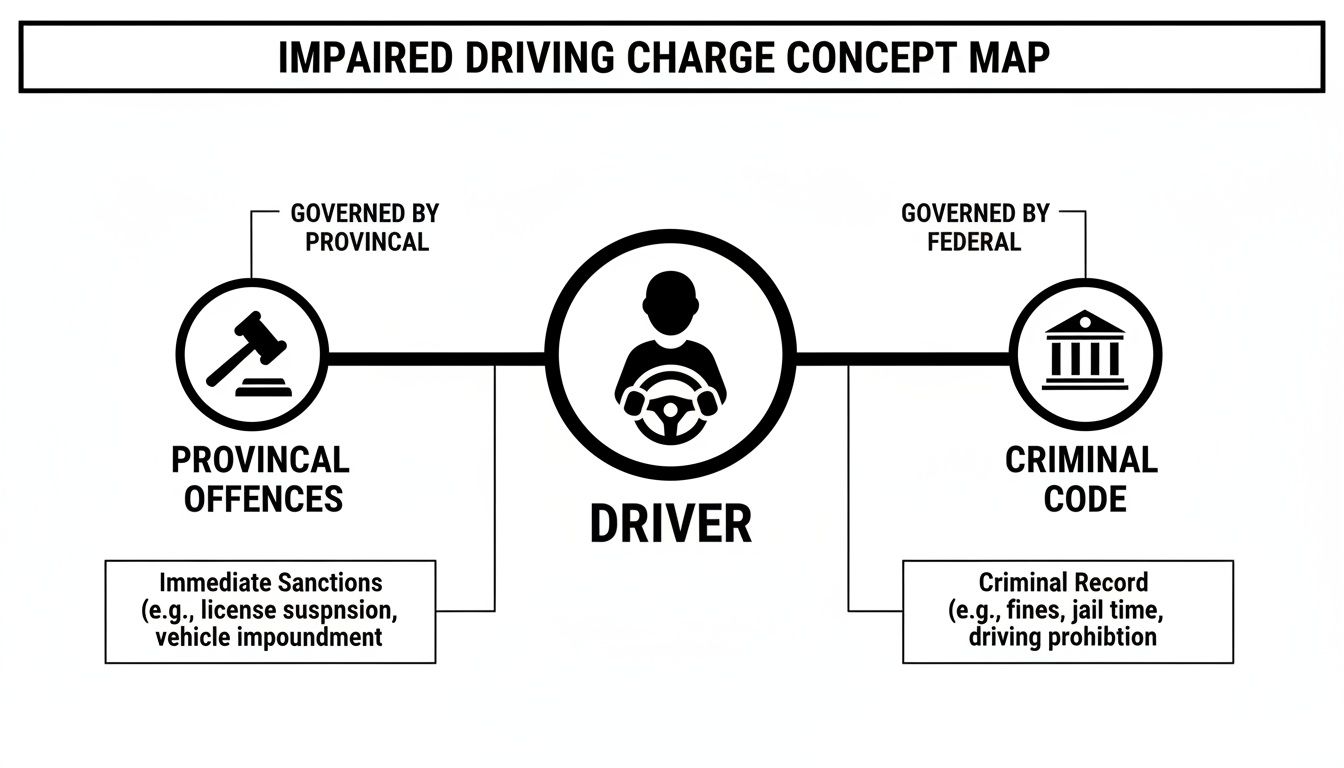
This visual makes it clear: you’re managing the immediate provincial sanctions while also needing to build a defence for the federal criminal charges coming down the pipeline.
Federal Criminal Code Consequences
The second front is the criminal charge itself. This is the part that moves through the court system and, upon conviction, carries penalties that can change your life. A criminal conviction for impaired driving, driving with an "Over 80" BAC, or refusing a breath test results in:
- A Permanent Criminal Record: This can affect your job, your ability to travel, and your immigration status.
- Mandatory Minimum Fines: Fines start at $1,000 for a first offence and climb steeply for any subsequent offences.
- Mandatory Driving Prohibitions: A conviction automatically comes with a minimum one-year driving ban across Canada.
- Potential Jail Time: While jail isn't mandatory for a standard first offence, it becomes a certainty for repeat offences, with a minimum of 30 days for a second offence.
It's crucial to understand that these criminal penalties are handed down by a judge after a conviction and are in addition to any administrative penalties you’ve already been hit with.
Provincial vs. Federal Penalties At a Glance
To make this dual-track system easier to understand, this table breaks down the key differences between the two sets of penalties you're facing.
| Penalty Type | Governing Law | When It Applies | Examples of Penalties |
|---|---|---|---|
| Provincial | Highway Traffic Act (Ontario) | Immediately, at the roadside. | 90-day licence suspension, 7-day vehicle impoundment. |
| Federal | Criminal Code of Canada | After conviction in court. | Permanent criminal record, $1,000+ fine, 1-year+ driving ban. |
Knowing how these two systems operate is vital. The distinction can also impact your legal defence, as you may need to understand the difference between a summary vs. indictable offence to fully appreciate the potential outcomes of the criminal charge.
Immediate Penalties at the Roadside
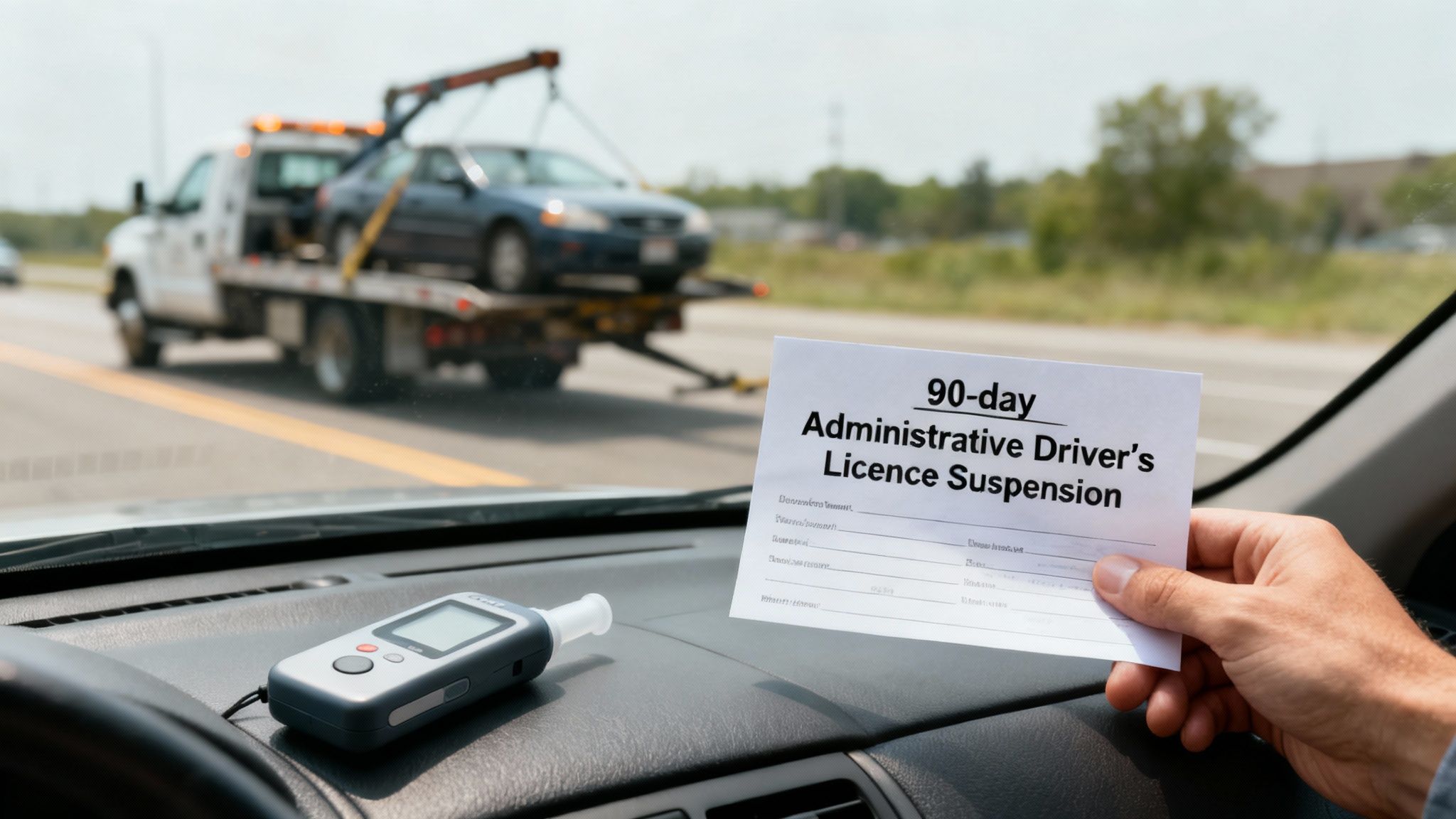
Long before you ever set foot in a courtroom, the consequences of an impaired driving stop in Ontario are already hitting hard. These immediate penalties are enforced by the province under the Highway Traffic Act, and they are completely separate from the criminal case that might come later. They are swift, automatic, and designed to get a potentially dangerous driver off the road right away.
Imagine this: one failed breath test, and suddenly you’re standing on the curb, holding a suspension notice while your car gets hooked up to a tow truck. This isn’t a hypothetical—it’s the standard, immediate reality for many people facing these charges. Understanding these roadside penalties is critical because they set the tone for the entire legal journey ahead.
The Warn Range Suspension
You don't have to be over the criminal limit of 0.08 to face serious consequences. Ontario has what’s known as the "warn range" for any driver with a Blood Alcohol Concentration (BAC) between 0.05 and 0.079. If you’re caught driving in this zone, you’re facing escalating administrative penalties right on the spot.
- First Offence: An immediate 3-day licence suspension.
- Second Offence (within 10 years): A 7-day licence suspension, plus a mandatory alcohol education program you have to pay for.
- Third and Subsequent Offences (within 10 years): A 30-day licence suspension, a mandatory alcohol treatment program, and a six-month ignition interlock requirement when you get your licence back.
These aren't up for debate. The police officer applies them automatically. It’s a stark reminder that you don’t need to be criminally impaired to lose your licence in Ontario.
Zero Tolerance for Novice and Young Drivers
For certain drivers, the rules are even tighter. Ontario has a strict zero-tolerance policy, meaning any detectable amount of alcohol or drugs in your system is illegal if you are:
- A driver aged 21 and under.
- A novice driver of any age with a G1, G2, M1, or M2 licence.
- A commercial vehicle driver.
If you fall into one of these categories, even a tiny amount of alcohol will result in an immediate 3-day licence suspension and other penalties.
These provincial sanctions are tough and immediate, demonstrating a clear commitment to road safety. For more information, you can always refer to the Government of Ontario's official page on impaired driving laws.
This strict enforcement shows just how serious the province is about holding new and young drivers to the absolute highest standard.
The 90-Day Administrative Driver’s Licence Suspension (ADLS)
This is the big one—the most severe immediate penalty. The 90-day Administrative Driver’s Licence Suspension (ADLS) is triggered automatically under two scenarios defined in both provincial policy and linked to the Criminal Code:
- Your BAC is found to be over 0.08 mg/100mL.
- You refuse or fail to comply with a police demand for a breath or fluid sample.
This suspension is non-negotiable at the roadside. The moment police have grounds, your licence is gone for three months. It also comes with a 7-day vehicle impoundment for a first offence, meaning you lose both your licence and your car on the spot.
It's crucial to understand that the ADLS is just the start. It’s the administrative penalty that runs while you begin to navigate the criminal charge, which could lead to much longer driving prohibitions. For a deeper dive into the numbers, check out our guide on the legal blood alcohol level in Ontario.
Criminal Code Penalties Upon Conviction
If the immediate roadside penalties are a sudden shock, a criminal conviction is the long-term earthquake that can permanently alter your life. The penalties handed down by a court under the Criminal Code of Canada are far more severe than those initial administrative sanctions. These are federal consequences, applying across the country, and they’re designed not just to punish but to send a clear message.
A conviction for impaired driving, driving with a BAC "Over 80," or refusing to provide a sample leaves you with a permanent criminal record. This isn't just a mark on your driving abstract; it's a formal criminal history that can impact your employment, travel, and personal freedom for the rest of your life.
The Mandatory Minimums for a First Offence
The Criminal Code sets out mandatory minimum penalties, which means a judge has no discretion to go below these baseline punishments if you're convicted. For a first-time impaired driving offence, the consequences are significant and unavoidable.
These penalties include:
- A Minimum Fine of $1,000: This is just the starting point. The fine increases based on your Blood Alcohol Concentration (BAC). A reading between 120-159 mg results in a $1,500 minimum fine, and a reading of 160 mg or higher carries a $2,000 minimum fine.
- A Minimum 1-Year Driving Prohibition: This is a Canada-wide driving ban. You cannot legally operate a motor vehicle anywhere in the country for at least 12 months.
- A Permanent Criminal Record: This is arguably the most damaging consequence. It follows you long after the fines are paid and the prohibition ends.
It’s a common and dangerous myth that first-time offenders get a simple slap on the wrist. The reality is that the law mandates these serious penalties to reflect the gravity of the offence.
Escalating Penalties for Subsequent Convictions
If you're convicted of a second or subsequent impaired driving offence, the penalties escalate dramatically. The justice system views repeat offenders as a significant public safety risk, and the punishments reflect that zero-tolerance approach.
A second conviction isn't just about higher fines; it triggers mandatory jail time. The Criminal Code requires a minimum sentence of 30 days in jail for a second offence and a minimum of 120 days in jail for a third or subsequent offence.
These aren't just possibilities—they are required sentences. The driving prohibition also gets much longer, starting at a minimum of two years for a second offence. This severe escalation is exactly why a strong defence is so critical from the very first charge.
To make this crystal clear, here’s a breakdown of the mandatory minimums you face upon conviction under the Criminal Code.
Criminal Code Minimum Penalties for Impaired Driving Convictions
This table outlines the mandatory minimum penalties upon conviction under the Criminal Code of Canada.
| Offence Number | Minimum Fine | Minimum Jail Time | Minimum Driving Prohibition |
|---|---|---|---|
| First Offence | $1,000 | None | 1 Year |
| Second Offence | N/A | 30 Days | 2 Years |
| Third+ Offence | N/A | 120 Days | 3 Years |
As you can see, the law is designed to get tougher with each conviction, leaving no room for leniency on repeat offences.
The Serious Consequences of Refusing a Breath Test
Some people mistakenly believe that refusing to provide a breath or blood sample is a clever way to avoid a conviction. This is a critical error. The Criminal Code treats a refusal with the same severity as the impaired driving offence itself.
If you are convicted of failing or refusing to comply with a demand, you will face the exact same mandatory minimum penalties as someone convicted of driving "Over 80." This includes a minimum $2,000 fine for a first offence, a criminal record, and a one-year driving prohibition. There is absolutely no legal advantage to refusing a test; it simply results in a different charge with equally harsh consequences.
A Criminal Record Is for Life
Beyond the immediate fines, jail time, and driving bans, the creation of a criminal record is a lifelong consequence. This record can create significant barriers in many areas of your life long after your sentence is served.
For some individuals, exploring options like a conditional discharge in Canada can be a crucial part of a defence strategy, as it may help avoid a formal conviction and the resulting record. However, such outcomes are never guaranteed and depend heavily on the specific facts of your case and the skill of your legal counsel.
The Reality of the Ignition Interlock Program
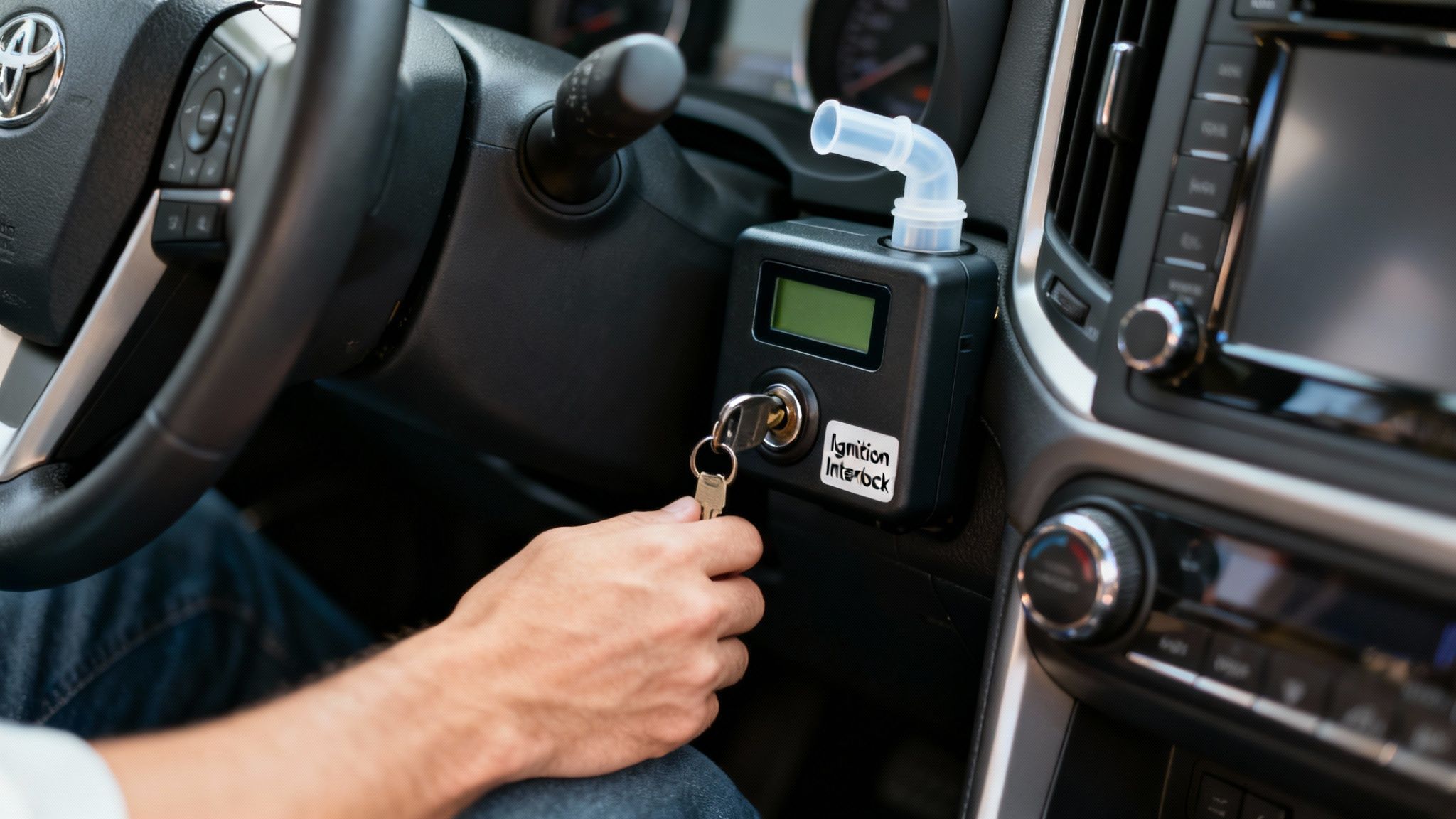
For most people convicted of an impaired driving offence in Ontario, getting back behind the wheel isn't as simple as just waiting out a driving ban. The road back to full driving privileges runs straight through the mandatory Ignition Interlock Program—one of the most significant and long-lasting impaired driving penalties Ontario imposes.
Think of the ignition interlock device as a personal breathalyzer hardwired directly into your car's ignition. Before you can even turn the key, you have to blow into the device and provide a clean breath sample. If it detects any alcohol above a very low, pre-set limit, your car simply won't start.
But it doesn't stop there. The device also demands random, rolling re-tests while you're driving. This clever feature is designed to stop someone from having a sober friend start the car for them, ensuring the person behind the wheel remains sober for the entire trip.
Who Must Install an Ignition Interlock Device?
Let's be clear: for most people convicted of an alcohol-related driving offence under the Criminal Code, this program isn't optional. You will be required to install an interlock device if you are found guilty of impaired driving, driving "Over 80," or refusing to provide a breath sample.
How long you’re stuck with the device depends on your specific charge and driving history. Ontario manages this through different program "streams":
- Stream A: This is for first-time offenders who plead guilty early. It offers a shorter absolute driving ban (minimum 3 months) in exchange for a longer interlock period (minimum 9 months).
- Stream B: This stream is for first-time offenders who don't qualify for or choose Stream A. It involves a longer driving prohibition (minimum 6 months), followed by a mandatory interlock period of at least 12 months.
- Stream D: Reserved for repeat offenders or those with more serious cases, this stream comes with much longer and more restrictive interlock requirements.
These streams are a core part of the province's strategy for managing drivers deemed high-risk and preventing them from re-offending. For a deeper look, you can learn more about the specifics of impaired driving laws in Ontario and how they apply in different scenarios.
The Financial and Personal Costs
Beyond the daily hassle, the Ignition Interlock Program is a major financial drain. The driver is on the hook for every single cost, which can easily run into the thousands of dollars over the entire term.
The financial commitment is substantial and non-negotiable. Drivers must pay for the device's installation, a monthly monitoring fee for data calibration and reporting, and finally, the cost of its removal. These fees can easily total $1,500 to $2,000 per year.
This is a penalty that sticks with you long after the court fines are paid. It’s a constant, expensive reminder of the conviction that impacts your budget and your daily life. And if you fail to follow the rules—like missing a re-test or blowing a "fail"—you could face program extensions or even get kicked out entirely, sending you right back to a full licence suspension.
Life Beyond the Courtroom: The Hidden Consequences
The penalties a judge hands down in court are just the beginning. An impaired driving conviction sends shockwaves through every part of your life, creating problems that stick around long after you’ve paid the fines and served the driving ban. People often overlook these "collateral consequences," but they can be the most damaging part of a conviction.
The true cost of an impaired driving charge isn’t just about the money. It’s measured in slammed doors, lost opportunities, and a frustrating loss of personal freedom. If you’re facing a charge, you need to understand just how high the stakes really are.
Skyrocketing Insurance Premiums
One of the first and most painful financial hits will come from your insurance company. Once you have a conviction, you're no longer a standard driver. You’re officially labelled as high-risk, and that label follows you for years, with an immediate and brutal financial impact.
To an insurer, an impaired driving conviction is a massive red flag. Your annual premiums can easily triple, quadruple, or even jump by more than 500%. In some situations, insurance companies will flat-out refuse to cover you at all, making it impossible to get back on the road legally. And this isn't a short-term problem; you can expect to pay these punishing rates for three to six years after you get your licence back.
A single impaired driving conviction can turn an affordable $2,000 annual insurance policy into an overwhelming $10,000 bill. This financial burden makes legal driving an impossibility for many people, even after their court-ordered prohibition is over.
This one consequence can completely derail your finances, forcing you to rely on public transit or even sell your vehicle because the insurance is simply unaffordable.
Professional and Employment Fallout
A criminal record for impaired driving can be a career killer. More and more employers now run criminal background checks as a standard part of their hiring process. A conviction can get you automatically disqualified from jobs, especially roles that:
- Require any amount of driving: Think sales reps, delivery drivers, tradespeople, and anyone in transportation.
- Involve company vehicles: You'll almost certainly be considered uninsurable under the company's fleet policy.
- Demand a professional licence: Fields like nursing, real estate, and finance often have character requirements that a criminal record violates.
- Need security clearance: Forget about many government jobs or private sector roles that require a clean record.
The stigma can also affect the job you already have. If driving is an essential part of your duties, you could be terminated. This professional fallout doesn't just hurt now—it can limit your earning potential for the rest of your life. It’s one of the main reasons why understanding all your legal options, like the difference between careless driving demerit points in Ontario and a criminal conviction, is so critical.
Immigration and Travel Restrictions
The consequences don't stop at the Canadian border. For anyone who isn't a citizen, including permanent residents, an impaired driving conviction is classified as serious criminality and can trigger devastating immigration issues. A conviction could lead to:
- Inadmissibility to Canada: This could prevent you from re-entering the country if you travel.
- Denial of citizenship applications: Your journey to becoming a Canadian citizen could come to a halt.
- Deportation: In the most severe cases, a conviction can start removal proceedings.
Even simple cross-border travel becomes a major problem. The United States, for example, is notoriously strict and frequently denies entry to anyone with an impaired driving conviction on their record. That weekend getaway or family vacation can become impossible, with the risk of being turned away at the border without any warning. This loss of mobility is a significant—and often permanent—restriction on your freedom.
Your First Steps After Being Charged
The moments after you’ve been charged with impaired driving are a blur of confusion and stress. But what you do right now is absolutely critical. Your next few moves can set the stage for your entire defence, shaping everything that comes after.
The most important thing to do is exercise your right to remain silent and call an experienced criminal defence lawyer. Don't wait. You've already given the police the information they need at the roadside; saying anything more without legal advice is a huge risk that almost never helps.
Understanding the Bail Process
After you're charged, police will either release you from the station with a court date or hold you for a bail hearing. This is your first real legal hurdle, and you need a lawyer to argue for your release on fair terms so you can go home while your case moves through the system. They’ll also make sure you understand any conditions you have to follow, like not driving or staying away from alcohol.
Remember, everything you say to the police can be used against you. Your first and most crucial action is to state that you wish to speak with your lawyer. This single step protects your rights more than any other.
Analyzing the Crown's Evidence
Once you hire a lawyer, their first job is to get their hands on the disclosure—every piece of evidence the Crown plans to use against you. This isn’t just a simple police summary; it’s the entire case file, and it contains everything.
- Police Officer Notes: This is the officer’s detailed story of the traffic stop, what they claim to have observed about you, and how the arrest went down.
- Breathalyzer Records: These are the technical logs for the breath machine, including the readings it produced and its history of calibration and maintenance.
- Video Footage: Dash-cam or body-cam video can be a game-changer. It either backs up what the police said or completely contradicts it.
A skilled lawyer doesn't just read this file; they tear it apart. They’re hunting for procedural mistakes, technical errors, and any violations of your rights under the Canadian Charter of Rights and Freedoms. Was the traffic stop even legal? Did the police inform you of your right to a lawyer right away? Was the demand for a breath sample made correctly?
Finding these errors is often the key to beating the serious impaired driving penalties Ontario imposes. A strong challenge can get evidence thrown out of court or even convince the Crown to withdraw the charges entirely. This in-depth analysis is your first line of defence.
Common Questions About Impaired Driving Penalties
When you’re facing an impaired driving charge in Ontario, a flood of questions and worries is completely normal. The legal system is complicated, and the consequences are serious. Below, I’ve answered some of the most urgent questions people have when they find themselves in this difficult spot.
Think of this as a starting point. While these answers give you a general lay of the land, every case is unique. Getting a handle on these basics is the first step toward building a real defence against the tough impaired driving penalties in Ontario.
Can I Refuse a Roadside Breath Test in Ontario?
No. Under Canada's mandatory alcohol screening laws, you are legally required to provide a breath sample when a police officer demands one. Refusing to blow into the device is a criminal offence in itself, and the penalties are just as severe—sometimes even more so—than an actual impaired driving conviction.
If you refuse, you’re looking at a minimum $2,000 fine for a first offence, a driving prohibition, and a permanent criminal record. The law is written this way to stop people from sidestepping a charge by simply not cooperating. Your legal obligation is to provide the sample, and your very next step should be to call a defence lawyer to protect your rights.
Do First-Time DUI Offenders Go to Jail in Ontario?
For a standard, first-time impaired driving conviction without any aggravating factors—like an accident that caused an injury—jail time is not mandatory. The Criminal Code sets out a minimum penalty of a $1,000 fine.
However, a judge always has the final say. They can absolutely impose a jail sentence if the facts of your case are more serious, such as having a very high blood alcohol reading or driving dangerously. The situation changes dramatically for repeat offences. A second conviction comes with a mandatory 30-day jail sentence, and a third means at least 120 days behind bars.
How Long Does a DUI Stay On Your Record?
A conviction for impaired driving leaves you with a permanent criminal record. It doesn’t fade or expire over time and is stored in the national CPIC police database for good.
You may eventually be able to apply for a record suspension (what used to be called a pardon), but only after your entire sentence is complete. This includes finishing your driving ban and any probation. The waiting period is five years for a summary conviction and ten years for an indictable one.
What Is the Difference Between Impaired Driving and Over 80?
These are two distinct criminal charges, and it’s common to be charged with both.
- Impaired Driving: This charge is all about observation. The Crown proves it with evidence from the police officer that your ability to drive was impaired by alcohol or a drug. This could be anything from erratic driving and slurred speech to fumbling with your documents or failing a roadside sobriety test.
- Over 80: This is a purely technical, scientific charge. It means a breathalyzer test showed your blood alcohol concentration (BAC) was over 80 mg of alcohol in 100 ml of blood within two hours of driving.
You can be convicted of being impaired even if your breath readings are under the legal limit. The officer’s observations alone can be enough to secure a conviction.
If you are facing these charges, the potential penalties for impaired driving in Ontario are too severe to navigate alone. At Badesha Law, we provide a strategic, confidential legal defence to protect your rights, your record, and your future. Contact us for a free consultation to understand your options.
No comment