


Being charged with impaired driving in Brampton is a jarring experience. One moment you’re driving, the next you’re facing a process that puts your licence, your finances, and even your freedom on the line. If you are looking for a DUI lawyer Brampton, this guide will cut through the legal jargon and give you a clear, straightforward explanation of what you’re up against and how we can help.
At Badesha Law, a criminal defence law firm in Brampton, we understand the stress and uncertainty you are feeling. Our first job is to clear the fog, explain the impaired driving laws in Ontario, and show you the path forward. This guide will cover the types of charges you might face, the court process in Peel Region, potential penalties, and how a strong defence is built.
Understanding the Three Main Types of DUI Offences

When you’re facing a drunk driving charge in Ontario, it’s crucial to understand that it’s not just one single offence. The Criminal Code of Canada actually sets out three distinct charges. Each one is built on different evidence, which means the Crown prosecutor has to prove its case in a completely different way for each.
Understanding which charge you’re facing is the very first step in building a smart defence. At Badesha Law, we’ve successfully defended clients in Brampton against every type of impaired driving charge. We know precisely where to look for weaknesses in the prosecution’s case, whether it’s based on a police officer’s opinion, a machine’s reading, or the legality of a police demand.
Offence 1: Impaired Operation
Think of Impaired Operation as the most subjective of the three charges. This one isn’t about numbers on a machine; it’s all about your ability to drive. To secure a conviction, the Crown must prove beyond a reasonable doubt that your capacity to operate a vehicle was impaired by alcohol or drugs, even to a “slight degree.” The evidence here almost always comes down to the police officer’s observations:
- Driving Pattern: Weaving, erratic braking, or inconsistent speed.
- Physical Signs: Smell of alcohol, slurred speech, or red eyes.
- Coordination: Fumbling for documents or poor performance on sobriety tests.
Because this is based on an officer’s perception, a strong defence often means challenging those very perceptions. A Brampton criminal defence lawyer at Badesha Law will dig into police notes to find inconsistencies that can create reasonable doubt.
Offence 2: Over 80 (Exceeding the Legal Limit)
This is the charge most people have heard of: Operation While “Over 80.” Where the first offence is subjective, this one is all about science. The Crown’s case hinges entirely on the reading from an approved breathalyzer or blood test. The rule is simple: it is a criminal offence to have a Blood Alcohol Concentration (BAC) of 80 milligrams of alcohol or more in 100 millilitres of blood within two hours of driving. You can learn more about the legal blood alcohol level in Ontario.
The key takeaway is that you can be convicted of an “Over 80” charge even if your driving was perfect. The number is all that matters to the Crown.
Fighting an “Over 80” requires a technical defence. Our lawyers meticulously review the breathalyzer’s maintenance logs, question police procedures, and look for any violations of your Charter rights during the testing process.
Offence 3: Refusal to Comply
The third charge, Failure or Refusal to Comply with a Demand, is unique. Here, the Crown doesn’t have to prove you were impaired or over the legal limit at all. This charge comes into play when a driver, without a valid reason, refuses to provide a breath or fluid sample after a lawful police demand.
The penalties for a refusal conviction are exactly the same as for impaired driving—a criminal record, a minimum fine, and a driving prohibition. A defence often focuses on whether the police demand was lawful to begin with, or if you had a “reasonable excuse” for not being able to provide a sample.
The Severe Penalties and Consequences in Ontario
Let’s be clear: a conviction for impaired driving in Ontario is a life-changing event. The consequences start immediately and ripple through your life for years, affecting your freedom, finances, and ability to drive. The penalties kick in the moment you’re charged, long before you see the inside of a courtroom.
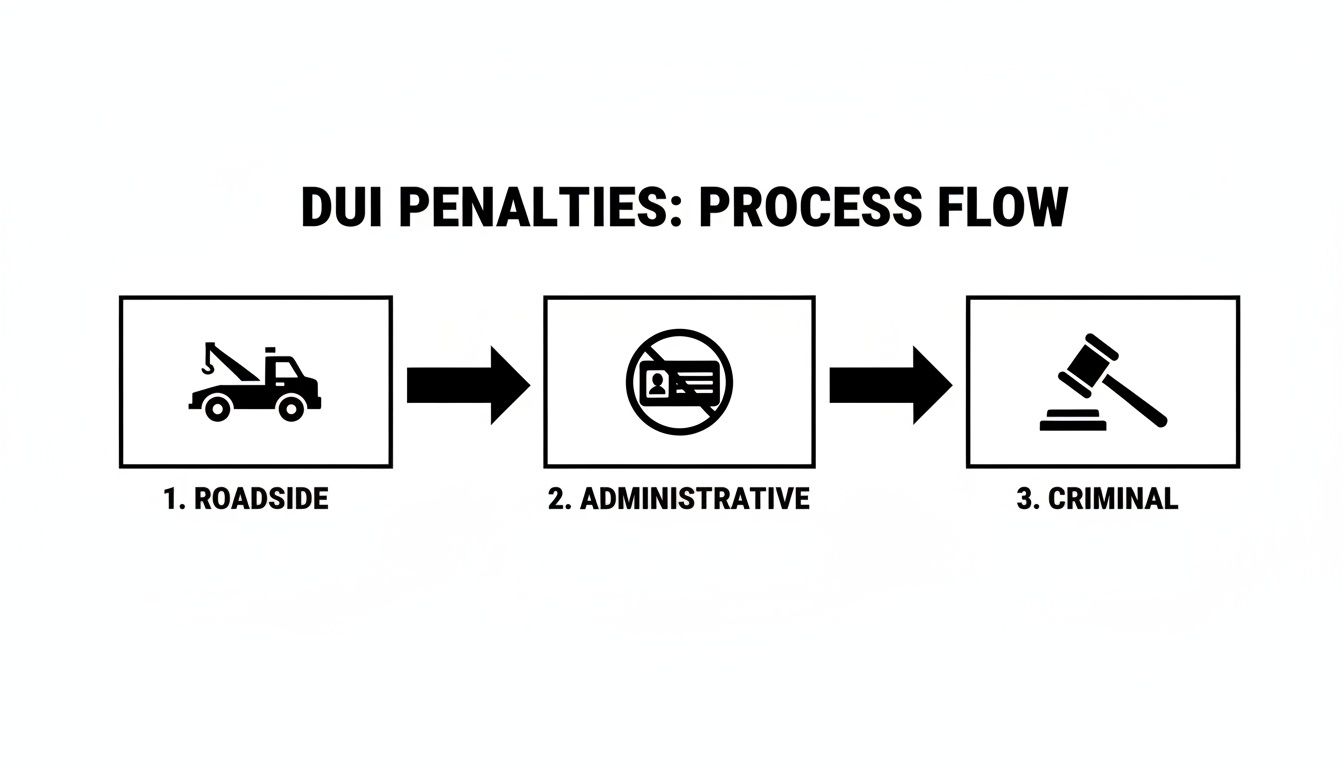
Immediately upon being charged, you face administrative penalties from the Ministry of Transportation:
- An immediate 90-day Administrative Driver’s Licence Suspension (ADLS).
- A seven-day vehicle impoundment.
- A $550 administrative monetary penalty.
This all happens on the spot, completely separate from the criminal charges that follow.
Criminal Penalties for a DUI Conviction
If you are convicted in criminal court, the situation gets much more serious. The Criminal Code lays out mandatory minimum sentences that judges must impose.
| Offence | Mandatory Minimum Fine | Mandatory Minimum Jail Time | Mandatory Driving Prohibition |
|---|---|---|---|
| First Offence | $1,000 | None | 1 year |
| Second Offence | None | 30 days | 2 years |
| Third & Subsequent | None | 120 days | 3 years |
These are just starting points. A judge can order higher fines, longer jail terms, and extended driving bans, especially if there are aggravating factors like an accident or a high BAC reading. On top of all that, a conviction leaves you with a permanent criminal record, which can be a major roadblock for jobs, international travel, and immigration.
The Long Road Back to Driving
Getting your licence back after a conviction is a long, complicated, and expensive journey. In Ontario, you will be required to:
- Complete the ‘Back on Track’ Program: A mandatory remedial course costing over $600.
- Install an Ignition Interlock Device: You must have a device installed in your car for at least a year, which makes you provide a breath sample before the engine will start. This can easily cost over $1,500 a year.
Unfortunately, impaired driving remains a major problem. A recent study revealed a significant increase in incidents across the GTHA, including Peel Region. You can learn more about the rise in GTHA impaired driving incidents. Given how much is at stake, it’s crucial to explore every legal option. At Badesha Law, we often negotiate for outcomes that avoid a criminal record, such as a plea to a non-criminal traffic offence. In some cases, a discharge may be possible; you can read our guide on what a conditional discharge is in Canada to understand that outcome.
Navigating the Brampton DUI Court Process
Walking into the A. Grenville and William Davis Courthouse for a DUI charge is intimidating. This section will walk you through the entire court journey, from arrest to a potential trial. With a seasoned DUI lawyer in Brampton from Badesha Law, you won’t face it alone.
The First Stages: Arrest and Release
Your journey through the court system begins when you’re arrested. After breath testing, police will either release you with a promise to appear in court or hold you for a bail hearing. Being held is more likely if your case involves aggravating factors or if you have a prior criminal record. A bail hearing is a critical first step where a Justice of the Peace decides if you can be released while the charges are dealt with. To understand this vital process, read our guide on what happens at a bail hearing.
First Appearance and Getting the Evidence (Disclosure)
Your First Appearance at the Brampton courthouse is mostly administrative. This is when your lawyer formally appears to receive the evidence the Crown intends to use against you, known as “disclosure.” This package includes the officer’s report, witness statements, and the official certificate stating your BAC readings. This is when our real work at Badesha Law begins, as we comb through every page looking for errors and defence opportunities.
Crown Pre-Trial: The Negotiation Stage
Once we’ve analyzed the disclosure, we schedule a Crown Pre-Trial. This is a closed-door meeting between your lawyer and the Crown Attorney. We use this time to highlight legal problems we’ve found and open negotiations.
Can the charges be withdrawn? Is the Crown willing to accept a plea to a non-criminal offence, like a careless driving ticket? This is where an experienced lawyer’s reputation and familiarity with the Peel Region Crown’s office pays dividends.
A surprising number of DUI cases in Ontario are resolved at this stage, long before a trial is considered.
Judicial Pre-Trial and Setting a Trial Date
If talks with the Crown don’t lead to a resolution, the next step is a Judicial Pre-Trial (JPT). This is a more formal meeting in a judge’s chambers where a judge helps mediate. If no resolution is reached, your case is set for trial. We pick a date, estimate how long the trial will take, and prepare to fight the charges in court. The entire process can take months, and having a lawyer from Badesha Law ensures your rights are protected every step of the way.
How We Build a Winning DUI Defence Strategy in Brampton

Facing an impaired driving charge can feel hopeless, but it is not. A Crown’s case might look strong, but a strategic analysis often reveals critical weaknesses. At Badesha Law, we systematically take the case apart to find the flaws that can lead to a successful outcome in the Brampton courts.
Challenging the Initial Traffic Stop
It all starts with the stop. Police must have a lawful reason to pull you over; they cannot stop you on a whim. This is a fundamental protection under Canadian law. We ask the tough questions:
- Did the officer witness a legitimate traffic violation?
- Was the stop based on a vague or unconfirmed tip?
- Can the officer’s notes justify the decision to stop your vehicle?
If the initial stop was unlawful, any evidence gathered after—including breath samples—can be thrown out of court, often leading to the entire case being dismissed.
Scrutinizing Charter Rights Violations
The Canadian Charter of Rights and Freedoms protects you during a criminal investigation. A major focus is your right to counsel under Section 10(b). This guarantees you the right to speak with a lawyer without delay after an arrest. We comb through police records to ensure this right was fully respected.
Were you told about your right to a lawyer immediately? Were you given a real, private opportunity to contact one? Any failure by the police here is a serious breach and can lead to the breathalyzer evidence being excluded.
We also challenge whether the police had the necessary “reasonable and probable grounds” to arrest you and demand breath tests.
Technical and Scientific Defences
For an “Over 80” charge, the Crown’s case is built on machine readings. This opens up a wide range of technical defence opportunities that an experienced DUI lawyer in Brampton knows how to use. We investigate every aspect of the breath testing process:
- Maintenance and Calibration: Was the breathalyzer properly maintained? We demand the service records.
- Operational Errors: Did the technician follow exact procedures? Even a small deviation can make the results inadmissible.
- Timing of Tests: The law is specific about when samples must be taken. Any slip-up can invalidate the evidence.
This detailed approach often uncovers errors needed to create reasonable doubt. While Ontario’s laws are strict, court outcomes are often better than people expect. In 2022/2023, 62% of DUI cases in Ontario courts ended in withdrawals or dismissals. You can discover more insights about these DUI case outcomes and see how often a strong defence makes a difference.
FAQ: Common Questions for a Brampton DUI Lawyer
Will I go to jail for a first DUI in Ontario?
For a typical first-time impaired driving charge without aggravating factors (like an accident causing injury), jail time is not a mandatory minimum sentence. The usual penalties include a significant fine, a one-year driving prohibition, and completion of the ‘Back on Track’ program. However, a skilled Brampton criminal defence lawyer will always fight to avoid a conviction altogether. For legal advice on your specific case, contact Badesha Law.
What happens if I refuse a breathalyzer test in Brampton?
Refusing to provide a breath sample is a separate criminal offence called ‘Failure or Refusal to Comply.’ The penalties are just as severe as an impaired driving conviction. The Crown only needs to prove that the police made a lawful demand and that you refused without a reasonable excuse. It is almost always better to provide the sample and then immediately contact a lawyer who can later challenge the legality of the police demand.
How long does a DUI stay on your record in Ontario?
A conviction for impaired driving results in a permanent criminal record. It does not automatically disappear after a few years. While you may be able to apply for a record suspension (formerly a pardon) after completing your sentence and a waiting period, the conviction itself is never truly erased. This is why it is so critical to hire an experienced lawyer to fight for an outcome that avoids a criminal record from the start.
Conclusion: Get the Right Legal Advice for Your DUI Charge
Navigating Ontario’s impaired driving laws on your own is a risk you cannot afford to take. A conviction carries life-altering consequences, including a criminal record, licence suspension, and significant financial costs. An experienced DUI lawyer Brampton from Badesha Law will analyze every detail of your case, protect your rights, and build the strongest possible defence.
If you have been charged with impaired driving in Brampton or Peel Region, do not wait. Contact Badesha Law today to schedule a free consultation with a criminal lawyer in Brampton. Let us help you protect your future.
https://criminallawyerinbrampton.com
No comment