


A conditional discharge is a unique sentencing outcome under Canadian criminal law where a judge finds you guilty of an offence but agrees not to register a formal criminal conviction. Instead, you’re given a set of court-ordered rules to follow for a specific time, much like probation. If you stick to the plan and complete the probation period successfully, you get to walk away without a permanent criminal record for that charge.
Understanding the Basics of a Conditional Discharge
Think of it like being put on a performance plan at a new job after making a mistake. Instead of firing you on the spot (a conviction), your boss recognizes the circumstances and gives you six months to prove yourself (the probation period). Meet the expectations, and the mistake is essentially wiped from your employee file. A conditional discharge works in a similar way within the Canadian justice system.
It’s absolutely critical to understand that a discharge is not an acquittal or a finding of innocence. The court has still found you guilty of the offence. However, it’s a special sentencing tool used when the circumstances of the case don’t warrant the lifelong consequences that come with a criminal record.
When looking at your case, an experienced criminal lawyer Brampton residents rely on can assess whether pushing for a discharge is a realistic and strategic move.
Discharges Versus Convictions
The single biggest benefit of a discharge is avoiding that formal, registered conviction. This is a massive distinction that can change the entire trajectory of your future. To really grasp what’s on the line, it helps to compare the different outcomes you could face after a finding of guilt. You can get a better sense of the court process by reviewing what to expect when charged in Brampton, Ontario.
A conditional discharge is a sentencing option available under section 730(1) of the Criminal Code of Canada, but it’s an exceptionally rare outcome. In fact, fewer than 1% of guilty findings in federal cases result in either an absolute or conditional discharge. Its rarity underscores just how strict the criteria are for a judge to grant this kind of sentence.
This outcome is almost always the result of skilled negotiation by a defence lawyer who knows how to present your case in the most compelling light.
Sentencing Outcomes At a Glance
To make the differences crystal clear, let’s break down the three main sentencing outcomes you might face after a finding of guilt.
| Outcome | Finding of Guilt | Criminal Conviction Registered | Probation Period | Impact on Criminal Record |
|---|---|---|---|---|
| Conditional Discharge | Yes | No | Yes | Your record is sealed 3 years after the probation period ends. |
| Absolute Discharge | Yes | No | No | Your record is sealed after just 1 year. |
| Criminal Conviction | Yes | Yes | Possible | A permanent record is created (a pardon may be possible later). |
As you can see, the path a discharge offers is profoundly different from that of a standard conviction, protecting your ability to find work, travel, and move forward with your life.
Conditional Discharge Versus an Absolute Discharge
When people talk about sentencing outcomes that let you avoid a criminal conviction, you’ll often hear two terms thrown around: “conditional discharge” and “absolute discharge.” They sound almost the same, but the difference between them is huge and comes down to one critical word: probation.
Getting this distinction right is vital because it directly impacts your responsibilities and how long it takes to clear your name.
At its simplest, an absolute discharge is a finding of guilt without any strings attached. It’s immediate. The moment the judge grants it, your case is over. You walk out of the courtroom with no probation order to follow and no conditions to meet.
A conditional discharge, on the other hand, is exactly what it sounds like—a discharge with conditions. The judge finds you guilty but then puts you on probation for a set period, which can be up to three years. Think of it as a test period where you have to prove that the court’s decision to give you a break was the right one.
The Role of Probation Conditions
That word “conditional” refers directly to the terms of your probation. A probation order isn’t just a list of suggestions; it’s a legally binding court order. If you fail to follow even one of the conditions, you can face a new criminal charge for the breach, and the court could revoke the discharge, leaving you with a formal conviction for the original offence.
Common conditions a court in Brampton might impose include:
- Reporting to a Probation Officer: Checking in regularly with a probation officer in your local area.
- Community Service: Completing a set number of volunteer hours.
- Counselling or Treatment: Attending programs for anger management, substance abuse, or other issues relevant to your case.
- Restitution: Paying back anyone who suffered financial loss because of your actions.
- No-Contact Orders: A strict rule not to communicate with certain people, like the complainant in your case.
A skilled criminal lawyer Brampton will fight to make sure any probation terms are fair, reasonable, and don’t set you up to fail based on your life circumstances.
Impact on Your Criminal Record
The biggest long-term difference between these two outcomes is how long they stick around on your record. This timeline affects everything from background checks for a new job to your ability to cross the border. It’s a crucial factor that a lawyer thinks about from the very first meeting.
An absolute discharge is purged from your record after just one year.
A conditional discharge, however, stays on your record for three years after you successfully complete your probation period. So, if you get a one-year probation term, the discharge won’t be purged until four years have passed (one year of probation + three years of waiting).
Key Takeaway: An absolute discharge is cleared from your record after one year. A conditional discharge is cleared three years after your probation period successfully ends.
That difference of several years can have a massive impact on your life and career. To get a better sense of the more immediate option, you might want to read our detailed explanation of what an absolute discharge is in Canada. Deciding which outcome to aim for is a strategic choice you and your lawyer will make, carefully balancing the facts of your case with your goals for the future.
Who Qualifies for a Conditional Discharge in Canada
Not everyone facing a criminal charge is eligible for this kind of second chance. Securing a conditional discharge isn’t a matter of luck; it’s a specific legal outcome a judge must carefully weigh based on strict criteria from the Criminal Code of Canada. The court’s job is to balance giving an individual a fresh start with upholding the safety and values of the community.
Right off the bat, there are some hard-and-fast rules that take a discharge off the table. The Criminal Code is very clear on this. If an offence comes with a mandatory minimum sentence (like a DUI, for instance), a discharge is simply not an option. The same goes for the most serious crimes—those with a maximum penalty of 14 years or life imprisonment. For those offences, a discharge cannot be granted.
The Two-Part Legal Test
Once you’re past those initial barriers, the court moves on to a critical two-part test, straight from Section 730 of the Criminal Code of Canada. For a judge to grant a conditional discharge, they must be convinced that it is both:
- In the best interests of the accused.
- Not contrary to the public interest.
This legal phrasing can sound a bit vague, but in reality, it gives a judge a framework to look at the whole picture. They don’t just look at the crime; they look at the person who committed it. A skilled criminal lawyer Brampton residents rely on will build a case that speaks directly to these two points.
This flowchart shows the basic decision-making path a judge follows after a finding of guilt, leading to either an outcome with conditions or one without.
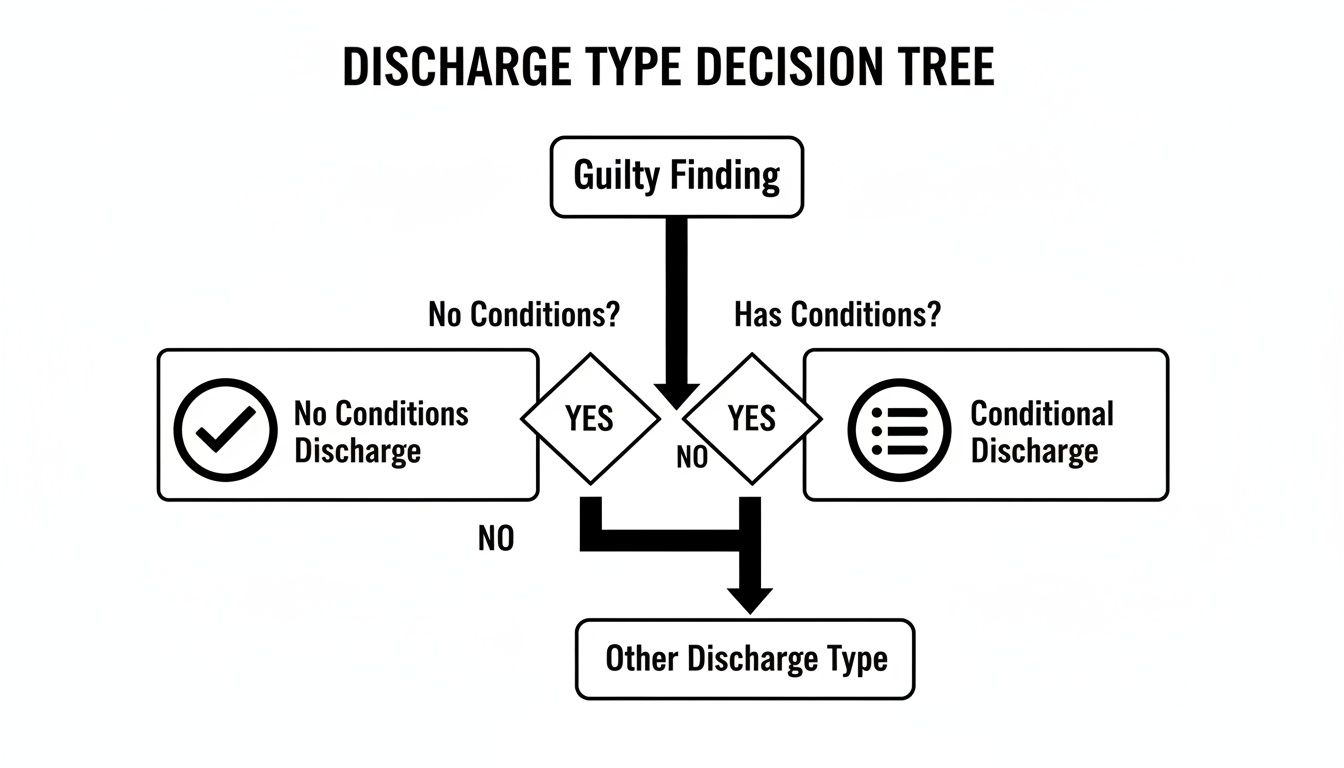
As the visual shows, the key difference between a conditional discharge and its counterpart, an absolute discharge, is the presence of court-ordered conditions you must follow.
Breaking Down the Best Interests Test
So, what does “in the best interests of the accused” really mean? It’s all about preventing a single mistake from causing life-altering and disproportionate harm. A judge will look at your unique situation and consider the real-world consequences a permanent criminal conviction would have on your life.
Factors the court considers here include:
- Your Character and Background: Are you a first-time offender? Do you have strong roots in the community? Things like letters of support can be incredibly powerful here.
- Employment: Will a conviction get you fired or prevent you from ever working in your chosen field?
- Immigration Status: For anyone who isn’t a Canadian citizen, a criminal conviction can trigger deportation proceedings. A discharge can prevent this devastating outcome.
- Travel: Will a criminal record stop you from crossing the border for work, family, or personal reasons?
Think about a young person charged with a minor theft under $5000 who is in school to become a nurse. A conviction would be a massive roadblock to their career. A lawyer would argue that a discharge is clearly in their best interest, allowing them to finish their studies and contribute to society as planned.
What Is the Public Interest
The second half of the test asks whether granting a discharge would go against the public interest. This is where the court zooms out to consider the community’s perspective. A judge needs to be satisfied that giving you a discharge won’t diminish the seriousness of the offence or send the wrong message to society.
The court must weigh the need for deterrence and denunciation against the rehabilitative goals of sentencing. In essence, will the public’s faith in the justice system be maintained if a person is found guilty but not convicted?
To make this call, a judge will assess:
- The Nature of the Offence: Was this a minor, isolated incident, or was there significant harm or violence? A simple assault that stems from a momentary lapse in judgment is seen very differently than a planned, malicious act.
- Your Level of Responsibility: Have you shown genuine remorse? Have you taken steps to make things right, like paying for damages or going to counselling?
- Need for Deterrence: Is a formal conviction actually necessary to stop you—and others—from doing something similar in the future?
Successfully arguing these points is a complex task. It takes a lot more than just showing up to court; it requires a well-thought-out strategy. For more details on how offences are categorized, you can learn more about summary vs indictable offences in our article. Ultimately, your lawyer’s job is to present a complete narrative that convinces the judge that giving you a second chance is the right and just decision for everyone involved.
How a Conditional Discharge Impacts Your Life
Getting a conditional discharge can feel like a massive weight has been lifted. While it’s an excellent outcome that helps you avoid a permanent criminal conviction, it’s not a magic wand that instantly erases everything. It’s a legal tool with specific rules and timelines, and you need to understand how it can still affect your life for a period of time.
The most common questions we hear from clients in Brampton are about the real-world stuff: jobs, travel, and background checks. Knowing the answers upfront helps you plan your future and sidestep any nasty surprises down the road.
Criminal Record Checks and Employment
One of the most immediate concerns is how a discharge shows up on background checks. Even though a conditional discharge is not a conviction, the court’s finding of guilt is recorded in the RCMP’s national database, the Canadian Police Information Centre (CPIC). This record stays active for three years after your probation ends.
For a specific window of time, the discharge can still appear. Here’s how that usually plays out:
- Standard Criminal Record Check: For most jobs, a basic check is only looking for convictions. Since a discharge isn’t a conviction, it will likely not show up on this type of search.
- Vulnerable Sector Check (VSC): This is a much deeper check needed for jobs or volunteer roles where you’d be in a position of trust with children or vulnerable adults. A conditional discharge is very likely to be disclosed on a VSC while it’s still active in the CPIC database.
If you’re applying for a job that requires a VSC, you absolutely must be prepared for this possibility. An experienced criminal lawyer Brampton residents trust can give you practical advice on how to handle these conversations and what you are obligated to disclose.
Travel and Crossing the US Border
This is where things get particularly tricky. While Canada sees a discharge as a non-conviction, the United States plays by a different set of rules. U.S. immigration law often doesn’t recognize the distinction between a discharge and a conviction.
When you try to cross the border, U.S. Customs and Border Protection (CBP) officers can access the CPIC database. They see the original charge and the finding of guilt. This can be enough for them to deny you entry, especially for offences they consider “crimes of moral turpitude,” like theft or fraud.
Important Reality: Many Canadians with a discharged offence have experienced being “allowed to withdraw their application for entry” at the border. This is a polite way of saying you’ve been denied entry, and it creates a permanent flag in the U.S. system. Future travel becomes even more complicated without legal help, like getting a U.S. Entry Waiver.
Because the U.S. system takes any finding of guilt so seriously, you could be deemed inadmissible even long after your record is sealed in Canada. It’s a frustrating reality that highlights how important it is to have a strong defence from the very beginning. Often, the best strategy is to avoid a finding of guilt altogether by getting the charges withdrawn, perhaps in exchange for a peace bond. To understand this alternative, learn more about what a peace bond is in Canada in our article.
Ultimately, a conditional discharge offers huge benefits by preventing a lifelong criminal record in Canada. But it’s not a complete erasure of the past. Understanding its temporary limits on background checks and its permanent potential impact on U.S. travel is key to moving forward successfully. Your best protection is consulting with a lawyer who understands both the immediate court process and these long-term consequences.
The Legal Strategy for Securing a Conditional Discharge
Getting a conditional discharge isn’t a stroke of luck—it’s the direct result of a carefully planned legal strategy. This kind of favourable outcome is earned through meticulous preparation, skilled negotiation, and persuasive arguments in court. For anyone wondering “what is conditional discharge in Canada,” understanding the strategic work involved is key to appreciating its value.
This process is a marathon, not a sprint, and it starts long before you ever see a judge for sentencing. An experienced criminal lawyer Brampton residents trust will begin laying the groundwork from your very first conversation.

Often, the first crucial step is the bail hearing. A skilled lawyer, such as a dedicated bail hearing lawyer, does more than just secure your release; they start building a positive narrative right away. By presenting you as a responsible person with strong community ties who can be trusted to follow court orders, they create an initial impression that can influence how your entire case is viewed down the line.
Building a Compelling Case for a Discharge
With bail secured, the strategy shifts to building a powerful case for leniency. This isn’t about fighting the facts of the case. Instead, it’s about painting a complete and humanizing picture of who you are as a person.
Your lawyer will gather a wide range of materials to tell your story, including:
- Letters of Reference: Testimonials from employers, community leaders, family, and friends that speak to your good character.
- Proof of Rehabilitation: Evidence showing you’ve taken proactive steps, like attending counselling, finishing a treatment program, or paying back any damages.
- Personal Circumstances: Documents that detail how a criminal conviction would cause you disproportionate harm, affecting your job, education, or immigration status.
This collection of evidence gives the Crown prosecutor and the judge a full picture, showing that the offence was an out-of-character mistake, not a reflection of who you truly are.
Negotiation with the Crown Prosecutor
The next critical stage is negotiating with the Crown. In the Canadian justice system, most cases are resolved through discussions between the defence and the prosecution. Your lawyer will present all the mitigating factors they have gathered, aiming to convince the Crown that a discharge is not only fair to you but is also in the public’s best interest.
The goal is to reach a “joint submission”—an agreement where both the defence and the Crown ask the judge for a conditional discharge. While a judge isn’t bound by this agreement, joint submissions carry significant weight and are accepted by the court in the vast majority of cases.
This negotiation is a delicate art. It demands a deep understanding of the law, strong professional relationships with the local Crown’s office in Brampton, and the ability to present your story persuasively.
The Role of the Guilty Plea and Sentencing Submissions
To receive any type of discharge, you must first accept responsibility by entering a guilty plea. This is a necessary step, as a discharge is a form of sentence, and sentencing only happens after a finding of guilt. Your lawyer will make sure you fully understand the consequences of this plea before it is entered.
Finally, your lawyer prepares and delivers sentencing submissions to the judge. This is their chance to formally argue why a conditional discharge is the most appropriate outcome. They will weave together all the evidence—your background, your remorse, your efforts to make things right—into a compelling oral argument that directly addresses the legal tests for granting a discharge.
Sticking to your discharge conditions is paramount. While discharges are a type of sentence, the importance of following court orders is seen across the justice system. For example, in the parole system, 85% of individuals whose full parole was revoked in 2022-23 were sent back to custody for breaching a condition, not for a new crime. This statistic shows just how seriously any breach is taken. To get a clearer picture of these statistics, you can explore the 2022-2023 performance monitoring report on conditional release. This entire strategic process, from bail hearing to final submissions, is designed to give you the best possible chance at a second chance. For a deeper dive into our strategic approach, learn more about the best criminal lawyer Brampton has to offer.
Common Questions About Conditional Discharges
Navigating the criminal justice system brings up a lot of practical questions. When we talk about a conditional discharge, you need clear, direct answers to understand what’s really at stake. This section tackles the most common concerns we hear from our clients right here in Brampton and the Peel Region.
What Happens If I Breach the Conditions of My Discharge?
Breaking any condition of your probation order is a serious misstep with huge consequences. It’s not just a minor slip-up; it can completely erase the second chance the court gave you.
If the Crown prosecutor finds out you’ve violated a condition—say, you missed a meeting with your probation officer or contacted someone you were ordered to avoid—two things can happen. First, they can lay a brand new criminal charge against you for Failure to Comply with a Probation Order under Section 733.1 of the Criminal Code of Canada.
More importantly, the Crown can ask the court to revoke your discharge. If the judge agrees, the original finding of guilt is immediately converted into a formal conviction. You’ll then be re-sentenced for the initial offence, and this time, the outcome will be a permanent criminal record. A single breach can undo the entire benefit of the discharge, which is why it’s absolutely critical to follow every single condition to the letter.
Can I Get a Conditional Discharge for a DUI Charge?
No, a conditional discharge is legally off the table for impaired driving (DUI) charges in Canada. This includes driving with over 80 mg of alcohol in your blood or refusing to provide a breath sample.
The Criminal Code of Canada imposes mandatory minimum penalties for these offences, like hefty fines and driving prohibitions, even for a first-time offender. A discharge is a sentencing tool designed to avoid a conviction and its penalties entirely. Because a discharge would let an offender sidestep the mandatory minimums set by Parliament, judges are legally barred from granting one for a DUI.
For these types of charges, the defence strategy is completely different. The focus shifts to challenging the Crown’s evidence—the legality of the police stop, the accuracy of the breathalyzer, or potential violations of your Charter rights. The goal is to secure an acquittal or get the charges withdrawn, not to negotiate for a discharge.
Will a Conditional Discharge Appear on a Vulnerable Sector Check?
Yes, it is very likely that a conditional discharge will show up on a vulnerable sector check (VSC). This is a crucial point for anyone who works or volunteers with vulnerable people, like children, the elderly, or individuals with disabilities.
Even though it’s not a conviction, the finding of guilt is recorded and accessible to police services conducting these high-level background checks. The record stays active on the RCMP’s national database (CPIC) for three years after you successfully complete your probation. During that three-year window, it can be disclosed on a VSC.
Once the three-year waiting period is over and the record has been sealed by the RCMP, it should no longer appear on future checks. However, local police service policies can sometimes differ. If you live in Brampton and need a VSC for your job, consulting with an experienced criminal lawyer Brampton residents trust is essential to understand the potential impact.
How Can a Brampton Criminal Lawyer Help Me Get a Discharge?
An experienced Brampton criminal lawyer is your strategic partner in pursuing this kind of favourable outcome. Our role goes far beyond just showing up in court; it involves building a compelling case for you from the ground up.
First, we thoroughly analyze the Crown’s case to see if fighting the charge for a full acquittal is the better path. If a discharge is the most strategic goal, the real work begins. We gather persuasive information about you—your background, employment history, character reference letters, and your unique personal circumstances—to paint a humanizing picture for the Crown and the judge. A crucial part of this can even start with a bail hearing lawyer setting a positive tone from the very beginning.
Next, we enter into direct negotiations with the Crown Attorney. Using our knowledge of the Brampton courthouse and our professional relationships, we present these mitigating factors to argue that a discharge is in the public interest. Often, the goal is to secure a “joint submission,” where both our firm and the Crown agree to ask the judge for a discharge.
Finally, we prepare and deliver powerful sentencing submissions in court. We artfully argue why you’ve earned this opportunity and why a conviction would be a disproportionately harsh outcome. It’s this combination of detailed preparation, skilled negotiation, and persuasive advocacy that gives you the best chance of securing a conditional discharge and protecting your future.
If you are facing criminal charges in Brampton or the GTA, securing a conditional discharge could be the key to protecting your future. The strategic guidance of an experienced criminal defence lawyer is essential. At Badesha Law, we have the expertise to navigate the complexities of your case and fight for the best possible outcome. Contact us today for a free, confidential consultation to discuss your options. Visit us at https://criminallawyerinbrampton.com.
No comment