


When you’re facing a potential jail sentence in Canada, the idea of a conditional sentence order (CSO) can feel like a lifeline. Often called “house arrest,” it’s a genuine jail sentence, but one you serve in the community under strict, court-ordered rules instead of behind bars. This allows you to keep your job and stay with your family, but your freedom will be heavily restricted, as governed by the Criminal Code of Canada.
What is a Conditional Sentence Order in Canada
Think of a traditional jail sentence as a complete disconnect from your life—your job, home, and family are left behind. A conditional sentence order, on the other hand, just changes the location where you serve that sentence. Your home becomes your prison.
This option is rooted in the Criminal Code of Canada and its focus on rehabilitation. The justice system recognizes that for some offenders, public safety doesn’t require a costly and disruptive jail term. The goal is to balance real punishment with rehabilitation, allowing you to keep working, supporting your family, and contributing to society while still being held accountable.
This approach helps prevent the devastating domino effect a jail sentence can have—job loss, eviction, and broken family ties.
The Purpose Behind Community Sentencing
Make no mistake, a conditional sentence is not a “get out of jail free” card. It is a demanding and restrictive punishment. The courts offer this option because, in certain cases, a community-based sentence can be far more effective at preventing someone from re-offending.
The main objectives of a CSO, as outlined in Canadian sentencing principles, are:
- Promoting Rehabilitation: By letting you stay connected to positive influences like your job and family, the sentence focuses on fixing the behaviour, not just locking you away.
- Reducing Strain on Prisons: It helps manage overcrowded correctional facilities, saving space for individuals who pose a more serious risk to the public.
- Minimizing Negative Impacts: It avoids the social and economic costs of incarceration, which affect not only the individual but their family and the entire community.
A conditional sentence is designed to be tough enough to condemn the crime but constructive enough to help you get back on track. The conditions, like strict curfews and mandatory counselling, are there to address the root causes of the criminal behaviour.
Ultimately, a CSO fills the gap between probation and jail. It’s far more restrictive than probation, reflecting the seriousness of an offence that would have otherwise landed you in custody. But unlike probation, it is a direct alternative to jail time.
It’s also critical to distinguish a CSO from other outcomes, like a conditional discharge. You can learn more about how a conditional discharge works in our detailed guide, but the key difference is that a discharge can leave you without a criminal record. A CSO, however, is a conviction and will appear on your criminal record.
Qualifying for a Conditional Sentence
Not everyone facing a criminal charge is eligible for a conditional sentence order, often called “house arrest.” A judge won’t grant one lightly. To even be considered for this alternative to jail, your case must pass a strict, three-part legal test set out in section 742.1 of the Criminal Code of Canada.
Think of this test as a series of three gateways. You have to get through all of them. If you fail at any single point, the door to a conditional sentence closes, and actual jail time becomes the most likely outcome. At sentencing, your defence lawyer’s most important job is to build a compelling case showing the court that you clear every one of these hurdles.
The flowchart below shows where a conditional sentence fits into the bigger picture of sentencing decisions.
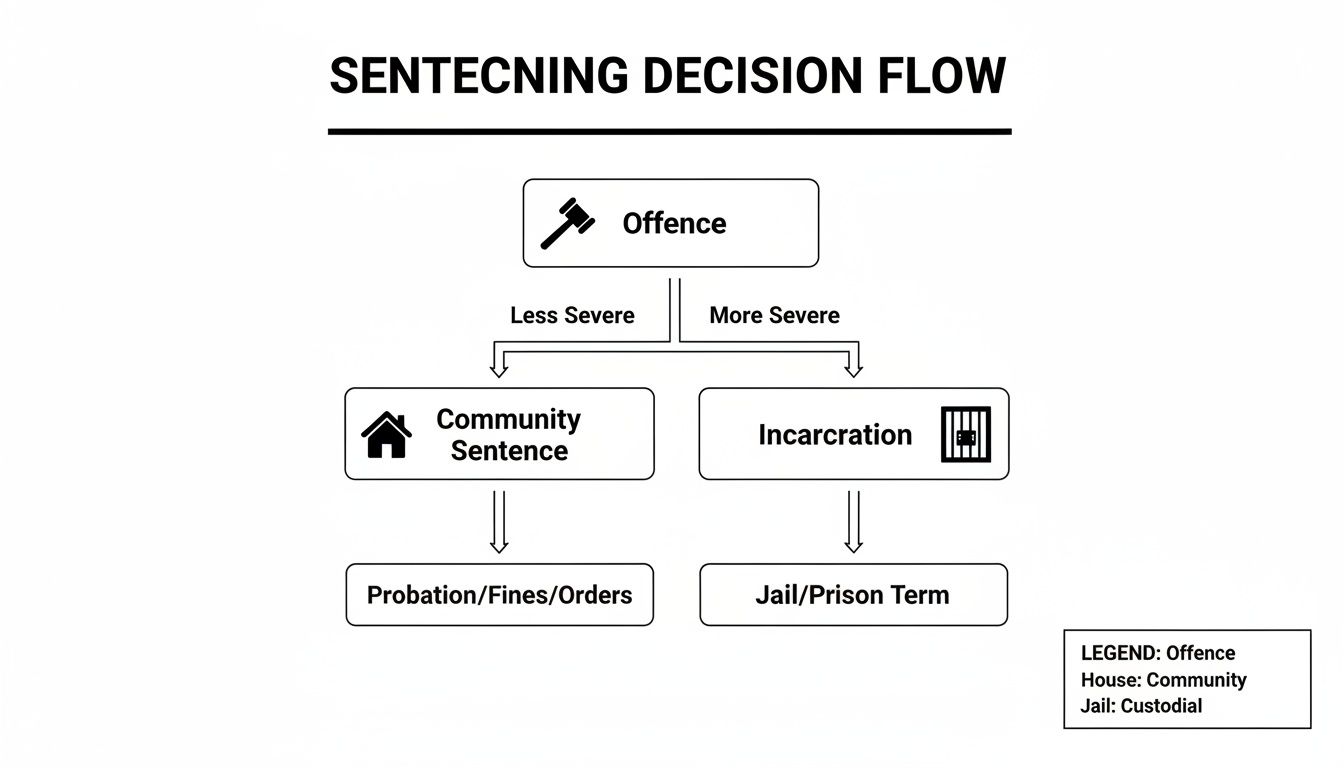
As you can see, a conditional sentence is only on the table after a judge has already ruled out other sentences, like mandatory minimums.
The Three Essential Gateways
To qualify for a conditional sentence, the court must be satisfied on three specific points. These aren’t just guidelines; they are firm legal requirements.
- No Mandatory Minimum Sentence: The offence you were convicted of cannot have a mandatory minimum penalty attached to it. Certain firearm offences or repeat impaired driving convictions, for example, come with required jail time by law, which automatically makes a conditional sentence impossible.
- Sentence is Less Than Two Years: Before even thinking about house arrest, the judge first has to decide what an appropriate jail sentence would be. If that theoretical sentence is less than two years (meaning 23 months or less), you pass this gateway. But if the judge feels the crime deserves two years or more, a CSO is off the table.
- Community Safety is Not at Risk: This is the most critical—and often most debated—part of the test. The judge must be completely convinced that allowing you to serve your sentence in the community, under strict conditions, would not put the public in danger.
Understanding the type of charge you face is crucial here. To learn more about how this can impact your case, take a look at our guide on the differences between summary vs. indictable offences in our guide.
What Does Endangering the Community Mean?
This final gateway is where the real legal battle is usually fought. It isn’t just about whether you might commit another crime; it’s about the realistic level of risk you actually pose.
A judge will look at two key factors to figure this out:
- Risk of Reoffending: The court will examine your background, your criminal record (if you have one), and the details of the offence itself to predict how likely you are to commit another crime.
- Potential Harm: If you did re-offend, how serious would the harm be? The risk of a minor theft is viewed very differently from the risk of a violent act.
To put it simply, the court asks: “If we let this person serve their sentence at home under strict rules, can we be confident that the community will be safe?” Your lawyer’s job is to present a strong case that the answer is “yes.”
This involves painting a full picture of who you are, beyond the offence you committed. We gather evidence of stable employment, strong family support, genuine remorse, and any proactive steps you’ve taken toward rehabilitation, like attending counselling. Your lawyer will create a detailed “plan of care,” showing the court exactly how you will be supervised and supported, proving that a conditional sentence is not only appropriate but also the most constructive path forward.
Offences That Block a Conditional Sentence
While a conditional sentence offers a critical alternative to jail, it’s not on the table for every offence. The Criminal Code of Canada draws a firm line, specifically excluding certain serious crimes to make public safety the top priority. Knowing these rules is the first step to managing expectations about how a case might end.
Think of it as a set of non-negotiable legal barriers. If the offence you’re convicted of falls into one of these restricted categories, a judge is legally blocked from giving you a conditional sentence—no matter how compelling your personal circumstances are. This is where the nature of the charge itself becomes the single most important factor.
The law is designed this way to ensure that sentences served in the community are reserved for situations where the crime, while still serious, doesn’t cross a specific threshold of violence or societal harm.
Offences Involving Serious Bodily Harm
One of the biggest categories of excluded offences involves crimes that cause serious personal injury. The law takes a hard stance here, making it clear that when significant physical violence is used, a community sentence is not an option.
These offences typically include:
- Aggravated Assault: This isn’t a simple assault. It’s an attack that wounds, maims, disfigures, or endangers the life of the complainant. Because of its severe nature, it’s automatically ineligible. If you’re looking for more information on assault charges, you can find a helpful overview in our guide on charges for domestic assault in Brampton.
- Sexual Assault Causing Bodily Harm: Any sexual assault that results in physical injury to the complainant is also completely excluded from consideration for a conditional sentence.
- Assault with a Weapon Causing Bodily Harm: Using a weapon during an assault that leads to injury falls squarely into this restricted category.
This sharp focus on bodily harm signals a clear principle: when an offence results in serious physical trauma, the justice system prioritizes punishment and deterrence through traditional jail time, not community supervision.
Terrorism and Criminal Organization Offences
Another major area where conditional sentences are prohibited involves offences tied to organized crime and terrorism. These crimes are seen as a direct threat not just to individuals, but to the safety and stability of the entire community.
The rationale here is that such offences are not isolated incidents but part of a larger, dangerous enterprise. Allowing an individual convicted of these crimes to serve their sentence at home is viewed as an unacceptable risk to public safety.
Specifically, any offence prosecuted by indictment that carries a maximum sentence of 10 years or more and is connected to a criminal organization is automatically ineligible. This includes crimes like trafficking large quantities of drugs for a gang or participating in an organized fraud scheme. All terrorism offences are also explicitly barred.
Other Specifically Barred Offences
Beyond these broad categories, the Criminal Code lists other specific offences that are ineligible for a conditional sentence order, especially if they carry a maximum prison term of 10 years or more. This list includes serious property crimes and offences that undermine the justice system itself.
A few examples include:
- Arson for a fraudulent purpose or that endangers a person’s life.
- Theft over $5,000 if the Crown proceeds by indictment.
- Breaking and entering into a dwelling-house (a home).
This list isn’t exhaustive, which is why a detailed legal analysis of your specific charges is absolutely critical. An experienced criminal lawyer can determine if your charge falls into any of these restricted categories and explain what sentencing options actually remain on the table.
The Reality of Living Under a Conditional Sentence
Getting a conditional sentence order is a massive win in court, but let’s be clear about what it means for your daily life. This isn’t a get-out-of-jail-free card; it is a jail sentence, just one you serve from home. The reality is a highly structured, restrictive world governed by a strict set of rules that dictate where you go, what you do, and who you see.
These conditions aren’t just suggestions—they are legally binding court orders. They fall into two main categories: mandatory conditions and optional ones. Both are put in place to protect the public and help with your rehabilitation, but following them day-in and day-out will demand a lot of personal discipline.

Mandatory Conditions for Every Order
Under section 742.3(1) of the Criminal Code, every single conditional sentence, no matter the offence, comes with a standard set of rules. Think of these as the non-negotiable foundation of your supervision.
You will always be required to:
- Keep the peace and be of good behaviour.
- Appear before the court whenever you’re required to.
- Report to a supervisor (usually a probation officer) exactly as they direct.
- Remain within the jurisdiction (typically the province) unless you get written permission from your supervisor or the court to leave.
- Notify your supervisor ahead of time if you change your name, address, or job.
These mandatory terms are the backbone of the order, ensuring constant oversight and accountability. From here, the court builds a more personalized set of rules tailored specifically to you.
Optional Conditions Tailored to Your Case
Beyond those standard rules, a judge has the power under section 742.3(2) of the Criminal Code to add a wide range of optional conditions. This is where the sentence is customized to address the specifics of your offence, your personal history, and what you need for rehabilitation. It’s these conditions that truly make a CSO feel like “house arrest.”
Some of the most common optional conditions include:
- House Arrest or Curfew: This is the defining feature of most CSOs. You could be confined to your home 24/7, with very limited, pre-approved exceptions for things like work, medical emergencies, religious services, or maybe a few hours a week for groceries.
- Abstain from Drugs or Alcohol: If substance use played any role in your offence, you can bet the court will order you to completely abstain from possessing or consuming alcohol or non-prescribed drugs.
- Attend Counselling: The judge can order you to participate in and complete specific programs, like anger management, substance abuse treatment, or psychological counselling.
- No-Contact Orders: You will almost certainly be forbidden from having any contact—direct or indirect—with the victim or any co-accused. This means no phone calls, texts, social media interactions, or even passing messages through a friend. These orders function similarly to peace bonds, which you can learn more about in our article on what a peace bond is in Canada.
A conditional sentence is not just about staying home. It’s an active, supervised plan designed to hold you accountable while giving you the tools to address the root causes of your behaviour. The goal is to ensure you never find yourself in the same situation again.
Living under these rules means a complete lifestyle overhaul. Your social life will be severely limited, and every single trip outside your home has to be either pre-approved or fall within the narrow exceptions of your order. It’s a demanding sentence that puts your discipline to the test every day. This reflects the significant community supervision caseloads seen across the country. For example, Public Safety Canada reports that Ontario’s federal community supervision caseload was 4,723 in one recent year, a figure that consistently represents about 10-11% of Canada’s total. Read more about these statistics on Public Safety Canada’s website.
Navigating the Sentencing Process in Court
Successfully arguing for a conditional sentence order isn’t as simple as asking a judge for house arrest. It requires a smart, persuasive strategy from your defence lawyer to build a compelling case that convinces the court this is the right—and safe—decision. This journey involves meticulous prep work, strong legal arguments, and a deep understanding of the local court system.
The process kicks off long before you ever step into the courtroom for a sentencing hearing. A critical first step is to gather powerful character evidence. This means collecting reference letters from employers, family members, and community leaders who can speak to your positive character and contributions, painting a complete picture of who you are beyond the offence you committed.
At the same time, your lawyer gets to work developing a detailed ‘plan of care.’ This is a concrete proposal we present to the court, spelling out exactly how you will serve your sentence in the community while ensuring both accountability and public safety.
Building a Persuasive Case for the Court
A strong plan of care is the bedrock of a successful argument for a conditional sentence. It’s a proactive document that anticipates the court’s concerns and offers clear, workable solutions.
This plan usually includes:
- A Detailed Supervision Strategy: It clearly states where you will live and who will supervise you, such as a spouse or parent who agrees to report any violations to the authorities.
- A Commitment to Rehabilitation: The plan will outline any counselling, treatment programs, or courses you’ve already started or plan to attend. This shows you’re addressing underlying issues like substance use or anger management.
- Proof of Stability: Evidence of a steady job or enrollment in school demonstrates that you are a productive member of society, a key factor for a judge’s consideration.
This plan shows the judge you’re taking the situation seriously and have a structured support system ready to go. To get a better feel for the entire court journey, you might find it helpful to read our guide on what to expect when charged in Brampton, Ontario.
The Importance of Local Court Knowledge
Where your case is heard really matters. Legal practices and judicial attitudes can vary significantly from one courthouse to another, making local expertise absolutely essential. Understanding how specific judges and Crown Attorneys in Brampton and the Peel Region view conditional sentences can fundamentally shape your entire defence strategy.
Regional differences in sentencing aren’t just a myth; the data backs it up. A Justice Canada study found that while Ontario courts imposed 30% of all CSOs in their survey, only a third of its judges were ‘high users’ of this option. This is a sharp contrast to Quebec, where 75% of judges were high users, suggesting a more conservative approach in Ontario that makes skilled local advocacy crucial. Learn more about these justice system findings.
A lawyer who is a regular at the Brampton courthouse knows which arguments resonate with local judges and what concerns certain Crown Attorneys are likely to raise. This insight allows your defence to be proactive, tackling potential objections before they’re even made and tailoring arguments for maximum impact. A timely guilty plea, a genuine show of remorse, and a rock-solid rehabilitation plan are all factors that can sway a judge’s decision—and a local lawyer knows how to present them most effectively.
What Happens When You Breach Your Conditions
A conditional sentence order is a privilege the court extends to you, but make no mistake—it’s still a jail sentence served in the community. Breaking its terms isn’t like missing a credit card payment; it’s a direct violation of a court order, and the consequences are both severe and immediate. Understanding what’s at stake is the best motivation for following every single rule to the letter.

The process kicks off quickly and without much warning. If your supervising officer has reasonable grounds to believe you’ve broken a condition—whether it’s missing your curfew by ten minutes, contacting someone you shouldn’t, or having a beer—they can issue a warrant for your arrest. You can be arrested on the spot and held in custody until a judge can see you.
The Breach Hearing in Court
Once arrested, you’ll be brought before a judge for a breach hearing. This isn’t a new trial for a new crime. The court has a very narrow focus: did you, in fact, breach one of your conditions? And if you did, did you have a “lawful or reasonable excuse” for doing so?
Here’s the critical part: the burden of proof shifts to you. It’s your job to convince the judge, on a balance of probabilities, that you had a legitimate reason for your actions. Simply forgetting about a condition or misreading your schedule won’t cut it. A true medical emergency that forced you to leave home during your curfew, on the other hand, might be considered a reasonable excuse.
According to section 742.6(9) of the Criminal Code, if the court finds you breached a condition without a good excuse, the judge has a range of options, from a simple warning to sending you straight to jail. The final decision rests entirely on the judge’s assessment of your actions and the breach itself.
This hearing is a high-stakes moment where your freedom is on the line. The Crown prosecutor will present the evidence of the breach, and your lawyer’s job is to either prove the allegation is false or provide a compelling justification for what happened.
The Potential Consequences of a Breach
If the judge concludes you violated your order without a good excuse, they have several paths they can take. The outcome will depend heavily on how serious the breach was and how you’ve been conducting yourself throughout the sentence.
The judge may decide to:
- Take no action: This is pretty rare. It’s usually reserved for a very minor, technical breach where the judge feels a stern warning is enough to get the point across.
- Change the conditions: The judge can make your existing rules even stricter. Think a tighter curfew, more frequent check-ins, or additional counselling requirements.
- Suspend the conditional sentence order: This is a major step. The judge can order you to serve a portion of your remaining sentence in an actual jail. After you’re released, you would return to the community to finish the rest of your sentence under the original conditions.
- Terminate the order entirely: This is the worst-case scenario. The judge cancels the conditional sentence completely and sends you to a correctional facility to serve the rest of your time behind bars. You lose the privilege of serving your sentence at home, effective immediately.
Breaking the rules of your order is a massive gamble with your freedom. The court gave you a chance to serve your time in the community, and it won’t think twice about taking that chance away.
Common Questions About Conditional Sentences
When you’re dealing with something as serious as a conditional sentence, a lot of practical questions come to mind. It’s completely normal. Let’s clear up some of the most common concerns about what it really means to serve a jail sentence in the community.
Can I Go to Work on a Conditional Sentence Order?
Yes, in nearly every case. One of the main reasons a judge would even consider a conditional sentence is to help you stay a productive member of society, and keeping your job is a huge part of that.
Your defence lawyer will work with the Crown and the judge to carve out specific, pre-approved exceptions for your work schedule. This isn’t just about the hours you’re on the clock; it also includes the time it takes you to get to and from your job. Outside of those approved times, you must be at home, following your house arrest or curfew rules to the letter.
Is a Conditional Sentence the Same as Probation?
No, and this is a critical distinction that people often get wrong. A conditional sentence is a jail sentence that you are permitted to serve at home. It’s far more strict than probation, and if you breach the conditions, you can be sent straight to jail to serve out the rest of your time behind bars.
Probation, on the other hand, is a less restrictive court order that usually comes after a jail sentence or a conditional sentence is finished. While breaking your probation is a separate criminal offence, it doesn’t automatically land you in jail to finish a prior sentence. Think of a conditional sentence as a direct substitute for prison, while probation is an added period of supervision.
A conditional sentence order is the court’s final decision on what would have been a jail term. Probation is an additional layer of supervision. Conflating the two is a common but dangerous mistake, as the consequences for a breach are vastly different.
Will a Conditional Sentence Give Me a Criminal Record?
Yes, absolutely. A conditional sentence is only given after you have either been found guilty at trial or have pleaded guilty. It is a formal conviction, and it will result in a criminal record. It is not a discharge or a slap on the wrist.
The massive benefit, however, is that you avoid the devastating personal and professional impact of actually being incarcerated. Once you’ve successfully served the entire sentence and a mandatory waiting period has passed, you may be able to apply for a record suspension (what people used to call a pardon) to have the conviction sealed from public view.
How Does a Judge Choose Between a CSO and Jail?
The final decision happens at a formal sentencing hearing, after both your lawyer and the Crown prosecutor have made their arguments. First, the judge has to agree that a jail sentence of less than two years is appropriate for the crime and confirm that your offence isn’t one of the types legally barred from receiving a conditional sentence.
From there, it all comes down to whether the judge believes you won’t be a danger to the community. This is where your lawyer’s skill is crucial. Their job is to build a compelling case by presenting evidence of your good character, genuine remorse, any steps you’ve taken toward rehabilitation, and a rock-solid “plan of care” explaining how you will be supervised at home.
Facing criminal charges in Brampton or the Peel Region is a serious matter, and the possibility of a conditional sentence order requires an expert legal strategy. The team at Badesha Law has the local court experience to assess your eligibility and build the strongest possible case for an alternative to jail. We protect your rights and fight for the best possible outcome. For a free, confidential consultation to discuss your case, visit us at https://criminallawyerinbrampton.com.
No comment