


When you’re facing domestic assault charges in Brampton, it can feel like your entire world has been turned upside down. The stress and uncertainty are immense, and the first thing you need to understand is something that surprises many people: 'domestic assault' isn't a specific, standalone charge in Canada's Criminal Code.
Instead, it’s a serious label the justice system applies to a standard assault charge when the incident happens between intimate partners or family members. At Badesha Law, a criminal defence law firm in Brampton, we know that this single distinction changes everything and dramatically raises the stakes. This guide will explain what these charges mean, the court process in Peel Region, and how a strong defence can protect your future.
Understanding Domestic Assault Charges in Brampton

When Peel Regional Police respond to a domestic dispute, any resulting assault allegation is automatically flagged as "domestic." This label triggers a very specific and tough response from both the police and the Crown Attorney's office.
The Crown's office has prosecutors who specialize in these cases, and they operate under a strict “zero-tolerance” policy. This policy makes it incredibly difficult to get charges dropped, even if the person who made the complaint has had a change of heart and wants to reconcile.
Why This Label Matters
The "domestic" label acts as a red flag for the court. Legally, it is an aggravating factor at sentencing. If you are found guilty, the judge must consider the domestic context as a reason to impose a harsher sentence than they would for a similar assault between strangers.
Understanding this from day one is absolutely crucial. The immediate and long-term consequences are severe:
-
Tough Bail Conditions: You will almost certainly be ordered to have no contact with the complainant. This often means you cannot return to your own home or speak to your partner.
-
Higher Chance of Jail: The Crown will often seek jail time, even for a first offence, depending on what is alleged to have happened.
-
A Permanent Criminal Record: A conviction can follow you for life, creating major roadblocks for jobs, international travel, and immigration applications.
-
Impact on Family Law: A pending domestic charge or a conviction can seriously harm your position in any child custody or access disputes.
This specialized court process was created to address the unique and sensitive dynamics of intimate partner relationships. The flip side is that you are now caught in a system with rigid policies that can feel stacked against you from the moment you're arrested.
The stakes are incredibly high right from the beginning. Every decision you make and the legal advice you get in those first few hours and days can have a massive impact on the final outcome. A Brampton domestic violence lawyer from Badesha Law can protect your rights and build a defence strategy aimed at the best possible result.
The Different Types of Domestic Assault Charges
When Peel Regional Police get involved in a domestic dispute, they lay a standard assault charge from the Criminal Code of Canada and then flag it as "domestic." This distinction is critical because it means the Crown Attorney has to prove every single element of that specific assault charge beyond a reasonable doubt.
Knowing exactly what you're up against is the first step in building a solid defence. Your strategy, tailored by the team at Badesha Law, will hinge entirely on the specific charge you're facing at the Brampton courthouse.
Let's break down the most common ones.
Simple Assault (Section 266)
This is the most frequent charge in domestic cases. Many people think an "assault" has to involve a punch or leave a mark, but the legal definition in Ontario criminal law is much wider.
Legally, a simple assault is the intentional application of force to someone else without their consent. It can be something as seemingly minor as an unwanted touch, a shove, or even a gesture that makes your partner reasonably believe you’re about to apply force.
- Example: During a heated argument, one person grabs their partner's arm to stop them from leaving the room. Even if it doesn't hurt them or leave a bruise, that unwanted physical contact is enough to be considered a simple assault.
The Crown doesn’t have to prove you meant to injure them—only that you meant to make the contact. A conviction for "simple" assault can still carry a maximum penalty of five years in prison.
Assault with a Weapon or Causing Bodily Harm (Section 267)
This charge is more serious. It’s laid when an alleged assault involves either the use of a "weapon" or results in "bodily harm."
The term "weapon" is defined incredibly broadly. It's not just about knives or guns. It could be a phone thrown in anger, a book swiped off a table, or almost any household object used to threaten or harm someone.
"Bodily harm" is any injury that’s more than trivial and interferes with a person's health or comfort, such as deep bruises, cuts, or a broken bone.
A key point is that the legal bar for "bodily harm" is lower than most people realize. A sprained wrist or a significant bruise that causes pain can easily meet the definition, escalating what might have been a simple assault into a much more serious charge.
The stakes are higher here, with the maximum penalty jumping to 10 years in prison.
Aggravated Assault (Section 268)
This is the most severe assault charge under the Criminal Code. It’s reserved for situations where an assault wounds, maims, disfigures, or endangers the life of the other person. Because the harm is so grave, the potential penalties are the most severe, carrying a maximum sentence of 14 years in prison.
Common Domestic Charges and Potential Penalties in Ontario
This table summarizes the common Criminal Code sections in domestic cases and their potential sentences.
| Charge | Criminal Code Section | Potential Penalties Overview |
|---|---|---|
| Simple Assault | s. 266 | Maximum 5 years imprisonment |
| Assault with Weapon / Bodily Harm | s. 267 | Maximum 10 years imprisonment |
| Aggravated Assault | s. 268 | Maximum 14 years imprisonment |
| Uttering Threats | s. 264.1 | Maximum 5 years imprisonment |
Uttering Threats (Section 264.1)
Not all domestic charges involve physical contact. You can be charged with "uttering threats" for knowingly conveying a threat to cause death or bodily harm. The threat doesn't have to be spoken face-to-face; it can be sent in a text, email, or passed through a third party. This charge is often laid alongside an assault charge but can also stand on its own. You can learn more in our guide to understanding domestic harassment charges.
What Happens Immediately After an Arrest
When police get a domestic dispute call in Peel Region, it sets off a fast and serious sequence of events. Understanding what happens in these first few moments is vital for protecting your rights.
In Brampton and throughout Ontario, police follow a “zero-tolerance” mandatory charging policy for domestic calls. This means if an officer has any reasonable grounds to think an assault occurred, they must lay a charge and make an arrest. The decision is no longer in the complainant's hands—it’s now in the hands of the justice system. This is why your first call should be to an experienced criminal defence lawyer.
The Critical Bail Hearing Process
After an arrest for domestic assault, you will almost certainly be held in custody for a bail hearing. The court decides whether you can be released back into the community while your case proceeds. The Crown will almost always push for very strict release conditions because the file is flagged as "domestic."
A lawyer from Badesha Law can immediately work on your release plan. A key part of that plan is finding a surety—a friend or family member who agrees to supervise you and pledges a sum of money to guarantee you follow the rules. A strong surety and a clear plan dramatically increase your odds of getting out on bail. Learn more in our guide on what happens at a bail hearing.
Understanding No-Contact Orders
If granted bail, you will be placed under a strict “no-contact” order. This is a standard condition in nearly every domestic case in Brampton.
A no-contact order means you are legally prohibited from communicating with the complainant in any way, shape, or form—no calls, texts, emails, or messages through a third party. It also usually means you cannot return to the home you shared, which can leave you without a place to live.
Breaking a no-contact order is a new criminal offence. It will get you re-arrested, make getting bail a second time much harder, and harm your credibility for the original assault charge.
Navigating the Brampton Domestic Court Process
The Ontario court system can be stressful and confusing. This section provides a map of the domestic court process at the Brampton courthouse, from your first court date to the final outcome.
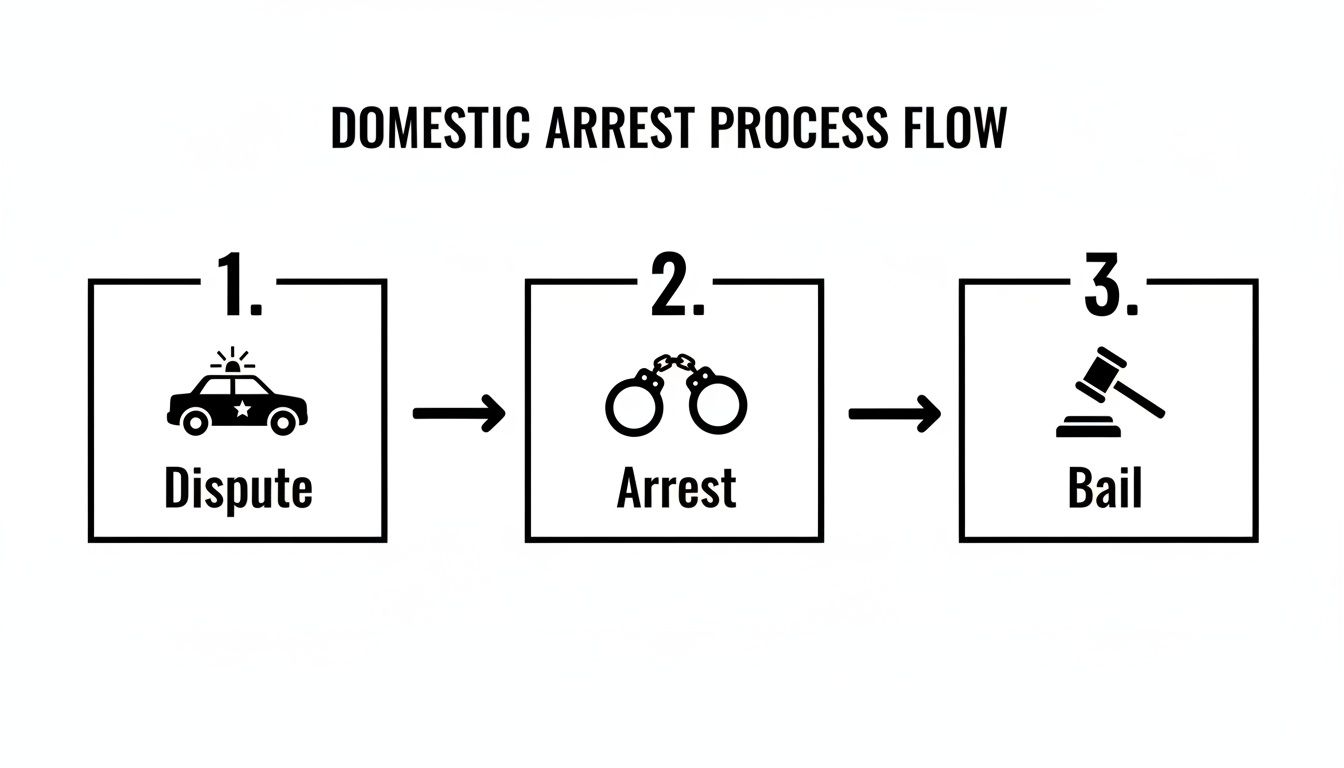
The infographic below shows how quickly a private argument can become a public legal battle.
First Appearance and Disclosure
Your first day in court is not your trial. It's an administrative check-in where your lawyer appears and receives the disclosure package. This is the Crown Attorney’s file containing all the evidence they have against you, including:
-
Police officer notes
-
Complainant and witness statements
-
Photos of alleged injuries
-
The 911 call recording
This package is the playbook we use to start building your defence. At Badesha Law, we comb through every page, hunting for inconsistencies, legal weaknesses, and potential violations of your Charter rights.
Crown Pre-Trials and Negotiations
After reviewing disclosure, the next step is the Crown Pre-Trial, a meeting between your defence lawyer and the Crown Attorney to discuss the case. This is our first chance to negotiate.
Your lawyer will point out weaknesses in the Crown's case and push for the best possible outcome. An experienced lawyer's reputation and working relationship with the Brampton Crown’s office is a major asset here. If you're dealing with a first time assault charge in Canada, this negotiation is key.
The goal of a pre-trial is to resolve the case without the risk and expense of a trial. Can the charges be withdrawn? Will the Crown agree to a peace bond? These are the crucial questions your lawyer will address.
Police in Peel Region respond to thousands of family and intimate partner disputes annually, an average of about 44 disputes every day. The courts depend on pre-trial resolutions to manage this high volume, as shown in local police reports.
Judicial Pre-Trials and The Final Decision
If we can't reach a deal with the Crown, the next step is often a Judicial Pre-Trial (JPT). This is a more formal meeting with your lawyer, the Crown, and a judge. The judge acts as a neutral third party, offering their view on the case's strengths and weaknesses and suggesting a fair resolution.
After the JPT, you and your lawyer from Badesha Law will make a final, strategic decision:
-
Accept a Resolution: This might mean pleading to a lesser charge or agreeing to a peace bond.
-
Set a Date for Trial: If no fair resolution is offered, we prepare to fight the charges in court.
How a Criminal Defence Lawyer Can Help

Being arrested for domestic assault is not the same as being found guilty. The time between being charged and the final court date is your opportunity to build a powerful, strategic defence. The goal is always to achieve the best possible result, whether that’s getting the charges withdrawn, negotiating a peace bond, or securing a full acquittal.
The process starts by dissecting the Crown’s disclosure package, hunting for weaknesses and inconsistencies that create reasonable doubt. Peel Regional Police take a zero-tolerance stance on domestic violence, and local crime reports show over 6,600 assaults reported in Brampton and Mississauga in a recent year. This approach means charges are often laid quickly, making a proactive legal defence crucial.
Possible Defences or Legal Strategies
A criminal defence lawyer at Badesha Law will explore every possible defence, including:
-
Challenging Credibility: In many domestic cases, the Crown’s entire case rests on the complainant's testimony. We carefully cross-reference every statement they have made, searching for contradictions between the 911 call, police statements, and other evidence.
-
Asserting a Legal Defence: Your lawyer will determine if a formal legal defence applies. The most common defences in domestic assault cases are:
-
Self-Defence: Arguing you used reasonable force to protect yourself from harm.
-
Defence of Others: Arguing your actions were necessary to protect someone else, like a child.
-
Lack of Intent (Mens Rea): Arguing the physical contact was accidental and you did not have the criminal intent required for an assault conviction.
-
Consent: This is a very narrow defence, as the law states you cannot consent to bodily harm.
-
-
Arguing Charter Violations: The Canadian Charter of Rights and Freedoms protects your rights. If police violated them during your arrest or investigation, the evidence they gathered could be excluded from court. Common violations include:
-
Denial of your right to speak with a lawyer.
-
Unlawful search of your home or phone.
-
Arbitrary detention or unlawful arrest.
-
Exploring all of these angles is exactly what a top criminal defence lawyer in Brampton does to protect your rights and future.
Conclusion: Get Expert Advice for Domestic Assault Charges
Facing domestic assault charges in Brampton is a crisis that can completely derail your life. A conviction leaves you with a permanent criminal record that can block job opportunities, prevent travel to the US, and seriously damage your position in family court, especially regarding access to your children.
Navigating the justice system alone is a significant risk. From the moment of arrest, you are in a process with specific rules and policies designed for domestic cases. This is where an experienced lawyer is critical.
At Badesha Law, we get involved immediately to protect your rights, starting with the bail hearing. We analyze all evidence, identify weaknesses in the Crown's case, and build a tailored defence strategy. We know the Peel Region prosecutors and negotiate directly with them to have charges withdrawn or resolved with alternatives like a peace bond, always fighting to keep your record clean.
If you are facing domestic assault charges, the stakes are too high to go it alone. Contact Badesha Law, a Brampton criminal lawyer, for a confidential consultation to understand your options and get the expert defence you need.
Frequently Asked Questions About Domestic Charges
Being charged with domestic assault in Brampton raises many urgent questions. Here are clear, straightforward answers to some of the most common concerns we hear from our clients at Badesha Law.
Can the charges be dropped if my partner takes back their statement?
This is a common misconception. In Ontario, once police lay a charge, the decision to drop it belongs entirely to the Crown prosecutor, not your partner. Due to strict domestic violence policies in Peel Region, the Crown will almost always proceed with the case, even if the complainant wants the charges dropped. The Crown can use other evidence, like the 911 call or police testimony, to build their case. Your lawyer can still negotiate with the Crown, but the complainant's wishes are not the final word.
Will I go to jail for a first domestic assault offence?
While a first offence doesn't automatically mean jail, it is always a possibility, especially if the incident involved significant violence or injuries. For a more minor, first-time offence, a skilled criminal defence lawyer can often negotiate a resolution that avoids both jail time and a criminal record. The goal is often to secure a peace bond or a discharge, which are outcomes that protect your future by preventing a conviction from appearing on your record.
What is a peace bond?
A peace bond is an agreement with the court and an excellent way to resolve a domestic assault charge. The Crown agrees to withdraw the criminal charge, and in return, you agree to follow specific court-ordered conditions for a set period, usually 12 months. Common conditions include keeping the peace, having no contact with the complainant, and not possessing weapons. Crucially, you do not admit guilt to get a peace bond, which is why it results in no criminal record. This is a common and successful outcome we achieve for clients at Badesha Law.
How will this affect my child custody situation?
A domestic assault charge can significantly impact family court proceedings, particularly child custody and access. Even if you are not convicted, the mere fact that you were charged can be used against you in a custody dispute. It is essential to work with a criminal lawyer who understands how criminal and family law intersect to protect your parental rights from the very beginning.
No comment