


Facing a first-time DUI charge in Brampton is a stressful and disorienting experience. It marks the beginning of a complex legal journey with serious consequences for your driver's licence, your job, and your future. Understanding what you are up against is the first critical step toward protecting yourself. This guide will explain what happens after being charged with impaired driving in Ontario.
At Badesha Law, a criminal defence law firm in Brampton, we have extensive experience defending clients against these charges. We understand the questions keeping you up at night and want to walk you through the process, from the roadside stop to the final court date, so you can make informed decisions.
What You Will Learn in This Guide
This article provides a clear, straightforward overview of what to expect after a first-time DUI charge in the Peel Region.
- The Specific Charges: We’ll explain the difference between "Impaired Operation" and "Over 80" and what each means under Ontario criminal law.
- Immediate Penalties: You will learn about the automatic 90-day licence suspension and vehicle impoundment that happen right away.
- The Brampton Court Process: We will outline what happens at your first court appearance and the steps that follow.
- Building a Defence: You will see how an experienced DUI lawyer in Brampton can challenge the evidence and protect your rights.
Remember, a charge is not a conviction. The hours and days following an arrest are critical. The legal advice you receive can significantly impact the outcome of your case.
Why You Need a Brampton DUI Lawyer Immediately
From the moment you are charged, the Crown prosecutor begins building their case against you. You need a professional doing the same for your defence. A lawyer does more than appear in court; they analyze police evidence for errors, negotiate with the Crown, and build a strategic defence.
Handling this alone is a significant risk. Your licence, ability to travel, and clean record are all on the line. The team at Badesha Law has spent years defending clients from impaired driving charges in Ontario. We meticulously review every detail to find weaknesses in the Crown's case and any violations of your Charter rights. To see how we build a strong defence, learn more about our approach as experienced impaired driving lawyers near you.
Understanding the DUI Charges You Face
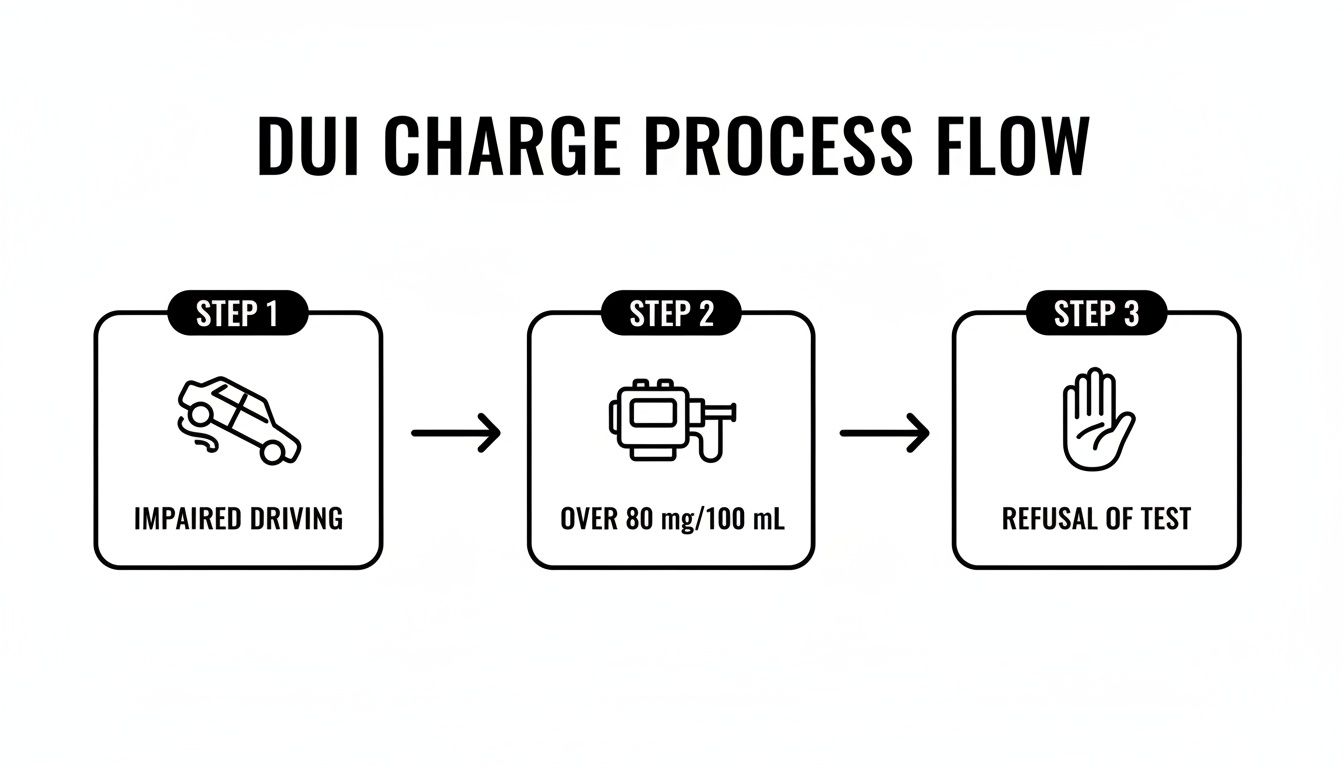
When you are pulled over and charged with impaired driving, the legal terminology can be confusing. To fight the allegations effectively, you must first understand what the Crown is accusing you of. In Ontario, the Criminal Code outlines three main offences related to impaired driving, each proven in a distinct way.
1. Impaired Operation by Alcohol or Drug
This charge is not based on a specific breathalyzer reading. Instead, it focuses on whether your ability to operate a vehicle was impaired by alcohol or drugs, even slightly. The Crown’s case is built on the police officer's observations, including:
- Driving Pattern: Swerving, erratic speed, or ignoring traffic signals.
- Physical Signs: Smell of alcohol, red eyes, slurred speech, or unsteadiness.
- Statements: Any admission of consuming alcohol or drugs.
- Field Sobriety Tests: Your performance on roadside tests.
Because this charge relies on subjective observations, it can often be challenged in court by an experienced Brampton criminal defence lawyer.
2. Operation Over the Legal Limit (Over 80)
This charge is based entirely on scientific evidence from an approved breath-testing instrument. If the machine indicates your blood alcohol concentration (BAC) was 80 milligrams of alcohol in 100 millilitres of blood or higher, you will be charged with "Over 80."
Similar limits exist for THC, the psychoactive component in cannabis:
- Over 2 ng but under 5 ng of THC: A less serious summary offence.
- Over 5 ng of THC: A serious hybrid offence, similar to an alcohol-related Over 80.
- Combination: A BAC over 50 mg/100 ml plus over 2.5 ng of THC.
While the numbers appear definitive, the police procedures for obtaining them are highly technical. A strong defence often involves scrutinizing police conduct to ensure every step was followed correctly. You can learn more about the legal blood alcohol level in Ontario and how it is measured.
3. Failure or Refusal to Comply with a Demand
The law requires you to comply with a lawful demand from a police officer for a breath or fluid sample. If you fail or refuse to provide a sample without a legally valid reason, you will face a "Refusal" charge.
A conviction for refusal carries the exact same penalties as a conviction for impaired driving, including a criminal record and a minimum one-year driving ban.
A refusal can include not just saying "no," but also failing to provide a proper sample for the machine to get a reading. A valid "reasonable excuse," such as a medical condition, can be a defence, but this is a complex area of law where a lawyer’s help is essential.
From Roadside Stop to Criminal Charge: The Process
It happens quickly: flashing lights, a police officer at your window, and a series of demands. Knowing what Peel Regional Police are legally allowed to do during a traffic stop is your first line of defence. Every action they take must follow a strict legal protocol.
Under current Ontario law, police can demand a breath sample from any driver they lawfully stop, even without suspecting impairment. Refusing this roadside test will lead to a criminal charge.
The Roadside Test and Arrest
Police use a handheld Approved Screening Device (ASD) to get a quick BAC reading. The result determines the next steps:
- "Pass" (under 50 mg): You are usually free to go.
- "Warn" (50-79 mg): You will receive an immediate, non-criminal roadside licence suspension.
- "Fail" (80 mg or higher): The officer has grounds to arrest you for an "Over 80" offence.
If you fail the test, you will be arrested, read your rights (including the right to speak with a lawyer), and taken to the police station for more precise breath tests on a larger instrument. Any police misstep during this critical stage, such as delaying your call to a lawyer, can become a key part of your defence.
Police Observations and Your Charter Rights
Police are also trained to document signs of impairment. They take detailed notes on your driving, coordination, and speech to build a case for an impaired driving charge, which is separate from an Over 80 charge. These observations can sometimes be distinguished from criminal conduct, such as in cases involving traffic tickets. You can learn more in our guide on careless driving vs. dangerous driving.
Your Charter rights are your shield. You have the right to remain silent and the right to contact a lawyer without delay upon arrest. Exercising these rights is not an admission of guilt—it is the smartest step you can take.
A skilled DUI lawyer in Brampton will scrutinize the entire police interaction, from the reason for the initial stop to the timing of your breath tests, to identify procedural errors and rights violations that can build a powerful defence.
Building Your Defence Strategy with a Brampton Lawyer
A DUI charge is an allegation, not a conviction. The Crown prosecutor has the burden of proving every element of their case beyond a reasonable doubt. The job of your defence lawyer is to dismantle that case.
At Badesha Law, we begin our work the moment we receive the "disclosure" package from the Crown. This file contains all the evidence against you: officer’s notes, videos from the police cruiser and station, and breathalyzer maintenance logs. We analyze every page to find weaknesses and potential violations of your rights.
Technical and Procedural Defences
Impaired driving law is governed by strict technical rules. Police must follow a precise script when gathering evidence, especially for breath samples. Any mistake can lead to the evidence being thrown out.
We investigate key questions:
- Was the stop lawful? Did the officer have a valid reason to pull you over?
- Was the breath demand valid? Did the officer have "reasonable grounds" to demand a sample?
- Were the breath tests conducted properly? Did police follow the mandatory 15-minute observation period and all other protocols?
- Was the breathalyzer working correctly? We review maintenance and calibration records for errors.
A single procedural error can be enough to have the breath readings excluded, often causing the Crown’s case to collapse.
Charter Rights Defences
The Canadian Charter of Rights and Freedoms protects your fundamental rights. If police violate these rights during their investigation, a judge may exclude the evidence or even dismiss the charges.
Your right to speak with a lawyer without delay after an arrest is paramount. Any police action that interferes with this right is a serious violation.
Common Charter breaches in DUI cases include:
- Delay in Access to Counsel: Police cannot delay your opportunity to speak with a lawyer.
- Unlawful Search and Seizure: A stop or breath demand without proper legal grounds can violate your rights.
- Right to Remain Silent: Police cannot compel you to answer questions about whether you were drinking.
A successful Charter argument is one of the most powerful tools a defence lawyer has. At Badesha Law, we have years of experience identifying and arguing these violations in Brampton courts. Understanding the importance of these rights is crucial from the moment of arrest, including during the release process. You can find out more by reading about what happens at a bail hearing.
Penalties for a First-Time DUI in Ontario
If you are charged with a DUI in the Brampton area, the consequences begin immediately. You face both administrative penalties from the Ministry of Transportation and potential criminal penalties from the court.
Right at the roadside, police will issue an immediate 90-day Administrative Driver’s Licence Suspension (ADLS). Your vehicle will also be impounded for seven days at your expense. These penalties are automatic and separate from the criminal court case.
Consequences of a Criminal Conviction
If the case results in a conviction, the Criminal Code of Canada mandates minimum sentences. For a first offence, this includes:
- A minimum fine of $1,000 (higher for high BAC readings).
- A mandatory one-year driving prohibition across Canada.
- A permanent criminal record.
Summary of Penalties for Impaired Driving Conviction in Ontario
This table outlines the mandatory minimums under the Criminal Code and the subsequent administrative consequences from the Ontario Ministry of Transportation.
| Offence | Mandatory Minimum Criminal Penalty | Ontario Ministry of Transportation Consequences (Post-Conviction) |
|---|---|---|
| First Offence | $1,000 fine | Mandatory education program, 1-year ignition interlock |
| Second Offence | 30 days jail | Mandatory education/treatment, 3-year ignition interlock |
| Third Offence | 120 days jail | Mandatory education/treatment, possible lifetime driving ban |
Long-Term Consequences
A criminal record for impaired driving has far-reaching consequences. It can make you inadmissible to the United States, limiting travel for work or vacation. It can also affect job opportunities that require a clean criminal record check and will cause your insurance premiums to increase dramatically. Sometimes, a resolution like a discharge can help avoid a permanent record. To learn more, read our guide on what a conditional discharge is in Canada.
The goal of your Badesha Law defence lawyer is to fight for an outcome that avoids these life-altering consequences altogether.
FAQs: First-Time DUI Charge in Brampton
Here are answers to some common questions we hear from clients in Brampton facing their first DUI charge.
Will I go to jail for a first DUI in Ontario?
For a standard first-time DUI charge without aggravating factors like an accident, jail time is not the typical outcome. The mandatory minimum penalty is a $1,000 fine and a one-year driving ban. However, factors like a very high breath reading can lead the Crown to seek jail time. An experienced DUI lawyer at Badesha Law will argue for the minimum penalties and work to avoid a conviction entirely.
Can I get my licence back before the 90-day suspension is over?
The 90-day Administrative Driver’s Licence Suspension (ADLS) is an immediate penalty from the Ministry of Transportation and is very difficult to appeal or shorten. Your legal defence will focus on the criminal charge to prevent the longer, court-ordered driving prohibition that follows a conviction.
How much does a DUI lawyer in Brampton cost?
The cost depends on the complexity of your case and whether it resolves early or proceeds to trial. At Badesha Law, we offer a free, confidential consultation to discuss your charges and provide a clear fee structure, often using block fees so you know the cost upfront. This is an investment in protecting your licence, record, and future.
What is the difference between impaired driving and Over 80?
These are two separate charges that are often laid together.
- Over 80 is proven with scientific evidence from a breathalyzer.
- Impaired driving is proven with a police officer's observations of your driving and physical condition.
You can be charged with both but only convicted of one.
If you are facing a first-time DUI charge in Brampton or the Peel Region, it is crucial to act quickly. Contact Badesha Law for a free, confidential consultation to understand your rights and start building your defence. Visit us at https://criminallawyerinbrampton.com to get the expert legal advice you need.
No comment