


When you're frantically searching for an "impaired driving lawyer near me" after a charge in Brampton, you're looking for one thing: clear, immediate answers. This guide explains the charges you face, the court process, and how a strong legal defence can protect your future. Facing an impaired driving allegation is a serious problem, but an arrest is not a conviction. The steps you take now lay the groundwork for your entire defence, and the single most important thing you can do is preserve your rights.
What To Do Immediately After a DUI Charge in Brampton
The moments after being charged with impaired driving are a blur of stress and confusion. You're suddenly without your driver's licence, your car has been impounded, and you're holding a stack of legal papers with serious consequences. At this stage, having an experienced criminal defence firm like Badesha Law, a criminal defence law firm in Brampton, step in can provide the urgent guidance you need. The goal is to stop reacting to the situation and start actively managing it.
Understanding Your Paperwork and Immediate Penalties
The police will hand you a set of documents. It's crucial to know what they are and what they mean for you right now. You'll likely have an Appearance Notice or a Promise to Appear. These papers tell you your first court date and when you need to go for fingerprinting. If you miss these dates, you'll face additional criminal charges.
At the same time, Ontario’s administrative laws hit you with immediate, non-criminal penalties:
-
90-Day Administrative Driver’s Licence Suspension (ADLS): Your licence is taken on the spot for 90 days. This suspension is separate from any court-ordered prohibition and is incredibly difficult to fight.
-
7-Day Vehicle Impoundment: The car you were driving is towed and impounded for seven days. You are responsible for all fees, regardless of who owns the vehicle.
These administrative penalties are designed to get you off the road immediately while your criminal case makes its way through the system.
Document Everything You Can Remember
Your memory is a vital piece of evidence. As soon as possible, write out every detail you can recall about the arrest. Your personal notes give your lawyer a firsthand account to work from and can help uncover small inconsistencies or procedural mistakes that can make a huge difference in your defence.
Try to focus on the specifics:
-
Why did the officer say they pulled you over?
-
What questions did they ask before arresting you?
-
Did they inform you of your right to speak with a lawyer?
-
How much time passed between the stop, the arrest, and any breath tests?
-
Did the breath-testing machine seem to have any problems?
The Importance of Remaining Silent
Once you've spoken to a lawyer, your most powerful tool is your right to remain silent. Do not discuss the details of your case with anyone other than your legal counsel. Anything you say can be used against you by the Crown prosecutor. Your lawyer at Badesha Law will take over all communication with the police and the Crown's office, ensuring your rights are protected. If you've been held for bail, representation is even more critical. To understand this process, you can read about what happens at a bail hearing and see how a lawyer fights for your release.
An Impaired Driving Lawyer Near Me Can Navigate the Brampton Court Process
Walking into the A. Grenville and William Davis Courthouse in Brampton can be an intimidating experience. The legal system has its own language and rules, and it's easy to feel lost. An experienced local lawyer is not just an advocate; they are your guide through this maze. At Badesha Law, our job is to manage every step, handle all confusing paperwork, and ensure you're never left wondering what's next.
Your First Appearance: Getting the "Disclosure"
Your first day in court is called a First Appearance. This is primarily an administrative step where your lawyer will appear and receive the initial evidence the Crown prosecutor has against you. This package of evidence is called the disclosure.
The disclosure file is the foundation of the Crown’s case and, in turn, the foundation of your defence. It typically includes:
-
The arresting officer's handwritten notes
-
Statements from any witnesses
-
Official results from breathalyzer or blood tests
-
Video footage from the police cruiser or breath-testing room
Once we have this package, the real work begins. Our team analyzes every detail, looking for inconsistencies, procedural errors, and any signs that your rights were violated.
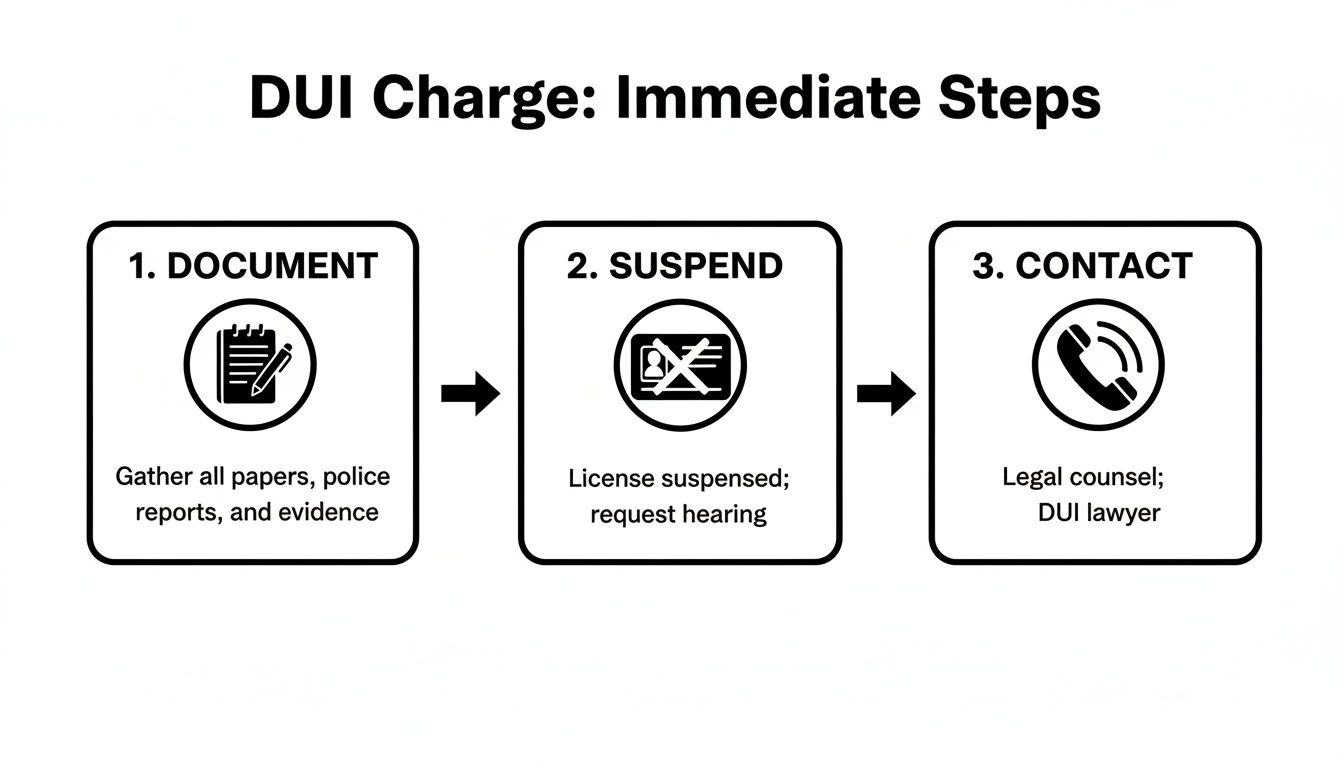
As you can see, documenting everything you remember and getting legal advice immediately sets the stage for a much stronger defence once we're in the court system.
Behind the Scenes: Crown and Judicial Pre-Trials
After a thorough review of the disclosure, the next stage involves pre-trial conferences. A Crown pre-trial is a discussion between your lawyer and the prosecutor where we present weaknesses we've found in their case. The goal is to negotiate a favourable resolution, which can sometimes lead to charges being reduced or even withdrawn.
If an agreement can't be reached, a judicial pre-trial may follow. This is a more formal meeting where both lawyers meet with a judge to map out the case, discuss key legal issues, and estimate how long a trial might take.
The Big Decision: Plead Guilty or Fight the Charge?
Based on the evidence and negotiations, you will face a critical choice: accept an early resolution or take your case to trial. An early plea can save time and stress, but if we’ve found serious flaws in the Crown’s case, fighting the charge is often the right move.
Pleading Guilty vs. Fighting Your Impaired Driving Charge in Ontario
| Consideration | Accepting an Early Resolution (Pleading Guilty) | Fighting the Charge (Proceeding to Trial) |
|---|---|---|
| Certainty of Outcome | Provides a definite, predictable outcome negotiated in advance. | The outcome is uncertain and depends on the judge's decision. |
| Timeline | Your case concludes much faster, often within a few months. | The process is much longer, potentially lasting a year or more. |
| Costs | Legal fees are generally lower as less court time is required. | Costs are significantly higher due to trial preparation and court days. |
| Potential Penalty | Often results in a reduced penalty or a plea to a lesser charge. | A "win" means a full acquittal and no criminal record. A "loss" could mean the maximum penalty. |
| Stress Level | The process is less stressful and emotionally taxing. | Trials are high-stakes and can be extremely stressful for you and your family. |
This decision should never be made under pressure. A skilled lawyer from Badesha Law will provide a clear, honest assessment of your options, explaining the potential outcomes so you can make a fully informed decision. Understanding the specific impaired driving laws in Ontario is key, as police must follow strict rules.
The Real-World Fallout of an Impaired Driving Conviction
Understanding the charges you’re facing is just the first step. The long-lasting fallout from an impaired driving conviction in Ontario can impact your finances, freedom, and future for years. The Crown can charge you under a few different sections of the Criminal Code, and a lawyer from our office can break down exactly what you’re up against.
The Different Types of Impaired Driving Charges
Police in Brampton and Peel Region typically investigate one of three main offences:
-
Impaired Operation: This charge focuses on your ability to drive. The Crown must prove your capacity to operate a vehicle was impaired by alcohol or drugs. Even slight impairment is enough.
-
'Over 80' (Blood Alcohol Concentration): This is a scientific charge. It means that within two hours of driving, your blood alcohol concentration (BAC) was at or over 80 milligrams of alcohol in 100 millilitres of blood.
-
Refusal or Failure to Provide a Sample: If an officer makes a lawful demand for a breath or blood sample and you refuse or fail to provide a proper sample without a valid excuse, you will be charged. The penalties are the same as for blowing over the limit.
How the Penalties Stack Up
The consequences get exponentially worse with each conviction. Even a first offence can turn your life upside down.
For a First Offence:
-
A mandatory minimum fine of $1,000 (or more for high BAC readings).
-
A Canada-wide driving prohibition for a minimum of 1 year.
-
A permanent criminal record.
-
Mandatory enrolment in Ontario's "Back on Track" program at your own expense.
-
Required installation of an ignition interlock device for at least one year after your driving ban ends.
For a Second Offence:
-
A mandatory minimum of 30 days in jail.
-
A minimum driving prohibition of 3 years.
For a Third (or more) Offence:
-
A mandatory minimum of 120 days in jail.
-
A potential lifetime driving ban.
These are just the starting points. If impaired driving causes an accident with injuries or death, you face years in a federal penitentiary.
The Hidden Costs That Haunt You for Years
The court-ordered penalties are just the beginning. A conviction sends out shockwaves that affect almost every corner of your life.
-
Sky-High Insurance Premiums: Your car insurance rates will explode. You'll be labelled "high-risk" and can expect to pay anywhere from $8,000 to $10,000 per year for basic coverage.
-
Barred from the U.S.: An impaired driving conviction makes you criminally inadmissible to the United States. This requires a complex and costly U.S. Entry Waiver application to overcome, with no guarantee of success.
-
Career Roadblocks: Many employers require a clean criminal record check. A conviction can disqualify you from jobs in transportation, finance, or roles working with vulnerable people.
-
Immigration Problems: For non-citizens, a conviction is considered serious criminality and can derail immigration status, lead to deportation, and bar you from ever becoming a permanent resident or citizen.
Understanding the legal blood alcohol level in Ontario and the technical details of these charges is crucial. The right lawyer can be the only thing standing between you and these devastating outcomes.
How a Strong Defence Can Challenge Your Impaired Driving Charge
A DUI charge can feel like an open-and-shut case, but that’s rarely true. The Crown’s case is built on a rigid set of rules and procedures. If the police make a single misstep, the entire case can fall apart. A criminal defence lawyer at Badesha Law will analyze the incident piece by piece to build a strategic defence.
Scrutinizing Police Procedure for Errors
Police in Ontario must follow a strict protocol. Any deviation can compromise the evidence they gather. We meticulously analyze every step:
-
The Traffic Stop: Did the officer have a legitimate, legal reason to pull you over? A stop based on a vague hunch may not hold up in court, potentially making all subsequent evidence inadmissible.
-
Roadside Screening: An officer must have a “reasonable suspicion” you have alcohol in your body to demand a roadside breath sample. We challenge whether their observations met the legal standard.
-
The Breathalyzer Test: At the police station, the breath technician must follow rules to the letter, including a mandatory 15-minute observation period before taking samples to prevent mouth alcohol from contaminating the reading. If they cut this time short, the results can be excluded.
Protecting Your Charter Rights
The Canadian Charter of Rights and Freedoms provides powerful protections. When police violate these rights, a judge can exclude key evidence—often the breathalyzer readings—which can gut the Crown's case.

Identifying and arguing these constitutional breaches is a core part of a strong defence strategy. Common Charter violations we look for include:
-
Right to Counsel (Section 10(b)): The police must inform you of your right to speak with a lawyer "without delay" and in private. Any failure to do so is a serious infringement.
-
Right to be Free from Unreasonable Search (Section 8): Taking a breath sample is a "search." If police lacked proper grounds to demand it, the evidence was obtained illegally and can be excluded.
-
Right to be Tried Within a Reasonable Time (Section 11(b)): If your case is delayed unreasonably by the Crown or court system, we can file to have the charges stayed.
Challenging the Technical Evidence
The breathalyzer is a machine, and machines can be wrong. Was the Approved Instrument properly calibrated and maintained? Detailed maintenance logs are required, and any gaps can create doubt about the reliability of your breath readings. Medical conditions can also sometimes affect a breathalyzer result. A winning defence is built by digging through every piece of evidence. You can explore other common defences for DUI charges in Ontario to learn how these cases are successfully fought.
Finding the Right Impaired Driving Lawyer in Brampton for You
Googling "impaired driving lawyer near me" will give you many options, but you need more than just a name. You need a real advocate who knows the Brampton courts and understands what’s at stake. At Badesha Law, a criminal defence law firm in Brampton, our entire focus is on building a clear, strategic defence based on the specific details of your situation.

What to Look for in a Peel Region Defence Lawyer
Not all criminal lawyers are experts in impaired driving cases, which are highly technical. You need a lawyer who lives and breathes this area of Ontario criminal law.
Here are the non-negotiables:
-
Deep Local Knowledge: Your lawyer should be a regular at the Brampton courthouse, familiar with local Crown Attorneys and judges. This insight is a massive advantage.
-
A Focus on Impaired Driving Cases: Ask what percentage of their practice is dedicated to DUI defence. A lawyer handling these files daily will be up-to-date on the latest legal arguments.
-
A Proven Track Record: A history of successfully challenging police evidence and achieving positive outcomes speaks volumes about a lawyer's skill.
Key Questions to Ask During Your Consultation
Your initial consultation is an interview. You must feel confident in the professional you hire to guide you through this crisis. A good lawyer will give you an honest, realistic assessment of your case—explaining both its strengths and weaknesses.
Walk into that meeting ready with some critical questions:
-
Who, specifically, will be handling my file?
-
What is your process for analyzing the police evidence (the disclosure)?
-
Based on my situation, do you see any potential Charter issues?
-
How are your legal fees structured? Do you use a block fee or bill by the hour?
-
How will you keep me updated on my case?
Our team at Badesha Law is built on direct communication and transparent block fees, so you know the full cost from the start with no surprises. You can learn more about our team of criminal lawyers in Brampton and our commitment to every client we represent.
FAQs: Impaired Driving Charges in Ontario
Being charged with impaired driving brings a flood of questions. Getting straight answers is the first step toward regaining control. Here are some of the most common questions we hear from people charged in Brampton and the Peel Region.
Will I go to jail for a first DUI in Ontario?
For a standard first-time offence without aggravating factors (like an accident or very high BAC readings), jail time is not a mandatory minimum penalty. Courts typically impose a fine starting at $1,000, a one-year driving ban, and a permanent criminal record. However, the Crown can seek jail time in more serious cases. Badesha Law can provide specific legal advice based on your circumstances.
Is there any way to get my licence back before the 90 days are up?
The immediate 90-day Administrative Driver's Licence Suspension (ADLS) is automatic and separate from the criminal court process. It is almost impossible to successfully appeal this suspension. You should plan on serving the full 90 days without driving. Driving while under this suspension leads to more serious charges.
How much does it cost to hire a DUI lawyer in Brampton?
The cost depends on the complexity of your case. A case that resolves early will cost less than one that proceeds to a full trial. Most experienced criminal defence lawyers in Brampton, including Badesha Law, use a block fee. This provides one clear, all-inclusive price from the start. We offer a free consultation to review your case and provide a transparent fee.
Can I travel to the US with a DUI charge or conviction?
An impaired driving conviction can make you criminally inadmissible to the United States, potentially for life. Even a pending charge can be enough for a U.S. border agent to deny you entry. Overcoming this requires a complex and expensive U.S. Entry Waiver application with no guarantee of success. The only sure way to protect your ability to travel is to avoid a conviction.
If you are looking for an "impaired driving lawyer near me" in Brampton, the stakes are too high to face alone. A conviction can alter your life permanently. Contact Badesha Law for a free consultation to discuss your case and learn how an experienced Brampton criminal lawyer can help protect your rights and your future.
No comment