


In Canada, the line between a lawful police investigation and an unlawful search and seizure is protected by a powerful constitutional right. This right is your shield against the state overreaching its authority, and it all comes down to Section 8 of the Canadian Charter of Rights and Freedoms. This section is a cornerstone of the Criminal Code of Canada‘s framework, ensuring that police actions are justified and not arbitrary.
At its core, Section 8 guarantees every Canadian’s right to a reasonable expectation of privacy. It means that the police or any government agent cannot legally search you, your home, your car, or your phone without a valid reason recognized by law. Understanding this right is the first step in building a strong criminal defence.
Your Charter Rights: The Foundation of a Criminal Defence
When you’re facing criminal charges, one of the most critical questions a skilled criminal lawyer in Brampton from a firm like Badesha Law will ask is: how did the police get this evidence? The entire case can stand or fall on whether the investigation respected your constitutional rights. The right to be secure against unreasonable search or seizure is often the bedrock of a successful defence strategy.

This isn’t some abstract legal theory; it’s a practical shield. Think of it as a personal privacy bubble that the government isn’t allowed to pop without proper justification, usually in the form of a warrant signed by a judge. This principle ensures police actions are based on evidence, not just arbitrary fishing expeditions for criminal activity.
To put it simply, these rights are designed to keep you in control of your personal information and property, free from unwarranted state intrusion. This table breaks down the core ideas behind your Section 8 rights.
Table: Core Principles of Your Section 8 Charter Rights
| Principle | What It Means for You | Example |
|---|---|---|
| Presumption of Privacy | The law starts by assuming you have a right to privacy. The government must prove its search was reasonable. | Police can’t randomly enter your home just because they’re curious. They need a warrant based on solid evidence. |
| Warrant Requirement | Generally, police must get a search warrant from a judge before conducting a search. | To search your laptop for specific files, police must first present a judge with evidence justifying the search. |
| Reasonableness | Any search, even one with a warrant, must be conducted in a reasonable and non-abusive manner. | A search warrant for a weapon doesn’t give police the right to read your personal diary or destroy your property. |
These principles work together to create a powerful safeguard. When the police fail to respect them, it opens the door for a strong legal challenge and a powerful criminal defence.
How an Unlawful Search Becomes a Criminal Defence
The concept of an unlawful search is the basis for one of the most effective defence strategies in Canadian criminal law. If police cross that line and gather evidence by violating your Section 8 rights, a skilled criminal lawyer can argue that the evidence is “fruit of the poisonous tree.” This means filing a Charter application to have this illegally obtained evidence excluded from your trial.
This crucial remedy comes from Section 24(2) of the Charter, which aims to protect the integrity of the justice system from police misconduct. Here’s how this criminal defence works:
-
Challenging the Search: Your lawyer will meticulously examine every detail of the police investigation, questioning whether they had a valid warrant or any other legal grounds to perform the search.
-
Excluding Evidence: If a judge agrees the search was unlawful, crucial evidence like drugs, weapons, or digital communications can be thrown out of court.
-
Weakening the Crown’s Case: Without that key evidence, the prosecution’s case can crumble. In many instances, this leads to a withdrawal of the charges or an acquittal at trial.
This is not an automatic process. It requires a detailed legal argument from an experienced professional who understands the complex nuances of Charter law. For anyone trying to understand the court process, our guide on what happens after you’ve been arrested provides crucial, time-sensitive information.
Navigating Searches in Brampton and the GTA
The line between lawful police work and a Charter violation can be incredibly thin. For example, the Canada Border Services Agency (CBSA) operates extensively in the Greater Toronto Area, conducting thousands of searches each year that lead to significant seizures. This highlights the constant tension between state security measures and your individual rights under Section 8.
When you’re facing charges in Brampton, a criminal lawyer from Badesha Law will analyze every detail of your case to ensure your rights were protected at every step.
Understanding What Makes a Police Search Lawful
In Canada, the state doesn’t get a free pass to investigate its citizens. The entire framework of criminal law is built on the principle that police must follow strict rules before they can intrude on your privacy. For a search to be legal, it has to be authorized by law; if not, it risks becoming an unlawful search and seizure in Canada.
This legal authority generally comes from one of three places. Think of them as the three main pillars holding up a lawful search. If even one of these pillars is shaky or missing, the entire search can collapse under legal scrutiny, giving your defence lawyer a powerful angle in court.
The three primary justifications for a police search are:
-
A Valid Search Warrant: This is the gold standard for a lawful search.
-
Search Incident to a Lawful Arrest: A specific, limited power police have when they arrest someone.
-
Recognized Common Law Exceptions: These are specific, narrowly defined situations where a warrant isn’t required.
Getting a handle on these categories is the first step in figuring out if your rights were violated.
The Power of a Search Warrant
A search warrant is a formal document a judge or justice of the peace issues, giving police permission to search a specific place for specific things. It’s not a blank cheque; it’s a highly detailed authorization. To get one, the police must swear an “Information to Obtain,” which lays out reasonable grounds to believe a crime has been committed and that evidence of that crime will be found at the location they want to search.
Imagine it as a permission slip with very strict instructions. It must clearly outline:
-
The exact address or location to be searched.
-
The specific items police are looking for (e.g., drugs, weapons, financial records).
-
A defined time frame during which the search must happen.
If police stray from these instructions—say, by searching your neighbour’s house by mistake or looking for items not listed in the warrant—the search can be thrown out. A criminal lawyer in Brampton from Badesha Law will meticulously review the warrant and the information used to get it, searching for any errors or overstatements that could invalidate the whole thing.
When police rely on a warrant, the burden of proof is on the defence to show that the warrant was invalid or the search was conducted unreasonably. This is a complex legal argument that requires deep knowledge of case law. You can learn more about how the burden of proof operates in criminal law in our detailed guide.
Search Incident to a Lawful Arrest
Another major justification for a warrantless search is what’s called a “search incident to arrest.” When police lawfully arrest you, they have the power to search you and the area immediately around you. The purpose of this search isn’t to go on a fishing expedition for evidence of other crimes, but for specific, protective reasons.
The Supreme Court of Canada has put clear limits on this power. A search incident to arrest is only lawful if its goal is to:
-
Ensure the safety of the officer and the public by finding any weapons.
-
Prevent the destruction or concealment of evidence related to the offence you were just arrested for.
-
Discover evidence that can be used at trial for the specific offence you’re being arrested for.
This is not a free-for-all. For example, if you’re arrested for impaired driving, the police might search you for alcohol or check your car’s glove box for documents. That power wouldn’t typically allow them to start reading all your text messages, as that would almost certainly be an excessive and unreasonable intrusion into your privacy without a specific warrant. The scope of the search must be directly tied to the reason for the arrest.
Recognizing When a Search Crosses the Line
While police have the authority to conduct searches, that power isn’t a blank cheque. The line between a legitimate investigation and an unlawful search and seizure in Canada is drawn by the Charter and decades of strict legal precedent. When police step over that line, it’s not a simple mistake—it’s a violation of your fundamental rights that can put the entire case against you in jeopardy.

Understanding how police can overstep their authority is the first step in building a powerful defence. These violations aren’t always as dramatic as kicking down a door. Often, they are subtle but legally fatal errors made during an investigation, and spotting them is the specialty of an experienced criminal defence lawyer.
When a Warrant Fails the Legal Test
A search warrant might seem like an unbreakable shield for police, but it can be surprisingly fragile. A warrant can be challenged and thrown out if the information police used to get it was flawed. This is one of the first things a defence lawyer will dig into.
Common issues that can kill a warrant include:
-
Misleading Information: The police gave exaggerated, false, or incomplete details to the judge just to get the warrant signed.
-
Lack of Reasonable Grounds: The information was flimsy, based on an unreliable source or just a hunch, failing to meet the legal standard of “reasonable and probable grounds.”
-
Vague or Overly Broad Terms: The warrant didn’t pinpoint the exact place to be searched or the specific items to be seized, giving police far too much room to roam.
If your lawyer can prove the warrant was obtained improperly, any evidence they found with it could be thrown out of court.
Exceeding the Scope of the Search
Even with a valid warrant or during a lawful search after an arrest, police have to stay in their lane. They can’t use a limited authorization as an excuse for a full-blown “fishing expedition” to look for evidence of other crimes. The scope of their search must always be tied to its original, lawful purpose.
For instance, a warrant to search a house for a stolen TV doesn’t give police the right to start reading your private journals or copying your computer’s hard drive. In the same way, being arrested for public intoxication doesn’t justify a deep forensic dive into your smartphone. When a search strays from its authorized purpose, it becomes an unlawful invasion of your privacy.
The concept of a “reasonable expectation of privacy” is central to all of this. The Supreme Court of Canada has made it clear that Canadians have a very high expectation of privacy in their homes, and an even higher one when it comes to the personal data on their phones and computers. This principle sets a very high bar for police to justify these kinds of intrusive searches.
The Myth of the Traffic Stop Search
One of the most common places where rights get violated is during a routine traffic stop. An officer pulls you over for something minor like speeding, but then starts asking questions or making demands that have nothing to do with a traffic ticket. They might ask to look in your trunk or tell you to hand over your phone.
In most of these situations, you are not required to consent to these searches. A traffic violation does not automatically give police a free pass to search your vehicle. They still need reasonable and probable grounds to believe you’ve committed a more serious crime, like impaired driving or drug possession.
If an officer pressures you into a “voluntary” search without legal grounds, a criminal lawyer in Brampton can argue that your consent wasn’t truly voluntary and the search was therefore unlawful. Protecting your rights starts with knowing you can say “no” to these requests. The team at Badesha Law has extensive experience defending clients in Brampton whose cases started in these exact scenarios.
Legal theory is one thing, but your rights only really matter when they’re tested in the real world. Figuring out what makes a search unlawful becomes a lot clearer when you see how the rules apply to situations you could actually face right here in Brampton or the Peel Region. These encounters often happen fast, leaving you feeling pressured and unsure what to do.
This section breaks down the most common scenarios where a police search can cross the line from a lawful investigation into a violation of your Charter rights. Knowing how to react in these moments is your best first line of defence.
Vehicle Searches During Traffic Stops
A routine traffic stop is one of the most frequent places where things can escalate into a search. Picture this: you get pulled over on Hurontario Street for something minor, like a rolling stop or speeding. The officer writes the ticket, but then starts asking questions that have nothing to do with the stop. “Anything in the car I should know about?” or “You mind if I take a quick look in your trunk?”
This is a critical moment. In most cases, a simple traffic ticket doesn’t give the police the authority to search your vehicle. They need something more—what the law calls reasonable and probable grounds—to believe there’s evidence of a different, more serious crime inside the car, like impaired driving or drug possession.
Without those grounds, they’re essentially just asking for your voluntary consent. Remember these key points:
-
You Have the Right to Refuse: You are not obligated to agree to a search. You can politely and clearly state, “Officer, I do not consent to a search.”
-
Silence is Golden: Beyond providing your licence, registration, and insurance, you have the right to remain silent. You don’t have to answer questions about where you’re going, where you’ve been, or what’s in your car.
-
“Plain View” is an Exception: If an officer sees something illegal (like drugs or a weapon) in plain sight just by looking through your car window, they can seize it. This doesn’t, however, automatically grant them permission to search the entire car without further grounds.
Consenting to a search makes it dramatically harder for a criminal lawyer in Brampton to argue later that the search was unlawful. Protecting your rights starts with not giving them away. For more context on traffic-related issues, our guide on how to fight a careless driving ticket provides some useful background.
Searches of Your Home With or Without a Warrant
Your home is where your expectation of privacy is at its absolute highest. Police can’t just walk into your home without a valid warrant, except in very specific and urgent circumstances (like responding to a 911 call about violence happening right now).
A search warrant is a specific authorization from a judge. If police arrive with one, they must show it to you. It will lay out exactly what areas they are allowed to search and what they are looking for. Any search that goes beyond what’s written in that warrant can be deemed illegal. If police find evidence of another crime while searching outside the warrant’s specific scope, a lawyer can argue to have that evidence thrown out of court.
If police knock on your door without a warrant and ask to come in or look around, you have the right to say no. They cannot force their way in unless there are “exigent circumstances,” a high legal bar that rarely applies.
Digital Searches of Your Phone or Computer
In today’s world, our phones and computers hold more private information than our homes ever could. The Supreme Court of Canada gets this, which is why it gives an extremely high expectation of privacy to our digital devices. As a general rule, police cannot search your phone without a specific warrant, even if you are under arrest.
A search “incident to arrest” might allow them to seize your phone, but it doesn’t give them the green light to start scrolling through your messages, photos, or emails. They need a separate warrant—often called a “telewarrant”—that specifically authorizes a search of the device’s contents.
Any attempt to search your phone without this judicial green light is a serious breach of your Section 8 Charter rights. The team at Badesha Law has deep experience challenging evidence that was obtained through illegal digital searches.
To help clarify these situations, here is a quick overview of what police are generally allowed to do and what your rights are during common types of searches.
Your Rights During Different Police Searches
| Search Type | Police Authority (General Rule) | Your Rights & Key Considerations |
|---|---|---|
| Vehicle Search (Traffic Stop) | Requires reasonable and probable grounds to believe a crime has been committed, or your voluntary consent. A traffic violation alone is not enough. | You can refuse to consent to a search. You must provide documents but do not have to answer unrelated questions. |
| Home Search | Almost always requires a specific search warrant signed by a judge. Exceptions are very rare (e.g., immediate threat to life). | You have the right to see the warrant. Police can only search the areas and for the items listed. You can refuse entry without one. |
| Personal “Pat-Down” Search | Can conduct a “pat-down” for safety if you are being detained, but it’s limited to searching for weapons. More invasive searches require arrest. | This is not a search for evidence. Police cannot go into your pockets unless they feel something that is clearly a weapon. |
| Phone/Digital Search | Requires a specific warrant to search the contents, even if the phone was seized after an arrest. Your digital privacy is highly protected. | Police can seize your phone upon arrest, but they cannot search its data without a warrant. Do not provide your password. |
Understanding these distinctions is crucial. While the law is complex, the core principle is simple: police need a legitimate reason to intrude on your privacy, and the more private the space (like your home or phone), the stronger that reason must be.
Using a Charter Defence to Exclude Evidence
Finding out the police conducted an unlawful search is a massive turning point in any criminal case, but it’s not an automatic win. A Charter breach doesn’t just make the charges vanish. What it does is give your criminal lawyer the legal firepower to argue that whatever the police found during that search should be thrown out of court. This is where a powerful Charter defence starts to take shape.
The main tool for fighting back against an unlawful search and seizure in Canada comes from Section 24(2) of the Charter. This is the rule that allows a judge to exclude evidence if using it would damage the reputation of the justice system.
You might have heard the “fruit of the poisonous tree” analogy. It’s a perfect fit here. If the police’s search method (the tree) was illegal and violated your rights, it’s considered “poisonous.” That means any evidence they found as a result (the fruit) is tainted. Section 24(2) is how your lawyer argues that the court shouldn’t be allowed to touch that poisonous fruit.
This isn’t a simple process. It hinges on a detailed legal argument from an experienced criminal defence lawyer who can draw a straight line from the police misconduct to why the evidence has no place in a fair trial.
The Three-Part Test from R v Grant
When a judge is asked to exclude illegally obtained evidence, they don’t just go with their gut. They have to apply a specific, three-part legal test from the Supreme Court of Canada’s landmark case, R. v. Grant. This test is all about balancing the need to hold police accountable against society’s interest in having a case decided on all the evidence.
A skilled lawyer, like the team at Badesha Law, structures their entire argument around these three factors to persuade the judge that excluding the evidence is the only right call.
The three stages of the Grant test are:
-
The Seriousness of the Charter-Infringing State Conduct: First, the court looks at just how badly the police behaved. Was it a small, honest mistake in the paperwork? Or was it a blatant, deliberate violation of your rights? A search that was clearly a “fishing expedition” with no legal basis is worlds away from a minor technical error on a warrant.
-
The Impact of the Breach on the Charter-Protected Interests of the Accused: Next, the court weighs how deeply the illegal search invaded your privacy. A search of your home or the private contents of your cell phone is a huge intrusion. On the other hand, finding something in an open field would have a much lower impact on your personal privacy.
-
Society’s Interest in an Adjudication on the Merits: Finally, the court considers the public interest. How crucial is the evidence to the Crown’s case? If the evidence is rock-solid and essential for a serious charge (like a murder weapon), the court might be more hesitant to throw it out. But, if the police misconduct was severe enough, this factor can easily be outweighed.
This infographic shows how police searches can escalate, moving into more and more private areas of your life.
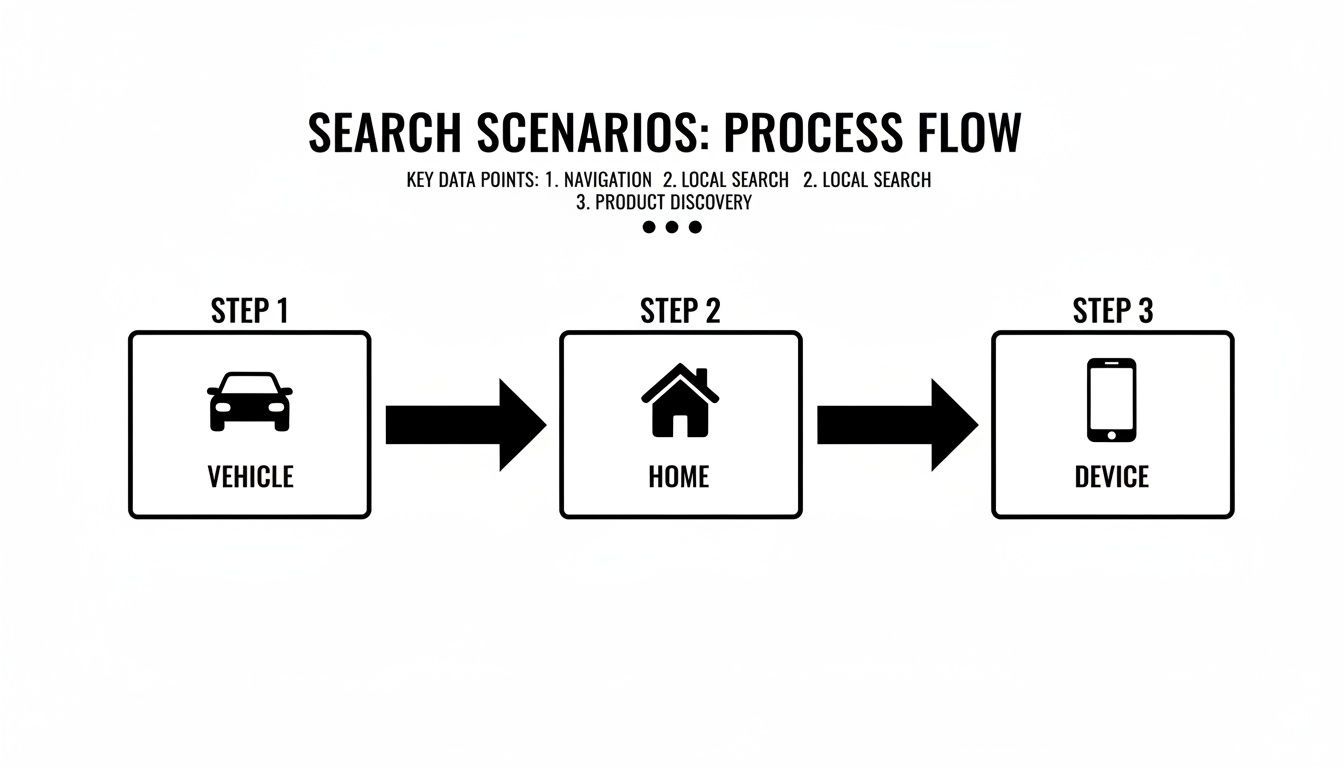
As you can see, a search can quickly progress from a less private space like a car to the highly protected zones of a home or a personal device. With each step, the seriousness of a Charter breach gets bigger.
How a Lawyer Dismantles the Prosecution’s Case
A criminal lawyer in Brampton uses the Grant test like a roadmap to pick apart the Crown’s evidence. By proving the police conduct was serious and the impact on your privacy was severe, they build a compelling case for exclusion. If the judge agrees, that evidence is out. It becomes inadmissible.
A successful Charter application under Section 24(2) can be devastating to the Crown’s case. If the excluded evidence was the only proof of the crime—for example, the drugs in a possession case—the charges will almost certainly be withdrawn or dismissed.
This is the ultimate goal of a search and seizure defence. It’s not about finding a “technicality” to get away with something. It’s about upholding the integrity of our entire justice system and making sure the rights guaranteed to all Canadians are actually respected. When police are allowed to benefit from breaking the rules, it erodes public trust.
If you need to find a criminal defense attorney near me, it’s critical to choose a firm that truly understands how to make these powerful Charter arguments count in court.
How a Brampton Criminal Lawyer Defends Your Rights
Knowing your rights is one thing; actually enforcing them in a courtroom is another. When you’re facing criminal charges that hinge on a potential unlawful search and seizure in Canada, the strategic moves of an experienced criminal lawyer are what turn a constitutional principle into a powerful, case-winning defence. At Badesha Law, we have a clear process designed to protect our clients in Bramton at every single stage.

It all starts with a free, confidential consultation. This is our chance to hear your side of the story, get a handle on the circumstances of the search, and give you a straight, honest opinion on the strength of a potential Charter challenge. That first meeting lays the groundwork for our entire defence strategy.
Meticulous Evidence and Warrant Review
Once you hire us, our first move is to demand and meticulously review every piece of evidence the police and Crown have against you. This is called “disclosure.” We go through police notes, officer reports, witness statements, and any video footage with a fine-toothed comb, looking for inconsistencies and legal errors.
If the police used a search warrant, we get our hands on the “Information to Obtain” (ITO)—that’s the sworn document police used to convince a judge to grant the warrant in the first place. We’re hunting for crucial mistakes, such as:
-
Misleading or downright false information provided to the judge.
-
A lack of reasonable grounds to justify the search.
-
Warrants that are drafted too broadly or are dangerously vague.
Finding just one significant flaw in this paperwork can be enough to get the entire search thrown out.
Filing a Formal Charter Application
After we’ve pinpointed a violation of your Section 8 rights, we don’t just casually mention it in court. We file a formal Charter application. This legal document puts the Crown and the judge on notice that we are challenging the legality of the search and asking for the evidence to be excluded under Section 24(2) of the Charter.
This application isn’t just a form; it’s a detailed legal argument packed with case law that explains exactly how the police overstepped their authority. It’s a formal demand for the justice system to hold the state accountable for its actions and protect your constitutional rights.
Negotiation and Vigorous Advocacy
Filing a strong Charter application creates serious leverage. It sends a clear signal to the Crown prosecutor that their case has a major weakness. More often than not, this opens the door to negotiations for a withdrawal of the charges, a reduction to a lesser offence, or another favourable outcome without the stress and risk of a trial.
Of course, we are always prepared to argue the application vigorously in a Brampton courtroom. The team at Badesha Law has extensive experience presenting these complex arguments before judges right here in the Peel Region. Our deep familiarity with local court procedures and the Crown prosecutors’ offices allows us to advocate effectively for our clients. For more information, you can learn about the dedicated work of a criminal defence lawyer in Brampton and how we fight to protect your future.
Your Questions Answered: Search and Seizure FAQs
The moments after a police search are filled with questions and uncertainty. Here are some straightforward answers to the questions we hear most often from our clients in Brampton.
Can I Fight the Search if I Said “Yes” to It?
Giving consent to a police search makes things trickier, but it’s not the end of the road. For your consent to be legally valid, the Crown must prove it was both informed and voluntary.
That means you had to understand you had the right to say “no,” and you weren’t pressured, tricked, or intimidated into agreeing. If an officer implied you had no choice or misled you about their authority, a criminal lawyer in Brampton can argue your consent wasn’t valid. If the argument succeeds, the search becomes unlawful. This is why the safest response is always to state clearly and calmly, “I do not consent to a search.”
What Is the “Plain View” Doctrine?
The “plain view” doctrine is a legal exception allowing police to seize illegal items without a warrant if they are immediately visible from a place the officer is legally allowed to be.
Think of it this way: if you’re pulled over for speeding and an officer sees a handgun sitting on your passenger seat, they can seize it. But this doctrine is very limited. It doesn’t give them a free pass to then rummage through your trunk or glove compartment. Their authority is strictly confined to what they can see in plain sight.
Does an Illegal Search Get My Case Thrown Out?
Not automatically, but it gives your defence powerful ammunition. When a search violates your rights, it doesn’t just disappear; your lawyer uses it strategically. We file a Charter application under section 24(2) to have the illegally obtained evidence excluded from your trial.
If the judge agrees to throw out the evidence, and that evidence is the cornerstone of the Crown’s case—like the drugs in a possession for the purpose of trafficking charge—the prosecution may be left with nothing. This is often what leads to charges being withdrawn or dismissed.
Can Police Search My Phone During a Traffic Stop?
As a general rule, absolutely not. Canadian courts have recognized that our phones hold the most intimate details of our lives, and we have a very high expectation of privacy in them.
Police almost always need a specific search warrant, known as a telewarrant, to go through your phone’s contents, even if you are under arrest. A warrantless search of a cell phone is only permitted in the rarest of urgent situations. Being pulled over for a traffic ticket is nowhere near that threshold.
If you are facing criminal charges after a police search in Brampton or anywhere in the Peel Region, protecting your rights is the first and most critical step. The team at Badesha Law has the expertise to dissect every detail of the police investigation, find Charter violations, and build a powerful defence. Contact us for a free, confidential consultation to understand your options. Visit us at https://criminallawyerinbrampton.com to get the help you need.
No comment