


When you're facing a criminal charge in Canada, one of the first and most stressful questions is always, "how much is this going to cost me?" In Brampton and across the country, the honest answer is that a lawyer's fees can range from a few thousand dollars for a straightforward guilty plea to tens of thousands for a complex trial.
The final price tag really depends on the specifics of your charge under the Criminal Code of Canada, how complicated the evidence is, and the path we take to defend you.
Decoding the Price of Your Defence
Facing the Canadian justice system is scary enough without the added worry of a massive legal bill. But the cost of hiring a criminal lawyer in Brampton isn't just a random number; it's a calculated investment in protecting your rights and your future. Understanding the key factors that shape the final bill is crucial.
By far, the biggest driver of cost is how your case gets resolved. A case that ends with the charges being withdrawn or with a guilty plea takes up far less of a lawyer's time and resources than one that has to go all the way to a trial. A trial means hours upon hours of preparation—interviewing witnesses, analyzing evidence, filing court motions—and then days spent fighting for you in a courtroom, all of which naturally drives up the cost.
Key Elements Influencing Legal Fees
To understand what you're paying for, you need to know what goes into a lawyer's quote. It really boils down to three main things:
- Type of Charge: Defending a simple theft under $5,000 charge is going to cost a lot less than fighting a serious assault or an impaired driving case. The more serious the charge, the more complex the evidence and the harsher the potential penalties under the Criminal Code of Canada.
- Case Complexity: The amount of work required can skyrocket depending on the details. The volume of police disclosure we have to review, the number of witnesses involved, and whether we need to file special legal motions (like a Charter application) all add hours of dedicated work to your file.
- Resolution Path: As I mentioned, negotiating a plea deal is a completely different financial commitment than preparing for and running a multi-day trial.
This next chart gives you a stark visual of just how different the financial investment can be when you compare resolving a case early versus taking it to trial.
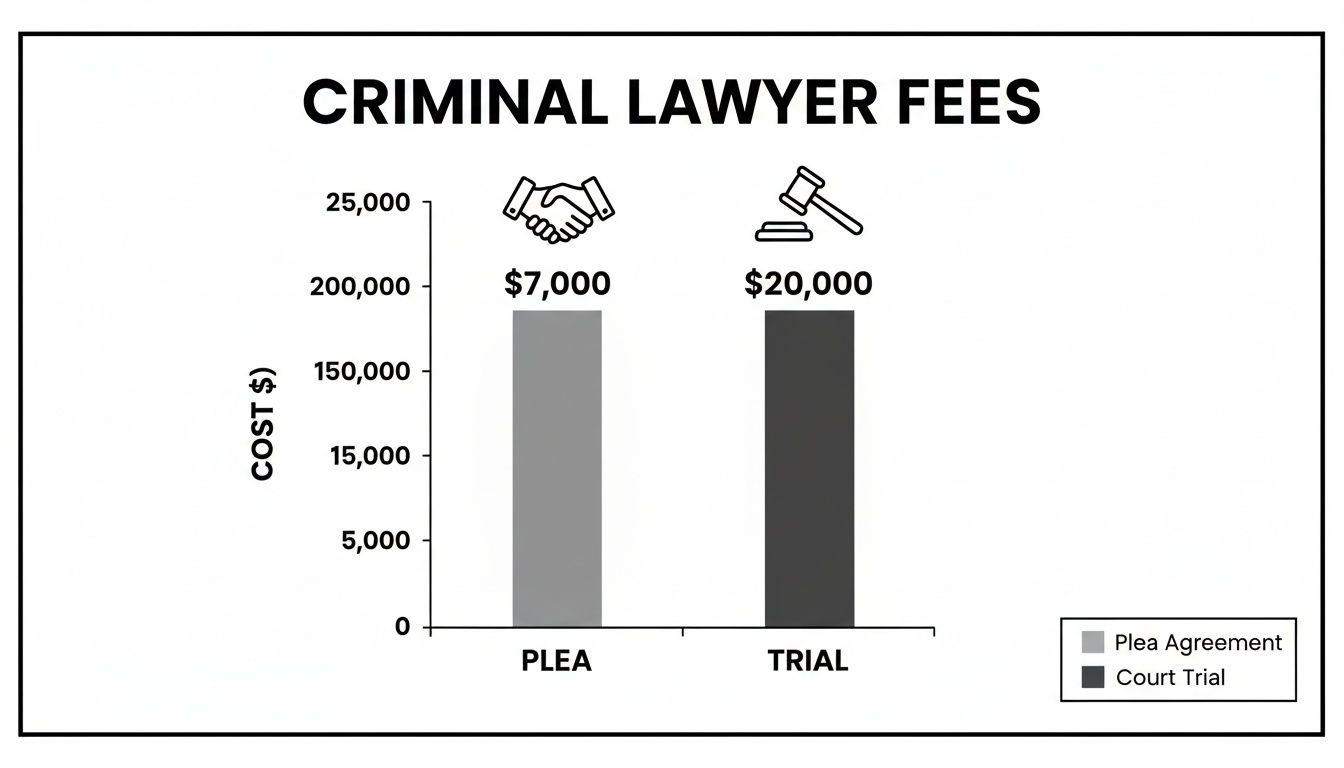
It's pretty clear: a trial represents a much larger financial commitment, which directly reflects the intense preparation and courtroom time needed to fight and win.
Estimated Criminal Lawyer Fee Ranges in Canada
To give you a clearer picture, here’s a table with some general fee ranges for common criminal charges in Canada. While these are broad estimates, they reflect common pricing in major urban centres like Brampton and the Peel Region.
Now, it's really important to remember that these are just estimates. Every case is unique, and a precise quote can only be provided after a detailed consultation to talk about your specific situation.
| Type of Charge | Resolution Without Trial (Plea or Withdrawal) | Cost for a Trial (Per Day Estimate) |
|---|---|---|
| Impaired Driving / DUI | $5,000 – $10,000+ | $7,500 – $10,000+ |
| Simple Assault | $3,500 – $7,500+ | $7,500 – $10,000+ |
| Domestic Assault | $5,000 – $10,000+ | $7,500 – $10,000+ |
| Theft Under $5,000 | $3,500 – $7,500+ | $7,500 – $10,000+ |
| Bail Hearing | $2,000 – $5,000+ | N/A |
Understanding these ranges is the first step toward making a smart, informed decision about your defence. This knowledge empowers you to ask the right questions and budget properly for the fight ahead. For more guidance on what makes a lawyer the right fit, you can learn more about finding the best criminal attorney near you in our detailed guide.
Understanding How Lawyers Bill for Their Time

When you get a quote from a criminal lawyer in Brampton, it's critical to understand how they arrived at that number. Legal billing isn’t some secret code; it’s usually based on a few standard models designed to fit the type of case you’re facing. Knowing how these work helps you compare quotes and make a financial decision you can feel confident about.
Most criminal defence lawyers structure their fees in one of three ways: a flat fee, an hourly rate, or with an initial retainer. Each method has its own logic, and the one a lawyer picks often comes down to how complex and predictable your case is. Let's break down exactly what each of these means for you.
Flat Fees for Predictable Cases
A flat fee is exactly what it sounds like: one single, upfront price for a specific legal service or for handling your entire case up to a certain point, like a plea deal. This is easily the most common way criminal defence is billed in Canada because it offers total clarity and predictability for both you and your lawyer.
Think of it like hiring a contractor to renovate your kitchen. They look at the job, figure out the cost of materials and labour, and give you one fixed quote. You know the total cost from day one, with no surprises down the road. This approach is perfect for cases with a predictable scope, like a straightforward impaired driving charge or a simple theft case where a trial is unlikely.
A flat fee provides cost certainty. You’re paying for your lawyer’s expertise and a specific outcome or stage of work, not just the hours they clock. This lets you budget effectively without worrying that the bill will grow every time you pick up the phone.
This structure covers all the work within the agreed-upon scope, from reviewing police evidence to negotiating with the Crown Attorney. If the case takes an unexpected turn and needs work beyond that scope, like heading to trial, a separate fee would be discussed.
Hourly Billing for Complex and Unpredictable Matters
While it’s less common for most standard criminal cases, hourly billing is sometimes the only practical option for really complex and unpredictable situations. With this model, you pay for the actual time your lawyer spends working on your file, billed at their set hourly rate.
This is more like paying that same contractor by the hour to fix a major, unforeseen problem, like a hidden leak behind a wall. The final cost is a mystery at the start because nobody knows how much work it will take. This structure is often used for very serious charges, cases with mountains of evidence to review, or matters that could evolve in completely unexpected ways.
The main benefit of billing by the hour is that you only pay for the exact time spent on your file. The big downside, however, is the financial uncertainty. Costs can climb quickly if the case gets more complicated than anyone first thought.
The Role of the Retainer
A retainer isn't really a fee model on its own. Instead, it’s a down payment or deposit you give the lawyer before they start working on your case. Whether your lawyer charges a flat fee or works hourly, they will almost always ask for a retainer to officially hire them and secure their services.
Here’s how it works:
- You pay a lump sum upfront, which the lawyer holds for you in a special trust account.
- As your lawyer works on your case, they draw their fees from that retainer.
- If the retainer funds get low, you might be asked to "top it up."
- Any money left over in the retainer at the end of your case is returned to you.
This initial payment confirms your commitment and makes sure the lawyer is compensated for the immediate work they need to do. Understanding these billing methods is a huge part of the process. In fact, knowing what questions to ask a lawyer about their fees is a cornerstone of learning how to choose the right criminal lawyer in Brampton for your unique situation.
Estimating Costs for Cases Resolved Without a Trial
Here’s a critical fact about the justice system that most people don't realize: the vast majority of criminal cases in Canada are resolved without ever seeing the inside of a trial courtroom. This is huge, because the answer to "how much does a criminal lawyer cost?" changes dramatically when a trial is off the table.
Resolving your case early is the most common and financially manageable path through the system. It saves an immense amount of time, stress, and—most importantly—money. When a case is resolved without a trial, you sidestep the extensive preparation, court time, and procedural complexities that make trials so expensive.
Instead of gearing up for a courtroom battle, your lawyer’s efforts are focused on negotiation and strategic advocacy behind the scenes.
The Legal Work Behind a Non-Trial Resolution
So, what are you actually paying for when your case doesn't go to trial? The legal work is still intensive and requires a ton of expertise. A skilled criminal lawyer in Brampton will dedicate their time to several key activities designed to get the best possible outcome for you.
This process typically includes:
- Thorough Disclosure Review: Meticulously analyzing all the evidence the Crown has against you—police notes, witness statements, and any video or audio recordings—to find the weak spots.
- Crown Pre-Trials: Meeting with the Crown Attorney to discuss the strengths and weaknesses of their case and to negotiate a potential resolution.
- Strategic Negotiations: Pushing for the withdrawal of your charges, a reduction to a lesser offence, or an agreement on a more favourable sentence.
- Client Meetings: Keeping you in the loop every step of the way, explaining your options, and giving you the legal advice you need to make critical decisions about your future.
This focused work is all aimed at one thing: securing a resolution that protects your criminal record and lets you move on with your life as quickly as possible.
Realistic Fee Ranges for Common Charges
For most people facing criminal charges in Ontario, resolving a case without trial typically involves legal fees ranging from $1,500 to $10,000. This bracket applies to the majority of matters that end through plea bargains or other negotiated outcomes.
Data from defence firms across the province shows that most lawyers in the Greater Toronto Area use flat fees within this range for common, straightforward cases. You can explore more about what influences these costs by reviewing insights on Ontario legal fees.
To give you a more concrete picture, here are some typical flat fee ranges for non-trial resolutions of common charges in the Brampton area:
- DUI / Impaired Driving: For a guilty plea resolution, fees often fall between $5,000 and $10,000. This covers the complex work of reviewing technical evidence and negotiating a sentence that minimizes penalties like licence suspensions.
- Simple Assault or Domestic Assault: Fees for resolving these cases typically range from $3,500 to $7,500. The work often involves negotiating for a peace bond or a conditional discharge, which can help you avoid a criminal conviction.
- Theft Under $5,000: For a straightforward theft or shoplifting charge, legal fees for a non-trial resolution are generally between $3,500 and $7,500. Lawyers often work to secure a diversion program, which results in the withdrawal of charges upon completion.
These figures reflect the value of securing a positive outcome efficiently. For example, a successful negotiation for a conditional discharge can prevent you from having a lifelong criminal record—a result that is priceless. For a deeper understanding of this specific outcome, check out our guide on what a conditional discharge in Canada means.
Choosing to resolve a case without a trial isn't giving up; it's a strategic decision. It allows your lawyer to focus on damage control and negotiation, often leading to outcomes that protect your future far more effectively than a risky and expensive trial.
Ultimately, investing in experienced legal counsel for a non-trial resolution is an investment in certainty and damage control. It provides a clear path forward and a predictable cost, allowing you to close a difficult chapter without the immense financial burden of a full trial.
The Financial Reality of a Criminal Trial
Deciding to take a criminal case to trial is a major commitment, both emotionally and financially. While resolving a case without a trial often revolves around negotiation and strategic settlements, a trial is a full-scale legal battle. The answer to "how much does a criminal lawyer cost?" gets significantly higher the moment you step into the courtroom, reflecting the immense work needed to challenge the Crown's case head-on.
This jump in cost isn’t arbitrary; it’s directly tied to the intensive, high-stakes preparation and in-court performance required. A trial is where your freedom, reputation, and criminal record are on the line, and a lawyer's expertise is put to the ultimate test. It's an investment in a robust, comprehensive defence designed to dismantle the prosecution's arguments, piece by piece.
The Intensive Labour Behind a Courtroom Defence
Preparing for a trial is a demanding process that begins long before anyone sets foot in the courthouse. Unlike a non-trial resolution, which involves focused negotiations, trial preparation means building a case from the ground up, anticipating the Crown’s every move, and preparing to counter it effectively.
This comprehensive preparation involves numerous critical tasks:
- Drafting Complex Legal Applications: This can include filing Charter applications to exclude evidence that was obtained unlawfully, which is a key strategy for many defences.
- Detailed Witness Preparation: Your lawyer must identify, interview, and prepare your witnesses for the pressures of testifying and facing cross-examination.
- Developing Cross-Examination Strategies: This involves meticulously analyzing the Crown’s evidence and witness statements to find inconsistencies and craft pointed questions to undermine their credibility in court.
- Legal Research and Argument Development: Hours are spent researching case law and sections of the Criminal Code of Canada to build strong legal arguments that will be presented to the judge.
Each of these steps is essential for a successful defence and requires significant time, skill, and legal acumen.
A criminal trial is not just a single event; it's the culmination of hundreds of hours of behind-the-scenes work. You are paying for your lawyer's strategic planning, meticulous preparation, and their ability to advocate for you under the immense pressure of a courtroom.
Calculating the Per-Day Cost of a Trial
The financial commitment of a trial is often measured in days. Each day spent in court is a full day of intense focus for your lawyer, preceded by hours of evening preparation for the next day's proceedings. For this reason, trial fees are typically quoted on a per-day basis, covering both in-court time and the associated prep work.
Criminal cases that proceed to trial in Ontario often involve substantially higher legal costs, with estimates ranging from $40,000 to $50,000 or more, and some complex cases exceeding $100,000. A single day of trial representation averages approximately $6,100 in Ontario, which shows how quickly a multi-day trial can lead to significant expenses. You can discover more insights about criminal lawyer fee structures in Ontario.
This per-day rate reflects the lawyer's undivided attention. They aren't working on other files; their entire focus is on defending you. For a trial lasting three or four days, the costs accumulate rapidly, underscoring why trials are a last resort for many. However, when your future is at stake, the expertise of a skilled trial lawyer is an invaluable investment. Locating the right advocate is crucial, and understanding your options for a criminal defense attorney near you is a critical step in this process. When facing the full resources of the Crown prosecutor, having an experienced criminal lawyer in Brampton is not a luxury—it is essential protection.
Key Factors That Drive Your Final Legal Bill
The initial fee estimate a lawyer gives you is a starting point, a helpful ballpark figure. But the final bill for your defence is never one-size-fits-all. Several key variables can shift the total cost, and understanding them is crucial. It helps you see why one case might be more expensive than another and lets you better anticipate the potential expenses for your own situation.
Think of it like a home repair. A simple fix can get a lot more complicated once you start looking behind the walls. A seemingly straightforward criminal charge can reveal layers of complexity that directly impact the amount of work and expertise your legal team needs to put in. Your final bill is a direct reflection of the time, skill, and resources needed to build the strongest possible defence for you.
The Lawyer's Experience and Reputation
One of the biggest factors influencing how much a criminal lawyer costs is their experience. A senior lawyer with decades of courtroom victories and a strong reputation among Crown Attorneys and judges in Brampton will naturally command a higher fee than a junior associate who is still building their practice.
This is a classic case of getting what you pay for. While a seasoned lawyer's flat rate might be higher, their expertise can often lead to a more efficient and favourable resolution. Their deep understanding of the Criminal Code of Canada and local court procedures can save time and money in the long run, potentially spotting a path to get your charges withdrawn that a less experienced lawyer might miss.
The Complexity of Your Case
Beyond the lawyer you choose, the specific details of your case play a massive role in the final cost. A charge is rarely just a charge; it comes with a unique set of facts, evidence, and legal challenges that dictate the workload.
Several elements can dial up the complexity and, therefore, the cost:
- Multiple Charges: If you’re facing several charges from a single incident, your lawyer has to prepare a defence for each one. That multiplies the amount of work required.
- Volume of Disclosure: A case with hundreds of pages of police notes, hours of video, and numerous witness statements requires a ton more time to review than a case with minimal evidence.
- Legal and Factual Nuances: Complex cases might involve tricky legal arguments, contradictory evidence, or require extensive investigation to get to the truth.
The Need for Special Legal Applications
Sometimes, the best defence involves challenging how the police gathered their evidence. If your rights under the Canadian Charter of Rights and Freedoms were violated—for instance, through an unlawful search or by not being allowed to speak with a lawyer—your defence counsel can file a Charter application to get that evidence thrown out.
A Charter application is basically a mini-trial within your main case. It requires extensive legal research, drafting detailed court documents, and arguing complex constitutional law before a judge. All of that adds a significant layer of work and cost to your file.
The Use of Expert Witnesses
In certain cases, expert testimony is essential to challenge the Crown’s evidence. For charges like impaired driving or serious assault, your defence may need to hire an independent expert to punch holes in the prosecution's theory.
Examples include:
- A toxicologist to challenge the results of a breathalyzer test.
- A forensic specialist to analyze DNA or other physical evidence.
- An accident reconstructionist for dangerous driving cases.
The fees for these experts are separate from your lawyer’s fees and are a necessary disbursement in complex cases. While they add to the overall expense, their testimony can be the very thing that creates reasonable doubt and wins your case.
What to Do if You Cannot Afford a Lawyer in Canada
Facing a criminal charge is incredibly stressful, and the thought of not being able to afford a lawyer can make an already bad situation feel hopeless. If you’re in Canada and worried about the cost of a criminal lawyer, it’s crucial to know that you have options. The justice system has resources in place to ensure a lack of money doesn't leave you completely defenceless.
Understanding these avenues is the first step toward building your defence, even with a tight budget. These services are specifically designed to give essential legal help to those who need it most.
Legal Aid
Each province and territory in Canada has its own Legal Aid plan, a government-funded organization that provides legal services to low-income people. If you qualify, Legal Aid may cover the costs of hiring a private criminal defence lawyer to represent you. For example, in Ontario, this is handled by Legal Aid Ontario (LAO).
To get help, you have to meet their criteria, which are based on two main things:
- Financial Eligibility: Your income and assets must fall below a certain line. Legal Aid will look at your family size, all sources of income, and any significant assets you own to see if you qualify.
- Case Eligibility: Your case has to be serious enough to get coverage. Generally, this means there’s a real chance you could go to jail if convicted, as set out in the Criminal Code of Canada.
Applying for Legal Aid means you'll have to provide detailed financial information. While the process can feel a bit intrusive, it's a necessary step to get this invaluable support.
Legal Aid isn't just about getting a free lawyer; it's about a core principle of our justice system—the right to a fair defence, no matter what’s in your bank account. It ensures everyone gets a fighting chance in court.
The Role of Duty Counsel
If you show up in court without a lawyer—especially for your first appearance or a bail hearing—you can get help from Duty Counsel. These are lawyers who are physically at the courthouse to provide free, on-the-spot legal advice to people who don't have representation.
Duty Counsel can help with immediate needs, such as:
- Advising you on what your charges mean.
- Helping you understand what’s happening in the courtroom.
- Speaking to the Crown prosecutor for you.
- Assisting you with a bail hearing.
It’s important to know that Duty Counsel’s role is usually limited to that specific day in court. They don't take on your case for the long haul. While their help is vital for urgent matters, they can't provide the same ongoing, dedicated representation as a private lawyer or a Legal Aid certificate lawyer who manages your file from start to finish.
Even while exploring these options, getting some initial clarity on your case is essential. You might want to understand the benefits of a free consultation with a criminal lawyer in Brampton just to get a professional opinion on your situation.
Your Questions About Criminal Lawyer Costs, Answered
When you're facing a criminal charge, the last thing you need is more uncertainty, especially when it comes to money. Let’s clear up some of the most common questions people have when they start looking for a lawyer.
Are "Free Consultations" Genuinely Free?
Yes, absolutely. A reputable criminal lawyer in Brampton offers a truly free, no-strings-attached initial consultation. This isn't a sales pitch; it's a confidential meeting where you can lay out the facts of your case and get a professional assessment of your situation.
There are no hidden fees or obligations. The entire point is to help you understand your legal options and get a clear picture of what a proper defence might cost before you make any decisions.
Do Lawyers Offer Payment Plans?
Most defence lawyers know that legal fees are a serious, often unexpected, financial burden. That's why many of us, especially when using a flat-fee structure, are flexible and offer payment plans.
It's always a good idea to bring this up during your first meeting. A good lawyer will work with you to find a payment schedule that fits your budget so you can focus on your defence, not financial stress.
What Are Disbursements and Are They Included in the Fee?
Think of disbursements as the out-of-pocket costs your lawyer has to pay to third parties to keep your case moving forward. They are separate from the legal fees for your lawyer's time and expertise.
Common examples include:
- Ordering official court transcripts.
- Hiring an expert witness, like a toxicologist for a DUI case.
- Paying a process server to deliver legal documents.
Your retainer agreement should clearly state whether these costs are built into a flat fee or will be billed to you separately. Always ask for clarification so you’re not caught by surprise later.
Why Do More Experienced Lawyers Charge Higher Fees?
When you hire a senior lawyer, you're not just paying for their time; you're investing in their years of courtroom experience, their hard-earned reputation, and their deep knowledge of the Criminal Code of Canada.
Their higher fee reflects a proven track record of successful negotiations and trial wins. While the upfront cost is greater, that level of expertise can often lead to a much better, faster resolution—potentially saving you a world of money and stress in the long run.
At Badesha Law, we believe in clear, transparent billing and providing an expert defence for our clients in Brampton and the GTA. If you are facing criminal charges, contact us for a free, confidential consultation to discuss your case and understand all your options. Visit us at https://criminallawyerinbrampton.com.
No comment