


When facing a charge as serious as manslaughter, the first question is almost always, "What is the sentence?" It’s a natural, pressing concern for anyone in this situation. In Canada, the answer isn't straightforward; the potential manslaughter prison sentence is incredibly broad, ranging from probation in exceptional cases all the way to life in prison. At Badesha Law, a criminal defence law firm in Brampton, we understand this uncertainty is terrifying, and our first job is to bring clarity to your specific legal problem.
This guide will explain the factors that determine a manslaughter sentence in Ontario, the different types of manslaughter, possible legal defences, and how an experienced Brampton criminal defence lawyer can protect your rights. There is no "typical" sentence, as the final outcome hinges entirely on the unique details of what happened.
Understanding The Sentencing Spectrum For Manslaughter

Navigating a manslaughter charge in Brampton can feel like trying to find your way through a maze without a map. Unlike many other crimes with clear-cut penalties, sentencing for manslaughter is left almost entirely to the judge's discretion. At Badesha Law, our first job is to provide clients with a clear picture of this spectrum and explain exactly where their case might fall within it.
A conviction for manslaughter can occur in two primary ways, and how the court arrives at that conviction makes a significant difference in the potential sentence. The judge must decide if the death was caused by:
- An Unlawful Act: This occurs when someone commits a separate crime, like an assault, that was not intended to kill but tragically resulted in a death.
- Criminal Negligence: This involves a much higher degree of carelessness—a "wanton or reckless disregard" for the lives of others that leads to a death.
The difference between these two paths is a crucial detail that a judge in a Peel Region courthouse will weigh heavily when deciding on a sentence.
Manslaughter Sentencing Parameters In Canada
The Criminal Code of Canada provides the framework for sentencing, laying out the absolute minimums and maximums a judge can impose. The table below outlines these critical boundaries.
| Sentencing Aspect | Details And Criminal Code Reference |
|---|---|
| Standard Maximum Sentence | Life Imprisonment (Section 236(a) of the Criminal Code) |
| Standard Minimum Sentence | No mandatory minimum sentence in most cases. |
| Mandatory Minimum with Firearm | Four (4) years in prison if a firearm is used in the commission of the offence. |
This table shows just how high the stakes are. While most manslaughter convictions don't have a mandatory minimum, one major exception changes everything.
If a firearm was used, a conviction for manslaughter comes with a mandatory minimum prison sentence of four years. This isn't a suggestion; it's a rule that removes the judge's ability to impose a lower sentence. It shows how seriously Ontario criminal law treats any offence involving a gun.
The massive gap between that four-year minimum and a maximum of life in prison is exactly why a tailored, strategic defence is so critical. Every piece of evidence and every argument made in court can push the final sentence in one direction or the other.
How Badesha Law Can Help
Facing an indictable offence like manslaughter is a terrifying experience. As one of the most serious charges in Canadian law, it's vital to understand the difference between summary vs indictable offences, because the penalties for an indictable conviction are so severe.
The team at Badesha Law provides the clarity you need and the powerful defence your future depends on. We dive deep into the Crown’s case, probing for weaknesses and building a compelling narrative to argue for the best possible outcome—whether that’s fighting for an acquittal or presenting powerful reasons to reduce the sentence.
Distinguishing Manslaughter From Murder

Before discussing a potential manslaughter prison sentence, it's crucial to understand that manslaughter and murder are not the same. People often use these terms interchangeably, but in the Canadian legal system, they are worlds apart. The entire difference hinges on one critical concept: intent.
Think of it this way: murder is like meticulously planning to burn down a building—you buy the gasoline, pick the time, and have a clear goal of causing destruction. Manslaughter, on the other hand, is like carelessly playing with matches in a dry forest. You didn't mean to start a wildfire, but your reckless actions led directly to that devastating outcome.
This distinction is the cornerstone of any manslaughter case in Ontario. The Crown prosecutor doesn't have to prove the accused intended to kill anyone. They only need to show that their actions did, in fact, cause the death. It's this lack of proven intent that separates manslaughter from a murder charge, which automatically comes with a life sentence.
Unlawful Act Manslaughter
The first major category is Unlawful Act Manslaughter. This is when someone causes a death—unintentionally—while committing another crime. The key is that the initial crime had to be something a reasonable person would see as likely to cause some bodily harm, even if death wasn't the intended outcome.
A classic, tragic example in Peel Region could be a bar fight that ends horribly. Picture an argument that spills into a Brampton parking lot. One person shoves the other, who stumbles backward, hits their head on the pavement, and later dies from the injury.
The person who pushed never intended to kill. Their only intent was to commit assault, which is the "unlawful act." But because that assault directly caused the death, they can be charged with manslaughter. The seriousness of the sentence in these cases often depends on how dangerous that initial act was perceived to be.
Criminal Negligence Causing Death
The second type of manslaughter is Criminal Negligence Causing Death. This is different because it doesn't require a separate illegal act. Instead, the focus is squarely on behaviour that shows a “wanton or reckless disregard for the lives or safety of other persons.”
This goes far beyond simple carelessness, like looking away from the road for a second. We're talking about a significant and obvious departure from how any reasonable person would act to keep others safe.
Think about a street racing scenario on Highway 410. If a driver is weaving through cars at dangerously high speeds, totally ignoring the safety of everyone else, and causes a fatal crash, that could lead to a charge of manslaughter by criminal negligence. Their actions were so fundamentally reckless that they showed an indifference to human life.
At its core, the type of manslaughter charge—unlawful act or criminal negligence—sets the stage for the entire legal battle. It defines the story the Crown will tell and shapes the defence strategy that Badesha Law will build to counter it.
Figuring out which category a case falls into is the critical first step. It has a massive impact on how the court views the accused's level of blameworthiness, which in turn heavily influences the final manslaughter prison sentence. A defence lawyer's job begins with painstakingly analyzing the evidence to challenge the Crown’s narrative and frame the facts in a way that best serves their client.
What Factors Shape A Manslaughter Prison Sentence?
When a judge in Brampton—or anywhere in Canada—decides on a sentence for manslaughter, they aren't just picking a number out of thin air. It’s a complex and deeply human process of weighing the blameworthiness of the act against the circumstances of the person who committed it.
Think of it like a set of scales. On one side, the Crown piles on aggravating factors—details that make the crime seem worse and argue for a longer prison term. On the other side, the defence lawyer presents mitigating factors—reasons for leniency and a shorter sentence. The judge's final decision comes from carefully balancing these two sides to arrive at a sentence that is fair and just. For anyone facing a manslaughter charge, knowing what goes on these scales is absolutely critical.
Aggravating Factors: What Can Make a Sentence Longer?
Aggravating factors are elements of the case that increase an offender's moral culpability. The Crown’s job is to emphasize these points to convince the judge that a tougher penalty is needed to denounce the crime and protect the public.
Common aggravating factors include:
- Brutality and Violence: If the act was particularly cruel, violent, or degrading, the sentence will almost certainly be higher.
- A Vulnerable Victim: Causing the death of someone who was especially vulnerable—like a child, an elderly person, or someone with a disability—is a major aggravating factor, as are deaths in a domestic violence context.
- A Criminal Record: A long record, especially with previous violent offences, shows a pattern of behaviour the court will want to stop. For instance, a past conviction for a related offence like assault signals to the judge that previous punishments haven't worked. You can learn more about the consequences of a first-time assault charge in Canada to see how the justice system views escalating violence.
- Breach of a Position of Trust: When the offender held a position of authority or trust over the victim (e.g., parent, caregiver), the crime is seen as a profound betrayal.
- Endangering the Public: If the act that led to the death also put others at risk—for example, a death caused by incredibly reckless driving on a busy street—this public endangerment will be held against the offender.
Just one of these factors can push a sentence from the lower end of the spectrum much closer to the maximum penalty of life in prison.
Mitigating Factors: What Can Make a Sentence Shorter?
On the flip side, mitigating factors help to lessen an offender's responsibility or show that they are a good candidate for rehabilitation. This is where a skilled defence lawyer from a firm like Badesha Law truly shines, by weaving these details into a compelling story for the court.
Key mitigating factors include:
- Showing Genuine Remorse: A sincere apology and taking responsibility, often demonstrated by an early guilty plea, can go a long way.
- A Clean Record: If this was a one-time, terrible mistake in an otherwise law-abiding life, the court is more likely to view it as a tragic anomaly.
- Good Character: Evidence that the person is a contributing member of society—holding a steady job, volunteering, having a supportive family—helps convince a judge that they have a future beyond this one terrible event.
- Taking Steps to Change: Actions like enrolling in counselling for anger management or seeking treatment for addiction show the court a genuine commitment to change.
- Challenging Personal History: While not an excuse, a person's difficult background—such as a history of being abused, serious mental health issues, or struggles with addiction—can provide important context for their actions.
The real goal here is to show the judge the whole person, not just the crime they committed. By explaining the "why" behind the act, we can argue for a sentence that focuses on rehabilitation instead of just punishment.
At Badesha Law, we make it our mission to ensure that every client's unique story, background, and circumstances are presented powerfully and persuasively to the court.
Aggravating Vs Mitigating Factors In Sentencing
Judges must weigh competing factors to determine a fair sentence. This table illustrates the kinds of details that can either increase or decrease the final prison term for manslaughter.
| Factors That Increase A Sentence (Aggravating) | Factors That Decrease A Sentence (Mitigating) |
|---|---|
| Extreme brutality or excessive violence used | Sincere remorse and an early guilty plea |
| The victim was vulnerable (e.g., a child, elderly) | No prior criminal record or history of violence |
| A significant prior criminal record, especially for violence | Strong evidence of good character and community ties |
| The crime was a breach of trust (e.g., caregiver) | Proactive steps taken towards rehabilitation (e.g., counselling) |
| The act endangered the public or community | Difficult personal background (e.g., abuse, mental health) |
| The crime was motivated by hate or prejudice | Minimal role in the events leading to the death |
Ultimately, the final sentence is a reflection of where the judge determines the balance lies between these competing realities.
Navigating The Brampton Sentencing Process
When someone is found guilty of manslaughter, the journey isn't over. The sentencing phase is one of the most critical parts of the process. This isn't a single, swift decision but a structured process inside the Brampton courthouse that ultimately determines the manslaughter prison sentence. For anyone new to the Ontario criminal justice system, it can feel like a labyrinth.
The sentencing hearing is where everything comes together—the evidence, the legal arguments, and the personal stories behind the case. It’s a deliberate procedure meant to ensure the punishment truly fits the crime and the individual. At Badesha Law, we walk our clients through every step, ensuring their side of the story is told clearly and powerfully.
From Bail Hearing To Sentencing Day
The path from arrest to sentencing for a manslaughter charge is long and complex. It starts long before a verdict is ever reached.
- The Bail Hearing: This is the first, and arguably one of the most important, hurdles. Right after an arrest, a judge decides whether the accused can be released back into the community. For a manslaughter charge, getting bail is tough. A well-crafted release plan is essential. You can get a deeper look into what happens at a bail hearing in our detailed guide.
- Pre-Trial Proceedings: This is the marathon portion of the case. It involves the Crown and defence exchanging all the evidence ("disclosure"), arguing legal motions, and meeting in pre-trial conferences.
- The Trial or Guilty Plea: The case is decided by a judge or jury, or the accused person chooses to plead guilty. Once there's a conviction, the formal sentencing process officially begins.
- The Sentencing Hearing: This is the final hearing where the judge hands down the sentence. Both the Crown and the defence make their case, presenting detailed arguments for what they believe is the right penalty.
The Role Of A Pre-Sentence Report
One of the most influential documents a judge will consider is the Pre-Sentence Report (PSR). This is a comprehensive background report put together by a probation officer who interviews the offender, their family, friends, and employers.
The point of the PSR is to give the court a complete picture of the person, not just the crime. It covers:
- Personal and family history
- Education and work background
- Whether they've shown remorse
- Positive steps taken, like counselling
- Underlying issues with mental health or addiction
A well-done PSR can be a game-changer for the defence. The team at Badesha Law works closely with clients to prepare them for the interview, ensuring all positive, mitigating details are front and centre.
This flowchart shows how the court balances everything to land on a final decision.
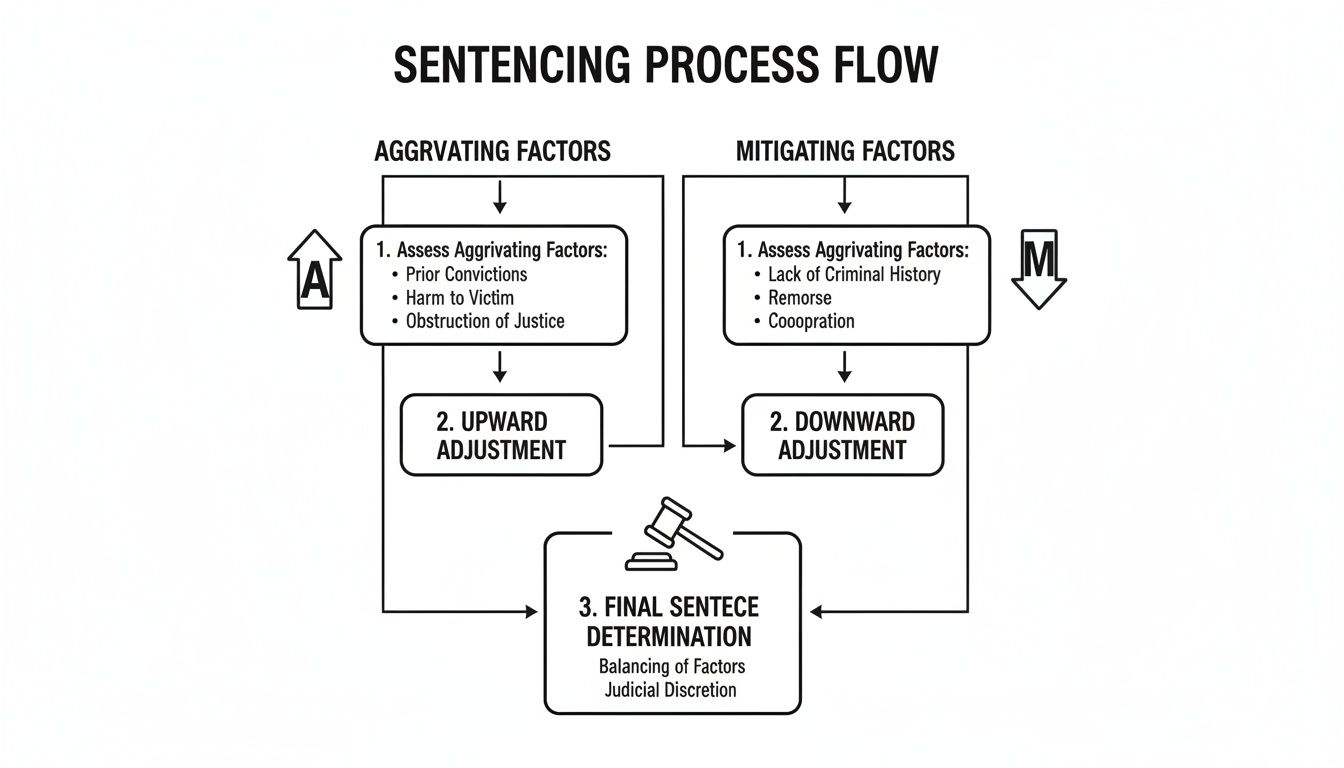
As you can see, it’s a push-and-pull. The judge has to weigh all the negative factors against the positive ones to find a penalty that is truly just.
Crown And Defence Submissions
At the sentencing hearing, both sides make their pitch. The Crown Attorney will focus on aggravating factors, arguing for a sentence that sends a strong message of punishment and denunciation.
On the other side, your criminal defence lawyer will build a case based on every available mitigating factor. We present the PSR, bring forward letters of support, and show evidence of any rehabilitative steps the client has taken. Our goal is to argue for a sentence at the lower end of the range—one that prioritizes rehabilitation over pure punishment. While our focus is on Canadian law, the principles of balancing punishment with eventual release are universal. For example, the Public Policy Institute of California tracks sentencing outcomes, underscoring how crucial it is to address parole eligibility right from the start, a key part of the sentencing strategy at Badesha Law.
How A Criminal Defence Lawyer Defends A Manslaughter Charge
Facing a manslaughter charge is a life-altering experience. The future becomes a terrifying unknown. With the stakes this high, having an experienced, strategic criminal defence lawyer isn't just a good idea—it's an absolute necessity to protect your rights and fight for the best possible outcome.
At Badesha Law, we know there's no one-size-fits-all defence. We start by taking the Crown’s case apart, piece by piece, looking for weaknesses and inconsistencies. This allows us to build a robust defence tailored to the unique facts of your situation. While our primary goal is always to secure an acquittal, we also know how to strategically argue for reduced charges or a mitigated manslaughter prison sentence.
Challenging The Crown's Case
The foundation of any solid defence is to rigorously challenge the prosecution's evidence. The Crown carries the heavy burden of proving every element of the offence beyond a reasonable doubt. Our job is to find and amplify that doubt.
This involves several critical strategies:
- Challenging Causation: Did our client's actions actually cause the death in the eyes of the law? We meticulously review medical reports and witness statements to see if an intervening event or pre-existing condition broke the chain of causation.
- Contesting Intent (for Unlawful Act Manslaughter): We scrutinize the evidence to argue that the underlying "unlawful act," like an assault, wasn't objectively dangerous and that a reasonable person would not have foreseen the risk of bodily harm.
- Disputing Criminal Negligence: The bar is high for the Crown. We work to show that our client's conduct, while perhaps regrettable, did not represent a "marked and substantial departure" from what a reasonable person would have done.
Building A Positive Defence
It's not enough to just poke holes in the Crown’s theory. We also build a strong, compelling counter-narrative. This often means raising powerful affirmative defences that can result in a full acquittal.
One of the most crucial of these is self-defence. If we can show that our client acted reasonably and necessarily to counter a threat of force, it can completely exonerate them. You can dive deeper into what constitutes legal self-defence in Canada in our detailed guide. This defence requires a careful presentation of the facts to illustrate the accused's state of mind and the reasonableness of their actions in a high-pressure moment.
Protecting Your Charter Rights
Every Canadian is protected by the Canadian Charter of Rights and Freedoms. Police officers can make mistakes, and procedural errors often happen during complex investigations.
The legal team at Badesha Law meticulously reviews every step of the police investigation. If evidence was obtained through an illegal search or your right to counsel was violated, we will file motions to have that evidence excluded from trial. A successful Charter application can cripple the Crown’s case and sometimes lead to the charges being withdrawn entirely.
Historical data shows just how seriously these cases are treated, reinforcing why every legal protection is so vital. For example, US data from the Bureau of Justice Statistics shows that offenders admitted for murder or manslaughter during a "tough-on-crime" era were handed average sentences of over 21 years. You can read the full analysis on sentencing trends, which drives home why a defence that explores every possible legal avenue is non-negotiable.
Negotiating With The Crown
A full trial isn't always the only path forward. A key part of a defence lawyer’s job is skillfully negotiating with the Crown Attorney. Our deep experience in the Brampton and Peel Region courts means we know the local legal landscape and have built professional relationships with prosecutors.
This allows us to effectively negotiate for a resolution that serves our client's best interests. That could mean:
- Arguing for the charge to be reduced to a lesser offence, like aggravated assault.
- Coming to an agreement on a joint sentencing submission to present to the judge.
- Securing the withdrawal of charges in exchange for a peace bond in cases where the evidence is weak.
From the first police interview to the final verdict, a criminal lawyer at Badesha Law provides dedicated, unwavering advocacy at every stage, making sure your rights are protected.
FAQs About Manslaughter Prison Sentences
Facing a manslaughter charge brings overwhelming uncertainty. To help bring some clarity, here are concise answers to common questions people in Brampton ask about the legal process.
Is There a Mandatory Minimum Sentence for Manslaughter in Canada?
For most manslaughter cases, there is no mandatory minimum sentence. This gives the judge significant discretion to impose a sentence anywhere from probation up to life in prison. The vast range of a manslaughter prison sentence depends entirely on the specific facts. However, if a firearm was used, a conviction automatically comes with a four-year mandatory minimum prison sentence.
Can I Get Bail if I Am Charged With Manslaughter in Brampton?
Getting bail for a manslaughter charge is an uphill battle, as the Crown will almost always fight to keep the accused in custody. To have a chance at being released, you need a rock-solid release plan with reliable sureties and strict conditions. The team at Badesha Law has extensive experience navigating these complex bail hearings in the Peel Region and can help build the strongest possible case for your release.
What Is the Difference Between Manslaughter and Second-Degree Murder?
The key legal distinction is intent. For murder, the Crown must prove the accused intended to kill the victim or cause bodily harm they knew was likely to result in death. Manslaughter covers deaths caused by an unlawful act or criminal negligence without that specific intent to kill. Since a murder conviction carries a mandatory life sentence, a central defence strategy is often to attack the Crown's evidence on intent.
How Does a Manslaughter Conviction Impact Life After Prison?
A manslaughter conviction leaves a permanent criminal record that can be a huge obstacle to getting a job, as many employers run background checks. It can also prevent international travel, particularly to the United States. For non-citizens, it can have devastating immigration consequences. The time spent in prison is just one part of the penalty. That's why the number one goal for any criminal lawyer in Brampton is always to fight for an acquittal and avoid a conviction altogether.
If you or someone you care about is facing a manslaughter charge in Brampton or the Peel Region, the stakes are as high as they get. The potential manslaughter prison sentence makes expert legal advice essential. Contact Badesha Law, a Brampton criminal lawyer, for a free, confidential consultation to understand your rights and start building a strong defence. We are available 24/7 to help.
No comment