


If you’ve been pulled over and charged, you are likely asking, what is stunt driving in Ontario? It is not a typical speeding ticket. Stunt driving is a serious provincial offence under Ontario’s Highway Traffic Act that comes with immediate, severe penalties, including having your licence suspended and car impounded on the spot. Badesha Law, a criminal defence law firm in Brampton, regularly defends clients against these charges, and this guide will explain the law, the consequences, and how we can help.
Understanding the Legal Definition of Stunt Driving in Ontario
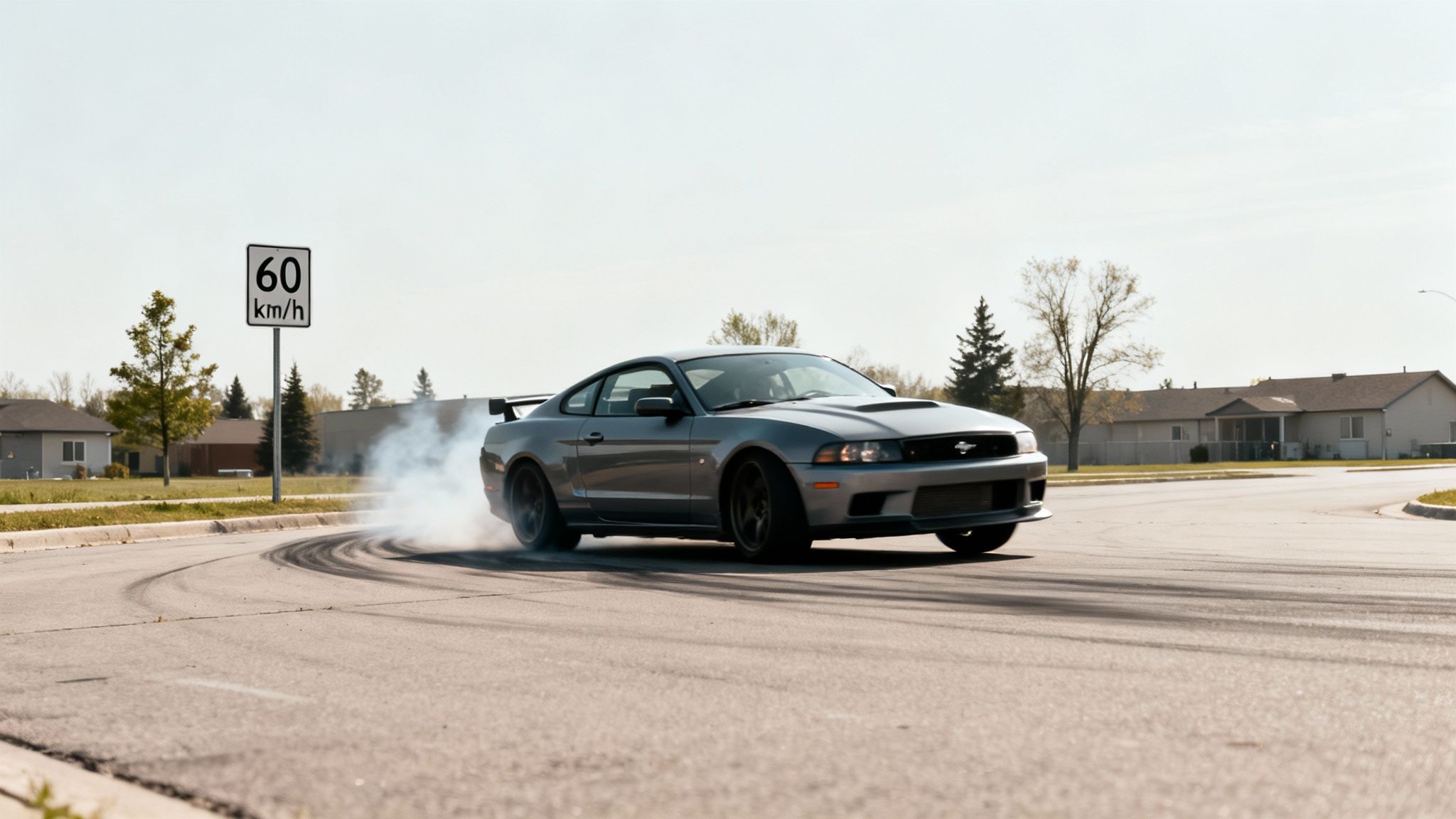
To build a proper defence, you must first understand exactly what the law considers “stunt driving.” The legislation is specific, breaking the offence into two main categories: driving at an excessive speed or performing certain dangerous manoeuvres. Make no mistake, this is not a minor infraction, and police forces in Peel Region and across Ontario are cracking down hard.
Provincial data reveals a staggering increase in stunt driving charges across Ontario. To give you a clearer picture, the government has laid out exactly what actions fall under the stunt driving umbrella.
Actions Classified as Stunt Driving in Ontario
This table breaks down the specific driving behaviours that legally qualify as stunt driving under Ontario’s Highway Traffic Act.
| Category of Offence | Specific Action or Behaviour |
|---|---|
| Excessive Speeding | Driving 40 km/h or more over the limit in a zone under 80 km/h. |
| Excessive Speeding | Driving 50 km/h or more over the limit in a zone 80 km/h or higher. |
| Dangerous Manoeuvres | Intentionally preventing another vehicle from passing. |
| Dangerous Manoeuvres | Lifting some or all of your vehicle’s tires from the road surface (a “wheelie”). |
| Dangerous Manoeuvres | Causing tires to lose traction (“burnout” or “peel out”). |
| Dangerous Manoeuvres | Spinning the vehicle in circles or performing “donuts.” |
| Dangerous Manoeuvres | Drifting or intentionally causing a sideslip. |
| Dangerous Manoeuvres | Driving with a person in the trunk of the vehicle. |
| Dangerous Manoeuvres | Intentionally driving too close to another vehicle, pedestrian, or object. |
As you can see, the definition is quite broad and covers much more than just speed.
Speed Thresholds For Stunt Driving
By far, the most common reason people get charged with stunt driving is for excessive speed. The thresholds are black and white, based entirely on the posted speed limit of the road you’re on.
- You can be charged for driving 40 km/h or more over the speed limit where the posted limit is less than 80 km/h.
- You can be charged for driving 50 km/h or more over the speed limit where the posted limit is 80 km/h or higher.
For example, driving 91 km/h in a 50 km/h residential zone in Brampton qualifies. So does hitting 155 km/h on Highway 401. In these cases, the reading from a police radar device becomes the core piece of evidence against you.
Other Dangerous Driving Actions
Speed isn’t the only trigger. A whole list of other driving behaviours are legally defined as stunting, and these actions are considered dangerous in their own right, no matter how fast you were going. A stunt driving charge is based on a police officer’s observation of a specific action.
Other clear-cut examples include:
- Spinning your vehicle or performing “donuts.”
- Drifting or engaging in a sideslip.
- Driving with a person in the trunk of your motor vehicle.
- Driving too close to another vehicle intentionally.
If you’re facing allegations like these, it’s essential to speak with a qualified criminal lawyer in Brampton who can properly dissect the evidence. The team at Badesha Law has a deep, practical understanding of these definitions and knows how to challenge them effectively in court.
The Immediate Roadside Consequences Of A Charge
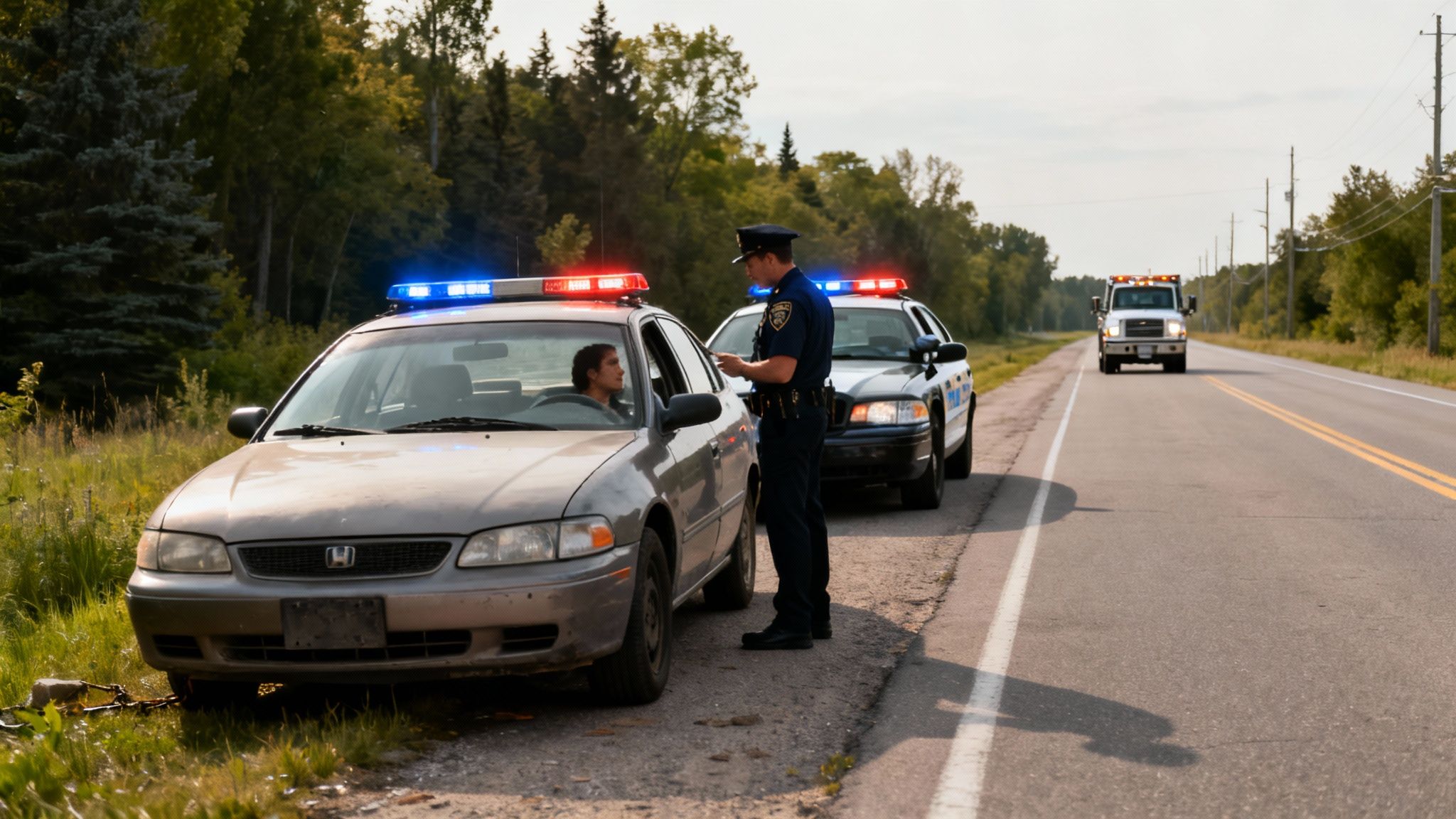
Unlike a simple speeding ticket where you drive away and deal with it later, a stunt driving charge in Ontario hits you with immediate, serious consequences right on the side of the road. These are automatic administrative penalties that take effect the moment an officer lays the charge.
The first thing you’ll be hit with is an immediate 30-day administrative licence suspension. Right then and there, your licence is suspended. You are not driving home from that traffic stop.
Your Car Is Towed, Your Licence Is Gone
On top of losing your licence for a month, your vehicle is seized and impounded for 14 days. This is a hard-and-fast rule. It doesn’t matter if the car belongs to a family member, your spouse, or your employer—it’s getting towed from the scene. The responsibility for all towing and impound fees falls squarely on you. These costs can easily climb over a thousand dollars, and you must pay them in full before the lot will release your vehicle.
This isn’t just an inconvenience; it’s a significant financial blow that happens long before you ever see the inside of a courtroom. These roadside penalties are swift, severe, and separate from any court-imposed penalties you will face later. While these administrative actions are a hallmark of stunt driving, other serious offences like impaired driving also carry immediate consequences, which a knowledgeable DUI lawyer in Brampton can explain in detail.
The Long-Term Consequences of a Conviction
While the immediate roadside penalties are harsh, the real pain of a stunt driving charge comes if you’re convicted in court. The consequences are far more severe and long-lasting than most people realize. A conviction isn’t just a slap on the wrist; it’s a major offence that triggers a cascade of financial and personal hardships.
Fines, Licence Suspension, and Potential Jail Time
The court-imposed penalties are designed to be tough and they escalate significantly for repeat offenders. For a first-time conviction, you’re already facing life-altering consequences:
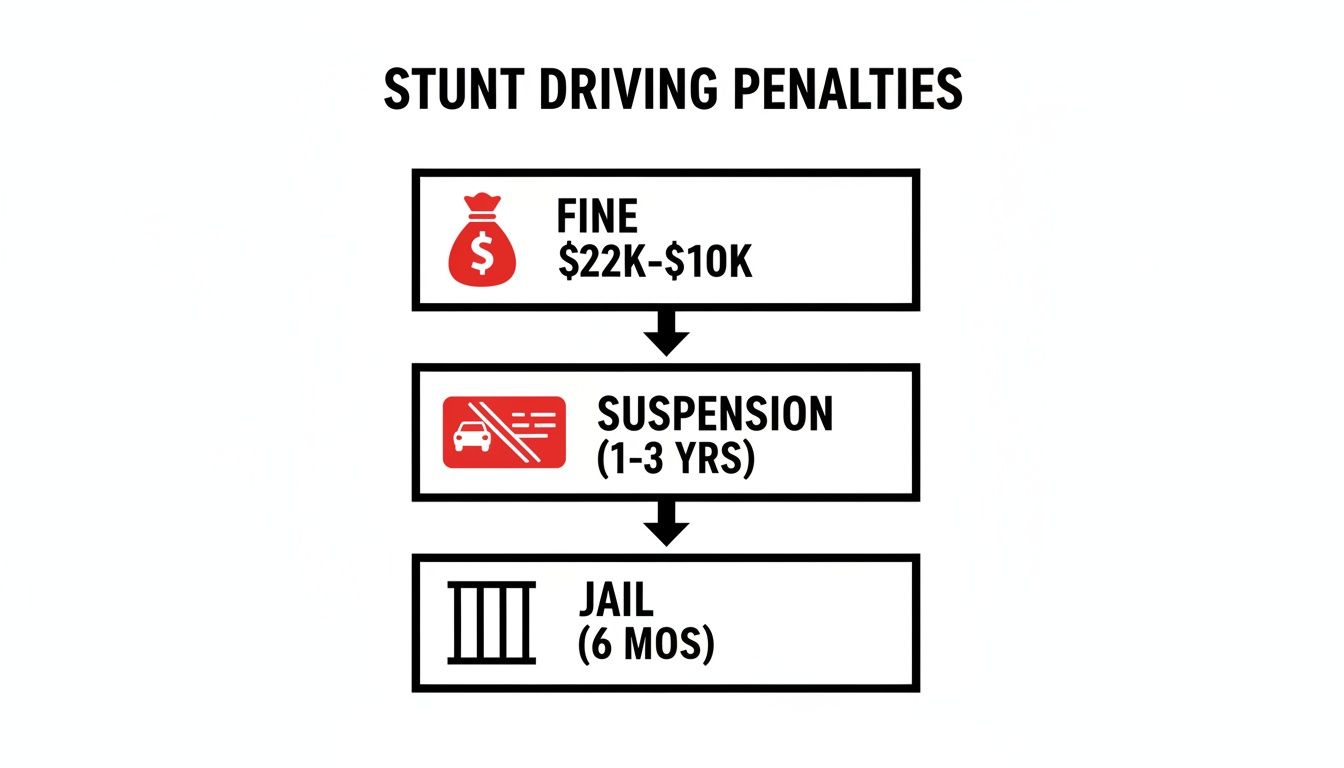
- Hefty Fines: A minimum fine of $2,000, which can climb to $10,000, plus court costs and the mandatory victim fine surcharge.
- Mandatory Licence Suspension: A conviction automatically means a licence suspension of one to three years for a first offence. A second offence can result in a suspension of up to ten years.
- Possible Jail Sentence: A judge has the option to sentence you to jail for up to six months. While less common for a first offence without aggravating factors, it is on the table.
Provincial laws have been tightened over the years, making these penalties standard. For more background, you can read about the evolution of stunt driving penalties in Ontario.
The Crushing Impact on Your Insurance Rates
If the court penalties don’t get your attention, the insurance fallout will. A stunt driving conviction is a major red flag for any insurer. Once you’re convicted, you are officially a “high-risk driver.” Your current insurance company will likely drop you at renewal, forcing you into the high-risk market where coverage costs a fortune. Expect your premiums to jump by 100% or more. This massive rate hike will stick with you for at least three to six years, easily costing you thousands of extra dollars.
Understanding Stunt Driving vs. Dangerous Driving
People in Brampton often use the terms “stunt driving” and “dangerous driving” interchangeably, but in the eyes of Ontario criminal law, they are worlds apart. One is a provincial traffic offence, and the other is a federal crime.
Stunt driving is a serious charge under Ontario’s Highway Traffic Act (HTA). A conviction will impact your driving record, insurance rates, and finances. It is handled in provincial traffic court and will not result in a criminal record.
Dangerous driving is a criminal offence under the Criminal Code of Canada. A conviction for dangerous driving means a permanent criminal record, which can prevent you from getting certain jobs, travelling to the U.S., and can create significant immigration problems.
The Critical Legal Distinctions
The main difference is where the law comes from. The HTA is a provincial set of rules for road safety. The Criminal Code is a federal law that defines crimes against society. This distinction changes everything—from how the case is argued in court to the severity of the penalties.
Stunt Driving (HTA) vs. Dangerous Driving (Criminal Code)
| Legal Aspect | Stunt Driving (Highway Traffic Act) | Dangerous Driving (Criminal Code) |
|---|---|---|
| Governing Law | Provincial Statute (Ontario) | Federal Statute (Canada) |
| Nature of Offence | Regulatory / Traffic Offence | Criminal Offence |
| Legal Standard | Strict Liability; intent is not required. Driving at a prohibited speed or in a prohibited manner is enough. | Requires proof of a guilty mind (mens rea). Driving must be a “marked departure” from the norm. |
| Immediate Penalty | 30-day roadside licence suspension & 14-day vehicle impoundment. | No automatic roadside sanctions; arrest and charges are laid based on investigation. |
| Long-Term Penalty | Fines, demerit points, further licence suspension. No criminal record. | Fines, driving prohibition, potential jail time. Results in a permanent criminal record. |
| Court | Provincial Offences Court (Traffic Court) | Ontario Court of Justice (Criminal Court) |
The legal bar for proving dangerous driving is much higher. The Crown prosecutor has to prove beyond a reasonable doubt that your driving was a “marked departure” from how a reasonable person would drive and showed a clear disregard for the lives and safety of others.
Knowing these differences is the first step in building a proper defence. The strategy for fighting a traffic ticket is completely different from defending a criminal charge. For a closer look at the criminal side of things, our guide on finding a dangerous driving lawyer in Brampton has the information you need.
How Badesha Law Builds A Winning Defence Strategy
Getting charged with stunt driving feels overwhelming, but a charge is not a conviction. A skilled lawyer can take apart the prosecutor’s case, piece by piece. A strong defence always starts with a deep dive into the details of the traffic stop. At Badesha Law, we put the Crown’s evidence under a microscope.
Challenging The Crown’s Evidence
One of the most powerful ways to defend a stunt driving charge is to question the reliability of the police equipment used to measure your speed. Both radar and LiDAR (laser) devices must be regularly maintained and properly calibrated to be considered accurate.
We immediately start asking critical questions:
- When was the last time this specific device was calibrated? We need to see the records.
- Was the officer who used it properly trained and certified on that model?
- Could other factors like heavy rain, dense traffic, or the angle of the device have skewed the reading?
Raising doubt about the accuracy of the speed reading can become the cornerstone of your defence. A small calibration error could be the only thing separating a life-altering stunt driving charge from a standard speeding ticket.
Exploring Other Defence Avenues
Beyond technical challenges, we look at the unique circumstances of your situation. For example, were you in a genuine emergency? A defence of necessity could apply if you can prove you were rushing for a medical crisis and had no other reasonable, legal alternative. We also explore the possibility of mistaken identity, especially in heavy traffic.
The success of any defence hinges on the specific facts of your case. An experienced lawyer at Badesha Law can identify weaknesses in the Crown’s argument. The first step is to understand your options. We offer a free consultation with a Brampton criminal lawyer to go over the specifics of your case and show you how we can help.
How a Brampton Defence Lawyer at Badesha Law Can Help

Trying to navigate the Brampton court process on your own after a stunt driving charge is a gamble. The consequences are too severe to risk a mistake. The team at Badesha Law is in your corner to protect your rights and fight for the best possible outcome at every stage of the court process.
Our first step is to get the police evidence—officially called “disclosure.” This is the Crown prosecutor’s entire file, including the officer’s notes and the maintenance logs for their radar or laser gun. We comb through every page, looking for cracks in their case.
Our Strategic Approach to Your Defence
With the full picture in front of us, we start building a defence strategy that fits your unique situation. Our approach is methodical and focused on getting real results for our clients in the Peel Region.
Here’s a look at how we tackle a stunt driving case:
- Negotiating with the Crown: We immediately open a channel with the prosecutor to point out weaknesses in their evidence. Often, our primary goal is to negotiate a resolution, such as getting the stunt driving charge withdrawn or reduced to a less serious offence like a minor speeding ticket.
- Preparing for Trial: If the Crown won’t offer a fair resolution, we prepare a powerful defence for trial. We will prepare you to testify, map out our cross-examination of the police officer, and present the legal arguments needed to challenge the evidence before a judge.
Police in Ontario are actively laying these charges, especially during enforcement blitzes. For example, during a single Canada Road Safety Week, the OPP’s East Region alone laid 38 stunt driving charges. Read more about recent provincial enforcement results. Facing the court system without an expert advocate is risky. From your first court date to the final decision, Badesha Law is your essential advocate.
Frequently Asked Questions About Stunt Driving
If you’ve been charged with stunt driving in Ontario, your mind is probably racing with questions. Here are straightforward answers to the most common concerns we hear from clients in Brampton.
Will I Go To Jail For A First Stunt Driving Offence In Ontario?
While the Highway Traffic Act allows for a jail sentence of up to six months, this is very rare for a first-time offence without aggravating factors, such as an accident causing injury. For most first-time offenders, the court is more focused on steep fines and the mandatory one- to three-year licence suspension. A lawyer at Badesha Law can review your case and give you a realistic idea of what to expect.
Can A Stunt Driving Charge Be Reduced To Speeding?
Yes, and this is often a primary goal of our defence strategy. Getting the charge reduced to a simple speeding ticket is a major win because it helps you avoid the automatic licence suspension and crushing insurance premium hikes. This outcome depends on the evidence and your lawyer’s skill in negotiating with the Crown prosecutor. An experienced lawyer knows how to find weaknesses in the Crown’s case to use as leverage for a reduction.
How Long Will A Stunt Driving Conviction Affect My Insurance?
A stunt driving conviction immediately flags you as a high-risk driver. Expect this conviction to impact your insurance premiums for at least three to six years. Your rates will likely double or triple. In some cases, your current insurer might drop you completely, forcing you to find coverage in the more expensive “high-risk” market.
Do I Have To Appear In Court For My Stunt Driving Charge?
Yes, a stunt driving charge comes with a summons, which means a court appearance is mandatory. However, that doesn’t mean you personally have to be there every time. When you hire Badesha Law, we act as your representative. We can attend most court dates on your behalf, so you don’t have to miss work.
If you are facing a stunt driving charge in Brampton, don’t wait. The stakes are too high to handle it alone. Contact Badesha Law for a free consultation. A criminal lawyer in Brampton from our firm can provide the clear legal advice you need to protect your licence and your future.
No comment