


In Canadian criminal law, the difference between a summary vs indictable offence is the single most important factor that dictates the entire legal journey of a case. As defined by the Criminal Code of Canada, this classification determines the court, the procedures, and the potential penalties. Summary conviction offences are less serious crimes, while indictable offences are the most severe criminal charges a person can face.
This classification isn't just legal jargon; it's the framework that sets the rules for court procedures, potential penalties, and even how long the Crown has to lay a charge.
Understanding Your Charges In The Canadian Legal System

When you’re charged with a crime in Canada, the first thing to figure out is how the Criminal Code classifies the offence. This isn’t just a technical detail—it shapes the entire legal road ahead. The Criminal Code of Canada sorts all offences into three distinct categories, and each one comes with its own set of rules for how the case will be handled.
The Three Types of Criminal Offences in Canada
It’s absolutely critical to understand these classifications. Your rights, the court you'll be in, and the penalties on the table all depend on whether the Crown prosecutor treats your case as a summary conviction or proceeds by indictment.
- Summary Conviction Offences: These are on the lower end of the criminal spectrum. They are handled exclusively in provincial courts, such as the Ontario Court of Justice, follow a simpler process, and carry much lower maximum penalties.
- Indictable Offences: Reserved for the most serious crimes like murder, robbery, or aggravated assault. These cases can be far more complex, potentially involving preliminary inquiries and jury trials, and carry the most severe penalties, including life imprisonment.
- Hybrid Offences: This is the most common category, covering a huge range of crimes like assault, theft under $5,000, or impaired driving. For hybrid offences, the Crown prosecutor gets to choose whether to treat the charge as a less serious summary matter or a more serious indictable one.
That decision by the Crown is a crucial turning point. Their choice—known as "electing"—can dramatically change the stakes of your case and is often based on the specific facts of the allegation and your criminal record, if you have one.
| Feature | Summary Offence | Indictable Offence |
|---|---|---|
| Severity | Less serious | Most serious |
| Court | Provincial Court only | Provincial or Superior Court |
| Trial Options | Judge alone | Judge alone or Judge & Jury |
| Maximum Penalty | Generally lower (fines, shorter jail time) | Can include life imprisonment |
The classification of an offence is the roadmap for your defence. It dictates the strategy, the courtroom, and the stakes involved. Knowing the difference between summary and indictable is the first step toward protecting your rights.
Ultimately, this initial classification sets the stage for everything that follows. For anyone trying to figure out what to expect when charged with a crime in Brampton, understanding this fundamental difference is the crucial starting point.
Understanding Summary Conviction Offences
When you're facing a criminal charge in Canada, the classification of the offence sets the entire tone for your case. Summary conviction offences are the less serious category of criminal acts defined in the Criminal Code of Canada. They are designed for less severe infractions, resulting in a more streamlined legal process.
The defining feature of a summary offence is its relatively minor nature. This means the court procedures are simpler and the penalties are less severe, which has a direct impact on your case from start to finish.
Key Characteristics of Summary Offences
There are a few core features that set summary offences apart from more serious charges. These characteristics dictate everything from where your case will be heard to the potential penalties and even how long the Crown has to charge you.
- Jurisdiction: All summary conviction matters are handled exclusively in a provincial court, like the Ontario Court of Justice. This means there is no option for a trial by jury; a judge alone will hear the evidence and deliver a verdict.
- Limitation Period: The Crown is on a strict clock. Under section 786(2) of the Criminal Code, proceedings for a summary offence must be started within 12 months from the day the alleged offence occurred. If that deadline is missed, a prosecution cannot proceed.
- Penalties: The punishments for summary offences are significantly lower than for indictable offences, reflecting their status as less severe infractions.
Penalties and Common Examples
The maximum penalties for a summary conviction are generally capped, which provides some certainty about the potential consequences. For most summary offences, the maximum penalty is a fine of up to $5,000, up to two years less a day in jail, or both, as outlined in the Criminal Code.
Some common examples of "pure" summary offences—those that can only be treated this way—include:
- Causing a disturbance in a public place
- Trespassing at night
- Public nudity
These offences are still serious, but the justice system handles them in a way that aims for efficiency. The process is typically faster, with fewer court appearances than an indictable matter. For people facing these types of charges, exploring options like a diversion program can sometimes lead to the charges being withdrawn, which means you avoid a criminal record completely.
A key advantage in summary cases is the defined legal pathway. The process is confined to the provincial court system, which often means a quicker resolution and less legal complexity for the accused.
In the Canadian justice system, this distinction is crucial. Statistics from Canadian courts show that summary cases typically conclude faster than indictable ones. This efficiency can be a benefit, but the importance of having skilled legal counsel to protect your rights and secure the best possible outcome can't be overstated.
Explaining Indictable Offences and Their Consequences

When the Crown proceeds by indictment, it signals that you are facing one of the most serious allegations in Canadian criminal law. An indictable offence is reserved for crimes that cause significant harm and carry the heaviest consequences according to the Criminal Code.
These are not minor infractions. Charges like murder, aggravated assault, robbery, and large-scale drug trafficking fall into this category. The entire justice system treats these allegations with the utmost gravity. As a result, the court process is far more complex, the potential penalties are severe, and your fundamental freedoms are on the line.
Severe Penalties and No Time Limits
One of the defining features of an indictable offence is the severity of the potential punishment. Unlike summary matters with their strict caps on fines and jail, the penalties here can be life-altering. The Criminal Code sets out maximum sentences for each indictable offence, many of which include the possibility of life imprisonment.
Another critical point is that there is generally no statute of limitations for indictable offences. This means the Crown can lay a charge years—or even decades—after the alleged crime took place. This is a stark contrast to the firm 12-month deadline for summary matters and underscores how seriously the system views these allegations.
Indictable offences represent the highest stakes in the criminal justice system. The legal procedures are more intricate, the penalties are the most severe, and the impact on your life can be permanent.
Complex Procedures and Your Right to Choose
Navigating an indictable offence means engaging in a much more detailed and often lengthy legal battle. Depending on the specific charge, you may have the right to a preliminary inquiry. This is a crucial pre-trial hearing where the Crown must present enough evidence to a judge to justify proceeding to a full trial. This is an invaluable opportunity for the defence to test the strength of the Crown's case.
You also have a critical choice to make about your mode of trial. For many indictable offences, the Criminal Code allows you to "elect" how you want to be tried:
- Trial by a provincial court judge alone
- Trial by a Superior Court judge alone
- Trial by a Superior Court judge and jury
This isn’t a minor detail; it’s a strategic decision that can dramatically shape the outcome of your case. A jury trial, for example, means convincing 12 members of the community, whereas a trial by judge alone hinges on the legal assessment of a single expert.
Making these high-stakes procedural choices correctly is essential. It requires a deep understanding of criminal law and strategy, including the complex nuances of sentencing, such as those involved in cases like manslaughter and its potential prison sentences. Navigating this landscape is all about protecting your future.
Navigating Hybrid Offences: The Crown’s Critical Choice

Between the clear lines of summary and indictable offences sits a third, and by far the most common, category: hybrid offences. The vast majority of charges in the Criminal Code of Canada fall into this group, covering everything from assault and impaired driving to theft and fraud under $5,000. If you're facing a hybrid charge, the initial stage of your case is defined by uncertainty.
A hybrid offence gives the Crown prosecutor a critical power: they decide whether to treat your charge as a less serious summary matter or a more severe indictable one. This decision, known as the Crown election, is a fork in the road that changes the entire legal path forward. It's the moment when the comparison of a summary vs. indictable offence becomes intensely personal, dictating potential penalties, court procedures, and the complexity of your defence.
How the Crown Makes Its Choice
The Crown’s decision isn't arbitrary. Prosecutors weigh a range of factors when deciding whether to proceed by summary conviction or by indictment, aiming to match the legal response to the specific facts of the case.
Key factors that influence the Crown’s election include:
- The Severity of the Allegations: Was the act particularly violent? Did it cause significant harm or loss? A minor shove is viewed very differently from an assault causing bodily harm.
- Your Criminal Record: A person with a clean slate is far more likely to see the Crown elect summarily. A history of similar offences, on the other hand, almost guarantees an indictable election.
- Aggravating and Mitigating Factors: Were weapons involved? Was the alleged victim vulnerable? Or were there circumstances that might lessen the perceived seriousness of the act?
- Local Prosecution Policies: Crown offices in different jurisdictions, like Peel Region, often have specific guidelines for handling certain offences, such as domestic assault or impaired driving.
Understanding what the Crown is looking for is the first step in building a proactive defence.
The Crown's election is the most significant strategic turning point for any hybrid offence. A summary election simplifies the process and caps the penalties, while an indictable election opens the door to a more complex legal battle with far higher stakes.
The Role of a Proactive Defence Lawyer
This is where an experienced criminal defence lawyer becomes your greatest asset. The time before the Crown makes its election is a crucial window of opportunity. A skilled lawyer doesn't just wait for the decision—they actively work to influence it.
By engaging in early resolution discussions with the prosecutor, your lawyer can present your side of the story in a compelling way. This involves highlighting any mitigating factors, pointing out weaknesses in the evidence, and presenting a personal background that shows your character. For instance, providing proof of employment, family responsibilities, or proactive steps like counselling can make a real difference.
The goal is to persuade the Crown that proceeding summarily is the most appropriate and just course of action. Successfully arguing for a summary election can dramatically reduce potential penalties, avoid a jury trial, and often lead to a faster, less stressful resolution. For many common charges, like figuring out your options for a theft under $5,000 charge in Brampton, this early intervention is the key to protecting your future.
A Comparative Analysis of Key Legal Differences
Understanding the difference between a summary vs indictable offence goes far beyond their definitions—it’s about the real-world, procedural differences that will shape your entire case. The path your charges take, the rights you can exercise, and the penalties you face are all dictated by this fundamental classification in the Criminal Code.
To make these distinctions crystal clear, let's break down the key legal differences side-by-side. This comparison highlights just how differently a case proceeds depending on whether it's treated as a summary matter or an indictable one.
Court Jurisdiction and Trial Options
One of the most immediate differences is the court where your case will be heard. Summary conviction offences are always tried in a provincial court, like the Ontario Court of Justice. This means your trial will be decided by a judge alone, with no possibility of a jury. The process is generally faster and less procedurally complex.
In contrast, indictable offences offer more options. Depending on the seriousness of the charge, your case could be heard in a provincial court or elevated to the Superior Court of Justice. Crucially, for many indictable offences, you have the right to choose your mode of trial—either by a judge alone or by a judge and jury. This choice is a cornerstone of Canadian law and a vital strategic decision.
The choice between a judge-alone trial and a jury trial is a critical strategic decision in an indictable case. It can influence everything from evidence presentation to the final verdict, and it's a right that simply doesn't exist for summary matters.
Limitation Periods and Penalties
The law sets a strict time limit for laying summary charges. The police must lay a charge for a summary offence within 12 months of the alleged incident. If they miss this deadline, the case cannot proceed. For indictable offences, however, there is generally no statute of limitations, meaning charges for serious crimes like murder or robbery can be laid at any time, even decades later.
Penalties also diverge sharply. Summary offences have a general maximum penalty of a $5,000 fine and two years less a day in jail. Indictable offences carry much heavier sentences, ranging from several years in a federal penitentiary to life imprisonment, depending on the crime's gravity. For a deeper understanding of how specific charges are handled, you can learn more about the differences between careless driving and dangerous driving in our detailed guide.
Summary vs Indictable Offences At a Glance
To quickly grasp the significance of your charge’s classification, this table offers a clear, at-a-glance look at the core differences.
| Feature | Summary Conviction Offence | Indictable Offence |
|---|---|---|
| Severity | Less serious criminal acts. | The most serious criminal acts. |
| Limitation Period | Strict 12-month time limit to lay charges. | Generally no time limit to lay charges. |
| Court Jurisdiction | Exclusively in the Provincial Court. | Can be heard in Provincial or Superior Court. |
| Mode of Trial | Judge alone (no jury option). | Accused may elect trial by judge or by jury. |
| Preliminary Inquiry | Not available. | May be available for certain serious offences. |
| Maximum Penalties | Capped at $5,000 fine and/or 2 years less a day jail. | Varies by offence; can include life imprisonment. |
| Criminal Record | A conviction results in a criminal record. | A conviction results in a criminal record. |
Each of these factors—from the court you attend to the sentence you might face—reinforces why the classification of a summary vs indictable offence is the most important element at the outset of any criminal case. It defines the legal battlefield and sets the stakes for your future.
How an Experienced Lawyer Defends Your Rights
Knowing the difference between a summary and an indictable offence is one thing; using that knowledge to build a powerful defence is another. An experienced Canadian criminal lawyer is the bridge between legal theory and a real-world strategy designed to protect your rights, your record, and your future. Their job isn't just to speak for you in court—it's to shape the direction of your case from the moment you're charged.
A skilled lawyer immediately analyzes all evidence, including police notes, witness statements, and any video footage. They will meticulously review the investigation and arrest, searching for violations of your rights under the Canadian Charter of Rights and Freedoms. Finding a single Charter breach can get crucial evidence excluded or even lead to the charges being stayed.
Strategic Negotiations and Advocacy
For hybrid offences, some of the most critical work a lawyer does happens before you even step into a courtroom. They engage in proactive negotiations with the Crown prosecutor, presenting legal arguments and mitigating factors to push for a summary election. Convincing the Crown to proceed summarily can dramatically reduce the potential penalties and make the entire court process far less daunting.
The goal is always to achieve the best possible outcome. Whether it’s negotiating for the charges to be withdrawn, arguing for a peace bond, or securing a summary election, a lawyer's early intervention is key to steering the case toward a favourable resolution.
This visual shows the critical decision points that determine which path your case will take after a charge is laid.
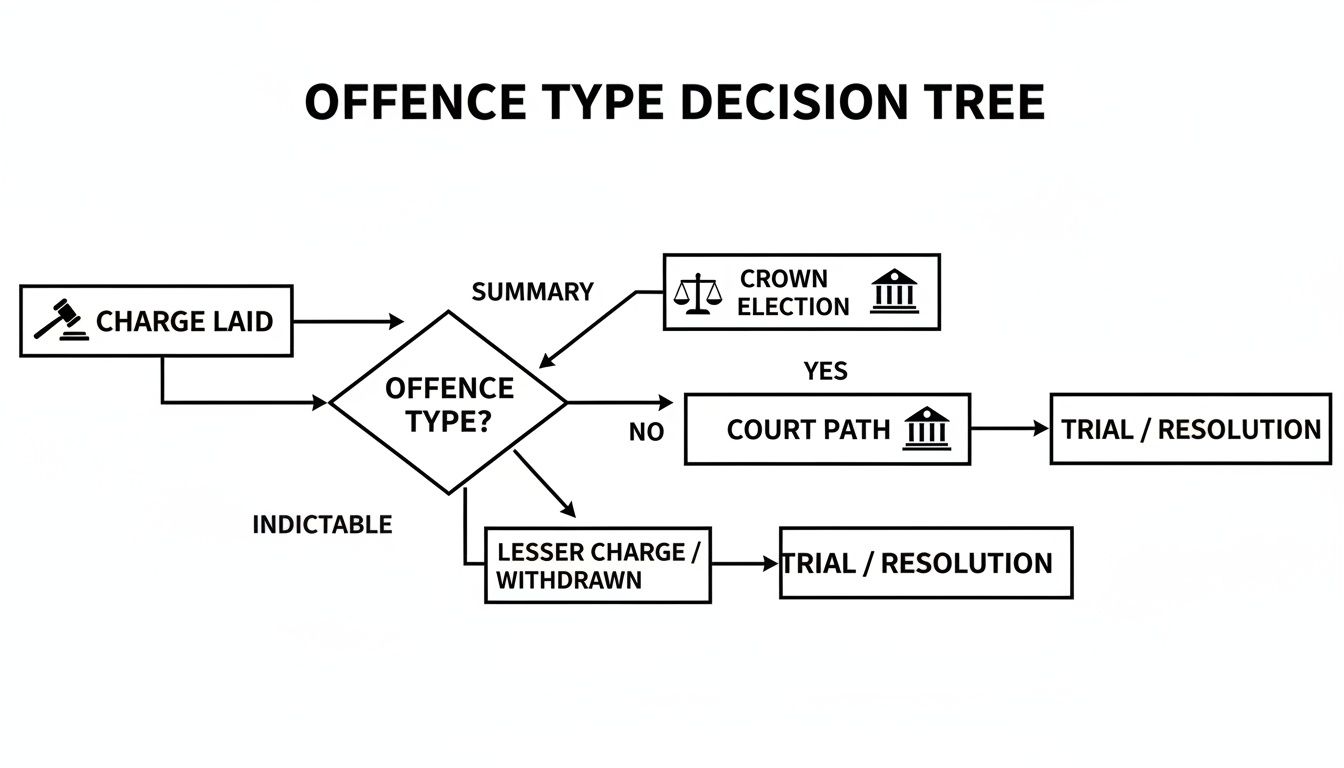
As the flowchart shows, the Crown's election on a hybrid offence is the pivotal moment that dictates whether your case proceeds down the less severe summary path or the more complex indictable route.
Ultimately, your lawyer translates complex legal rules into practical, defensive actions. From challenging the Crown’s case at a preliminary inquiry for an indictable offence to identifying a missed statute of limitations for a summary charge, every move is calculated. If you are facing a criminal charge in Canada, the most important step you can take is to seek immediate, expert legal advice. A confidential consultation will help you understand your options and give you the confidence to navigate the justice system.
Your Questions Answered
When you're dealing with the Canadian justice system, the legal jargon can feel overwhelming. Let’s cut through the confusion and get straight to what matters. Here are clear answers to the questions we hear most often from our clients.
What Happens First If I Am Charged With a Hybrid Offence?
Initially, a hybrid offence is treated as an indictable offence. This gives the police greater powers of arrest and sets a more serious tone for your bail hearing. The charge remains classified as "indictable" until your first court appearance.
At that first appearance, the Crown prosecutor will formally "elect" in court how they will proceed—either by summary conviction or by indictment. An experienced defence lawyer can get involved before that day, negotiating with the Crown’s office to push for a summary election. Securing that outcome dramatically simplifies the court process and limits the potential penalties you face.
Can a Summary Conviction Still Result in a Criminal Record?
Yes, absolutely. A conviction for any criminal offence in Canada—whether summary or indictable—results in a permanent criminal record. That record can create significant barriers to employment, international travel, and immigration opportunities.
Even though the penalties for summary offences are lighter, the lifelong impact of a criminal record is just as severe. A primary goal for any defence lawyer is to find a way to resolve the case without a conviction, such as getting the charge withdrawn, securing a peace bond, or obtaining a discharge. Protecting your clean record is always the top priority.
While the court process for a summary offence is simpler, a conviction leads to the same outcome as an indictable one: a permanent criminal record that follows you forever.
Is There a Time Limit for the Crown to Lay a Summary Charge?
Yes, and it’s a strict one. For a pure summary conviction offence, the Criminal Code of Canada provides a firm deadline. Under section 786(2), proceedings must be instituted within twelve months of the day the offence was allegedly committed.
If that deadline is missed, the charge is legally invalid and cannot proceed. This is one of the first things a sharp defence lawyer will check.
Conversely, there is generally no statute of limitations for indictable offences, which means charges for serious crimes can be laid years or even decades later. For hybrid offences, the twelve-month clock only starts ticking if the Crown chooses to proceed summarily.
If you are facing a criminal charge in Canada, understanding whether it’s being treated as a summary or indictable offence is the first step in building your defence. The team at Badesha Law has the experience to guide you through this process and fight for the best possible outcome. For a free, confidential consultation to discuss your case, contact us today.
No comment