


Being charged with assault is a frightening and confusing experience. One moment, your life is normal; the next, your freedom and future are on the line. If you’ve just been charged and are searching for a “criminal lawyer near me,” you’ve come to the right place. The first hours and days after an arrest are critical, and your first move should be to secure an expert assault lawyer in Brampton to protect your rights.
This guide explains what happens when you are charged with assault in Ontario, the different types of assault charges you might face, and how to navigate the court process. Badesha Law, a criminal defence law firm in Brampton, has prepared this guide to give you clarity during this stressful time. We will outline the steps you need to take to build a strong defence and protect your future.
What Happens Immediately After an Assault Charge in Brampton?

The moments right after an arrest for assault can feel like a blur. It’s disorienting, but the actions you take here can have a huge impact on how your case unfolds. Your number one job is to safeguard your legal rights.
At Badesha Law, we understand the intense stress and uncertainty you’re facing. This guide is designed to give you immediate clarity on what to do, from that initial police interaction to securing your release and getting ready for the legal road ahead.
Your Right to Remain Silent
After an arrest, you have the right to remain silent. It’s not just a line from a movie; it’s a critical constitutional right you must exercise. The police are trained professionals, and even seemingly innocent questions are designed to gather evidence against you. The best response is a polite but firm one. Simply state that you wish to speak with your lawyer and that you will not be answering any questions until you have.
Contact a Criminal Defence Lawyer Immediately
This is the single most important step you can take. You need to call a criminal lawyer in Brampton as soon as possible. In Ontario, the justice system moves incredibly fast, particularly when it comes to domestic-related incidents.
In many domestic assault situations, an arrest is followed by a bail hearing within approximately 24 hours. This tight timeline creates an urgent need for experienced legal counsel to step in, argue for your release, and negotiate the least restrictive conditions possible.
An experienced lawyer can intervene early, often during the crucial bail phase, to protect your rights and set a positive tone for the rest of your case. Delaying this step can put you at a significant disadvantage.
Getting out of custody is the first major hurdle. A lawyer from Badesha Law can represent you at this hearing, presenting a strong and credible release plan to the court on your behalf. You can learn more by reviewing our guide to the bail hearing process in Brampton.
Understanding the Different Types of Assault Charges in Ontario
When most people hear the word “assault,” they picture a physical fight. But from a legal standpoint in Ontario criminal law, the term is much broader and covers a spectrum of actions. The reality is, not all assault charges are created equal. The specific type of charge you’re facing is the single most important factor, dictating everything from potential penalties to the best defence strategy.
An experienced criminal defence lawyer’s first job is to cut through the confusion and explain exactly what the police and Crown are alleging. Understanding the charge against you is the critical first step.
Simple Assault (Common Assault)
This is by far the most common type of assault charge. It’s what the Criminal Code of Canada calls a “common assault,” and it’s defined as applying force to someone else—directly or indirectly—without their consent.
Here’s what trips many people up: no actual injury has to occur.
A simple assault charge can be laid for actions such as:
- A push, shove, or an unwanted touch.
- Attempting to apply force, like swinging a punch and missing.
- Threatening by act or gesture to apply force if it causes the other person to believe you have the present ability to carry it out.
It’s a surprisingly low threshold, which is why these charges are so frequent in Peel Region.
More Serious Assault Charges
As soon as certain elements are introduced, such as the use of a weapon or the degree of injury, the charge escalates—and so do the consequences. These more serious charges demand a very different and more aggressive defence from an experienced criminal lawyer.
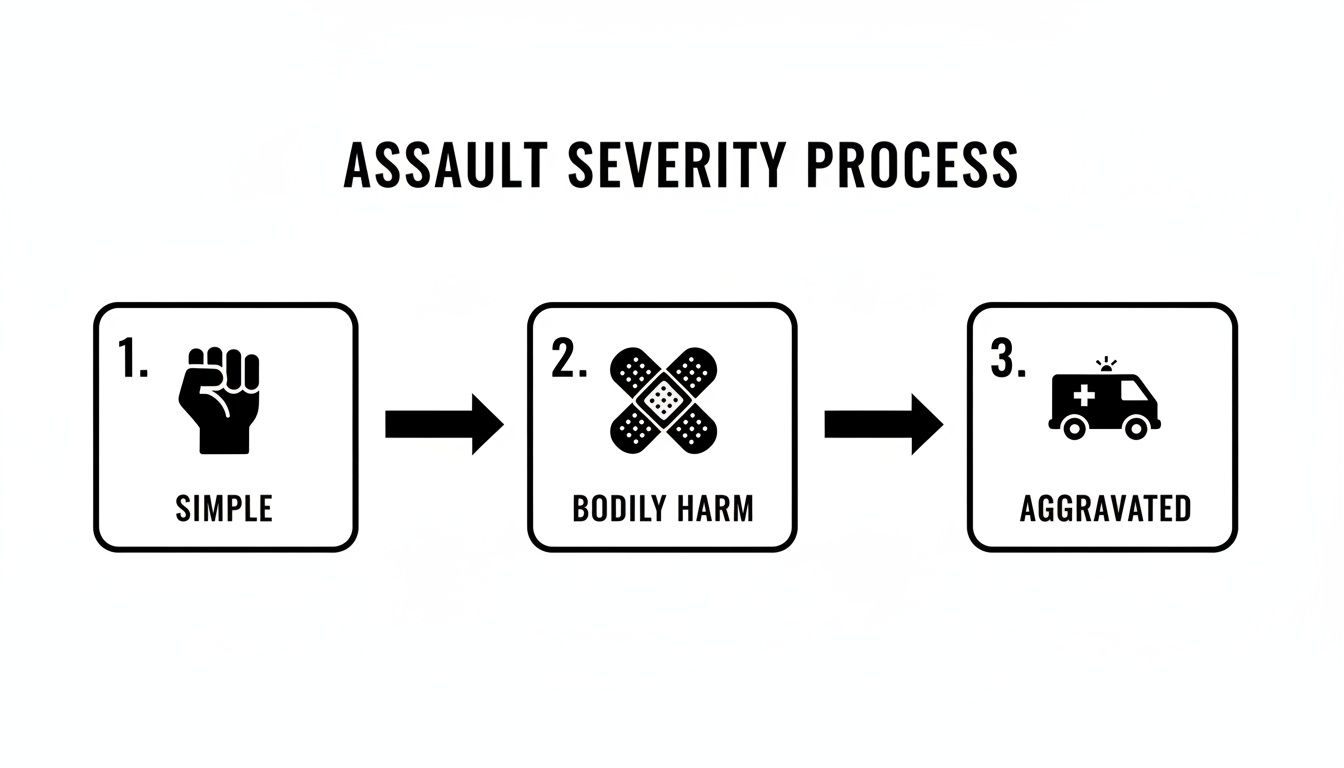
- Assault with a Weapon or Causing Bodily Harm: This charge is laid when a weapon is involved. A “weapon” can be almost anything used to threaten or harm someone, not just a knife or a gun. It also applies if the assault causes “bodily harm,” which is legally defined as any injury that’s more than minor and interferes with the person’s health or comfort.
- Aggravated Assault: This is the most severe form of non-sexual assault. The Crown will press this charge if the assault wounds, maims, disfigures, or endangers the other person’s life.
- Sexual Assault: This is a specific type of assault that is sexual in nature. Consent is the absolute central issue in these cases, which have their own complex legal rules. If you’re facing this, you need a lawyer who specializes in defending against a sexual assault charge in Bramton.
To help clarify, here is an overview of these common assault charges and the serious penalties they can carry.
Overview of Assault Charges and Potential Penalties
| Type of Assault | Brief Description | Potential Maximum Penalty (Indictable Offence) |
|---|---|---|
| Simple Assault | Unwanted touching, a push, or a threat to apply force. No injury is required. | 5 Years Imprisonment |
| Assault with a Weapon | An assault involving the use or threat of using any object as a weapon. | 10 Years Imprisonment |
| Assault Causing Bodily Harm | An assault that results in an injury that is more than minor (e.g., a broken nose). | 10 Years Imprisonment |
| Aggravated Assault | An assault that wounds, maims, disfigures, or endangers the life of the person. | 14 Years Imprisonment |
The potential outcomes vary dramatically. An aggravated assault charge, for example, comes with a maximum penalty of 14 years in prison. This huge difference in severity is exactly why a one-size-fits-all defence never works. At Badesha Law, we start by digging into the specifics of your charge to find the best path forward.
The Brampton Court Process for an Assault Charge
Facing the criminal court system in Brampton can be a disorienting and stressful experience. From the moment you’re charged, a complex legal process kicks off, and every step has its own rules and potential consequences. Getting a handle on what’s coming is the first step toward regaining control. Think of this as your roadmap through the Peel Region justice system for an assault case.
It all starts with the arrest and the critical bail hearing. This hearing usually happens within 24 hours, so there’s no time to waste—you need a criminal defence lawyer in your corner, ready to fight for your release right away. After that, your case begins its journey through the formal court system.
The Stages of Your Case: What to Expect
The path from that first court appearance to the final outcome is rarely a straight line. It’s more like a series of checkpoints, each with a specific purpose. Your case will likely move through these milestones:
- First Appearance: Your first time in court for the charge. This is mostly an administrative step where your lawyer appears on your behalf and receives the initial package of evidence from the Crown, known as “disclosure.”
- Crown Pre-Trial (CPT): A critical, behind-the-scenes meeting between your defence lawyer and the Crown Attorney. They’ll review the evidence and discuss possible resolutions without a trial, such as withdrawing the charges or agreeing to a peace bond.
- Judicial Pre-Trial (JPT): If the case can’t be resolved at the CPT, the next step is a JPT. This time, a judge joins the discussion with your lawyer and the Crown. The goal is to narrow down legal issues, estimate trial length, and give resolution one more shot.
The seriousness of the assault charge itself has a huge impact on how the Crown will handle each of these stages.
Your Lawyer’s Role at Every Stage
This is where having a skilled assault lawyer in Brampton becomes non-negotiable. At Badesha Law, we manage every single phase for you. Our job is to be your advocate, protect your rights, and find the best strategic path forward.
- At the Bail Hearing: We present a strong release plan to get you out of custody.
- During Pre-Trial Negotiations: We use our knowledge of the law and local procedures to negotiate for a withdrawal of the charges.
- If a Trial is Necessary: We meticulously prepare your defence, cross-examine witnesses, and challenge the Crown’s evidence.
It’s no secret that the Peel Region courts are among the busiest in the country. Data from the Ontario Court of Justice confirms this, as you can see by reviewing the Ontario criminal court statistics on their official site. In a system this busy, having a lawyer with deep, local court knowledge isn’t just a benefit—it’s a necessity.
Building a Strong Defence Against Your Assault Charge
Being charged with assault is a serious allegation, but it is not a conviction. You have the right to a defence, and building a powerful one is the most critical step you can take. A seasoned criminal lawyer in Brampton knows how to navigate the system, but the right strategy always comes down to the unique facts of your case.
The first move is always a deep dive into the Crown’s evidence—what they call “disclosure.” This includes police reports, witness statements, video footage, and photos. At Badesha Law, we comb through every piece of this material, looking for weaknesses in the prosecution’s case that we can use to build a defence that fits your specific situation.
Common Defence Strategies in Assault Cases
Several proven defences can lead to charges being withdrawn or an acquittal after a trial. The skill lies in matching the right defence to the specific circumstances.
Common strategies include:
- Self-Defence: The law allows you to use reasonable force to protect yourself or someone else from harm. If you genuinely believed you were being attacked, this can be a complete defence. For example, if someone shoves you aggressively, pushing them back to create distance could be considered self-defence.
- Defence of Property: Similar to self-defence, you are permitted to use reasonable force to stop someone from trespassing on your property or to prevent them from taking or damaging your belongings.
- Consent: This defence can sometimes apply in simple assault cases, especially in situations like a consensual fight where neither person intended to cause serious bodily harm.
Challenging the Crown’s Evidence
Often, the strongest defence isn’t about arguing what you did, but rather highlighting what the Crown can’t prove. A good criminal defence lawyer will put every piece of the prosecution’s evidence under a microscope.
The burden of proof is always on the Crown. They must prove every element of the offence beyond a reasonable doubt. If there is any reasonable doubt, you must be found not guilty.
This means we actively challenge their case from every angle:
- Identity: Are they sure it was you? Mistaken identity is a real possibility in cases with poor lighting, distant witnesses, or chaotic situations.
- Credibility: Can the witnesses be trusted? A lawyer’s job during cross-examination is to expose inconsistencies in their stories, reveal potential motives to lie, or uncover biases that make their testimony unreliable.
- Charter Violations: The Canadian Charter of Rights and Freedoms protects you. If the police violated your rights during the arrest or investigation—perhaps they conducted an illegal search or didn’t let you speak to a lawyer—we can argue to have that evidence excluded. This can sometimes cripple the Crown’s entire case.
When an assault allegation involves family members, the situation becomes even more complicated. These cases operate under a specific legal framework. You can find out more in our guide on navigating a domestic violence charge in Brampton.
How to Choose the Best Assault Lawyer for Your Case

When you find yourself searching for the “best criminal lawyer near me” or an “affordable criminal lawyer near me,” you’re looking for an ally—someone who can give you a clear, honest path forward. Picking the right lawyer in Brampton isn’t just a small detail; it’s a decision that can fundamentally change the outcome of your case.
The best lawyer for you isn’t always the one with the fanciest ads. It’s the one who pairs deep, local courtroom experience with a real commitment to your defence. For an assault charge in Brampton, you need someone who knows the A. Grenville and William Davis Courthouse inside and out. They should be familiar with the local Crown Attorneys, their tendencies, and the judges who will hear your case. That kind of local knowledge is invaluable.
Key Qualities of an Effective Criminal Defence Lawyer
When you start your search, focus on tangible qualities. An experienced criminal defence lawyer Brampton should have a specific set of skills and be upfront about how they work.
Keep an eye out for these essential traits:
- Specific Experience with Assault: Ask if they’ve successfully defended assault cases like yours, right here in Peel Region. General experience is fine, but a proven track record with assault charges is what you need.
- Clear Communication: A good lawyer can break down complicated legal jargon into plain English. You need to feel comfortable asking any question and get straight answers.
- Transparent Fees: A reputable lawyer will lay out their fee structure clearly from the start. At Badesha Law, we often use block fees, so you know the total cost upfront with no surprises.
- Verifiable Client Reviews: What are former clients saying? Look for detailed testimonials that talk about the lawyer’s professionalism, communication, and the results they achieved.
Your First Consultation: What to Expect and What to Ask
Your initial consultation is a two-way interview. It’s your chance to explain your situation and to size up the lawyer. At Badesha Law, we offer a free, no-obligation consultation so you can make an informed decision.
What to Bring:
- Any documents you received from the police, like your Promise to Appear or Undertaking.
- A written summary of what happened, as you remember it.
- A list of your questions.
What to Expect:
The lawyer will listen to your side of the story, review your documents, and give you a preliminary assessment of your case. They should explain the potential outcomes, possible defence strategies, and their fee structure.
Key Questions to Ask Any Criminal Lawyers in Brampton Ontario:
| Area of Inquiry | Key Questions to Ask | Why It Matters |
|---|---|---|
| Local Experience | How many assault cases have you handled at the Brampton courthouse? | Deep local knowledge means familiarity with local Crown prosecutors and judges, which is a massive strategic advantage. |
| Case Strategy | Based on what you’ve heard, what are the potential strengths and weaknesses of my case? | This reveals their analytical process and shows if they give you a realistic assessment instead of just telling you what you want to hear. |
| Communication | Who will be my main point of contact? How often can I expect updates? | Clear communication protocols prevent frustration and ensure you’re never left in the dark about what’s happening. |
| Fees and Billing | Do you charge a block fee or by the hour? What is included in that fee? | Understanding the full financial commitment upfront allows you to plan accordingly and avoids the stress of unexpected legal bills. |
Making an informed choice is one of the most powerful steps you can take. Learn more about how a dedicated criminal lawyer in Brampton can begin protecting your rights from day one.
Conclusion: Your Next Step to a Strong Defence
Facing an assault charge is daunting, but you do not have to go through it alone. The single most important decision you can make right now is to retain an experienced and dedicated assault lawyer in Brampton who can protect your rights and fight for the best possible outcome. From the initial bail hearing to negotiating with the Crown and, if necessary, defending you at trial, having a skilled advocate in your corner makes all the difference.
At Badesha Law, we combine deep knowledge of Ontario criminal law with a compassionate, client-focused approach. We are committed to providing a robust defence tailored to the specifics of your case. Your future is too important to leave to chance. Take the first step today by scheduling a free, confidential consultation with a criminal lawyer in Brampton to discuss your case and learn how we can help.
Frequently Asked Questions About Assault Charges in Brampton
1. Will I definitely go to jail for a first-time simple assault?
Not necessarily. For a first-time simple assault with minor or no injuries, jail time is far from guaranteed. An experienced lawyer can often negotiate for alternative outcomes like a conditional discharge (which results in no criminal record) or a peace bond. The court considers all factors, and a strong defence can significantly influence the outcome.
2. What is a peace bond and can it help my case?
A peace bond (Section 810 Recognizance) is an agreement with the court where you promise to “keep the peace and be of good behaviour” for up to 12 months. In exchange, the Crown prosecutor agrees to withdraw the criminal assault charge. This is an excellent outcome because it means no trial, no conviction, and no criminal record. A lawyer at Badesha Law can assess if a peace bond is a viable strategy for your case.
3. Can the person who called the police drop the assault charges?
No. This is a common misconception. Once police lay a charge, the decision to proceed rests solely with the Crown Attorney. The complainant’s wishes are considered, but they do not have the final say. Your defence lawyer must negotiate directly with the Crown to argue for the withdrawal of the charge.
4. I have a no-contact order for domestic assault. Can I go home?
Absolutely not. You must follow all conditions of your bail order precisely. Violating a no-contact condition is a separate criminal offence that can lead to your re-arrest and new charges, making it much harder to get bail again. If you need to retrieve belongings, your criminal lawyer in Brampton must make the proper arrangements through the court or with Crown consent.
5. How much does an assault lawyer in Brampton cost?
The cost depends on the seriousness of the charge, the complexity of the case, and the lawyer’s experience. When searching for an “affordable criminal lawyer near me,” prioritize transparency. Many firms, including Badesha Law, use block fees rather than hourly billing. This gives you a clear, all-inclusive price upfront, so there are no surprises. Badesha Law offers a free consultation to provide a transparent breakdown of the costs for your defence.
6. What should I do if my child is charged with assault?
If your child is under 18 and charged with assault, they will be dealt with under the Youth Criminal Justice Act (YCJA). The process and potential consequences are different from the adult system. It is crucial to hire a youth criminal lawyer Brampton who is experienced with the YCJA to protect your child’s future. Badesha Law has experience defending young persons and can guide your family through this difficult process.
7. What is the difference between assault and criminal harassment?
Assault involves the non-consensual application of force or the threat of it. Criminal harassment involves repeated conduct that causes someone to fear for their safety, such as repeatedly following them, contacting them, or watching their home. While they can be related, they are distinct charges. If you are facing harassment charges, you need a skilled criminal harassment lawyer.
No comment