


You’re driving home through Brampton after dinner when blue lights appear behind you on Queen Street. The officer asks where you’ve been, requests a breath sample, and reads a right-to-counsel warning. In that moment, the question is not whether you “feel drunk.” It is what the law in Ontario says impaired driving is, what evidence police may rely on, and what happens next if you are charged.
For many drivers, an impaired driving allegation is their first contact with the criminal justice system. The experience is stressful, confusing, and immediate. You may be worried about your licence, your job, your insurance, and whether you need to go to court in Brampton. This guide explains the basics in clear terms, with a focus on what local drivers need to know about impaired driving charges in Ontario.
What Is Impaired Driving in Ontario?
In Ontario, impaired driving is a criminal offence under the Criminal Code of Canada. Even though the offence is federal, it is investigated by local police services and prosecuted in Ontario courts. For Brampton drivers, that usually means dealing with police in Peel Region and attending court in Brampton if charges are laid.
Under section 320.14 of the Criminal Code, a person can be charged if they operate a conveyance while their ability to do so is impaired by alcohol, a drug, or a combination of both. The law also creates a separate offence where a driver’s blood alcohol concentration is equal to or more than 80 mg of alcohol per 100 mL of blood within two hours after driving. You can review the wording in section 320.14 of the Criminal Code.
In plain language, impaired driving in Ontario can involve:
-
alcohol impairment
-
drug impairment, including cannabis
-
a combination of alcohol and drugs
-
a blood alcohol reading at or above the legal limit
-
refusing or failing to comply with a lawful breath demand
For most people searching for an Impaired Driving Lawyer Brampton, the immediate concern is not the legal wording alone. It is understanding how the charge may affect driving privileges, criminal record exposure, and the court process ahead.
Why Impaired Driving Charges Are Serious in Brampton
An impaired driving charge is not a traffic ticket. It is a criminal allegation that can lead to a criminal record, licence suspension, court appearances, significant fines, higher insurance costs, and other long-term consequences.
Police in Brampton and across Peel Region actively investigate suspected impaired driving, especially during weekends, holidays, and traffic enforcement campaigns. A roadside stop can quickly become a criminal investigation if an officer says they smell alcohol, observes signs of impairment, or makes a lawful demand for a roadside breath sample.
Peel Regional Police and the OPP conduct impaired-driving enforcement in and around Brampton, including during holiday periods and long weekends. The RCMP also enforces the federal Criminal Code in areas served by its detachments. A person who wants practical prevention information before travelling can review this resource on road safety for road trips, especially when alcohol, cannabis, medication, or fatigue may affect driving decisions.
Practical rule: If an officer begins an impaired-driving investigation, stay calm, follow lawful instructions, and ask to speak with a lawyer when your right to counsel is given.
A conviction may also affect employment, travel, professional licensing, immigration matters, and background checks. For Brampton-specific information about the relationship between federal offences and local driving consequences, see how Brampton DUI laws affect drivers.
What Does “Over 80” Mean in Ontario?
One of the most common charges people search about is an Over 80 Charge Ontario. This charge is often still called “over 80,” but the current law applies where the driver’s blood alcohol concentration is equal to or exceeding 80 mg of alcohol per 100 mL of blood within two hours after operating the vehicle.
That wording matters. It means the allegation is based on the legally measured alcohol concentration, not only on whether the driver appeared drunk. A person may seem composed and still face an Over 80 charge if the Crown alleges the testing was valid and the result was at or above the legal threshold.
Bill C-46 changed the law from “over 80” to “equal to or exceeding 80 mg.” The Justice Department explains this change and the two-hour rule in its Bill C-46 impaired-driving guidance.
This part of the law can be confusing for drivers because a charge may be based on breath samples taken after the roadside stop. Timing, machine records, officer notes, and testing procedures may all matter in a case involving an Over 80 allegation.
The Criminal Code also contains drug-related offences involving specified concentrations of THC and other substances. The statutory scheme includes provisions in sections 320.13 and 320.14(1)(c) concerning prohibited drug concentrations within the relevant period. These offences are distinct from proving actual impairment under section 320.14(1)(a), which remains an evidence-based question about ability to operate.
For Ontario drivers comparing roadside readings, legal thresholds, and court evidence, legal blood alcohol level in Ontario provides related context.
What Happens If You Refuse a Breath Test in Ontario?
Another major concern for drivers is the Refuse Breath Test Ontario situation. Under section 320.15 of the Criminal Code, it is a criminal offence to fail or refuse, without a reasonable excuse, to comply with a lawful demand for a breath sample.
In simple terms, refusing a lawful breath demand does not make the problem go away. It can lead to a separate criminal charge with serious penalties.
The important issue in many refusal cases is whether the demand was lawful and whether there was a valid reason for the alleged refusal or failure. These cases can involve disputes about what the officer said, how clearly the demand was made, how the driver responded, and whether medical or communication issues played a role.
The federal law treats refusal seriously and provides penalties comparable to alcohol-impaired driving. The statutory background is set out in the Parliamentary text for Bill C-46.
For someone looking for a DUI Lawyer Brampton, refusal charges are often especially stressful because people may believe they had no good options in the moment. A careful review of the facts, demand wording, recordings, and disclosure is important before assumptions are made.
The Main Types of Impaired Driving Charges in Ontario
Not every impaired driving case in Brampton is the same. Similar roadside events can lead to different criminal charges depending on the evidence police say they have.
| Element | Impaired Operation (s. 320.14(1)(a)) | Over 80 (s. 320.14(1)(b)) | Refusal (s. 320.15) |
|---|---|---|---|
| Core allegation | Ability to operate was impaired by alcohol, a drug, or both | BAC equalled or exceeded the statutory threshold within the relevant period | Failure or refusal to comply with a lawful demand without reasonable excuse |
| Main evidence | Driving, speech, coordination, physical signs, statements, video, and expert or toxicology evidence where applicable | Approved screening or approved instrument results, timing, technician evidence, and instrument records | The demand, the driver’s response, officer evidence, recordings, and any claimed excuse |
| Must there be a breath result? | No | Usually the prosecution relies on a valid alcohol result | No completed breath result is required to allege refusal |
| Key legal issue | Whether actual impairment is proven beyond a reasonable doubt | Whether the concentration and testing evidence satisfy the Code | Whether the demand was lawful and the failure or refusal lacked a reasonable excuse |
Impaired operation
This charge focuses on whether your ability to drive was actually impaired by alcohol, drugs, or both. Police may point to driving pattern, speech, coordination, balance, or other observations.
Over 80
This charge focuses on the alcohol concentration result. Even if someone did not feel impaired, the charge may still be laid if police rely on a legally sufficient reading.
Refusal
This charge focuses on an alleged failure or refusal to comply with a lawful breath demand. The case may turn on the exact interaction between the driver and police.
The practical point is simple. These are different charges with different evidence issues. A person charged in Brampton should not assume that all impaired driving cases are identical or that one explanation resolves every allegation. Information about challenging the evidence is available in fighting DUI charges in Ontario.
What Happens After an Impaired Driving Charge in Brampton?
After an impaired driving arrest in Brampton, the process often begins at the roadside and continues at the police station. Depending on the circumstances, you may be released with paperwork that gives you a future court date, or you may be held for a hearing if there are additional issues.
Many people charged with impaired driving in Ontario are released without a formal bail hearing, but that depends on the facts and whether there are other allegations involved.
After release, most people want answers to practical questions such as:
-
When is my court date?
-
Can I drive?
-
What happens to my licence?
-
Do I already have a criminal record?
-
Should I speak to a lawyer before court?
These are normal concerns. A charge is the start of the criminal process, not the end of it.
Licence Consequences in Ontario
For many Brampton drivers, the immediate impact of an impaired driving allegation is the effect on their licence. In Ontario, licence consequences can begin before the court case is finished.
This is important because there are different systems at work:
-
criminal court consequences under the Criminal Code
-
administrative licence consequences under Ontario law
-
insurance consequences imposed by insurers
That means a person may face an immediate disruption to driving privileges even though the criminal charge has not yet been resolved in court.
Court consequences and driving consequences are different
The court may impose a driving prohibition under the Criminal Code. Ontario’s Ministry of Transportation can also impose administrative consequences under provincial law. The exact outcome depends on the charge, the person’s driving and criminal history, the result of the case, and the applicable legal rules.
Insurance companies may also treat an impaired driving allegation or conviction as a high-risk event. Reinstatement may involve fees, ignition interlock requirements, and compliance with Ontario licensing rules.
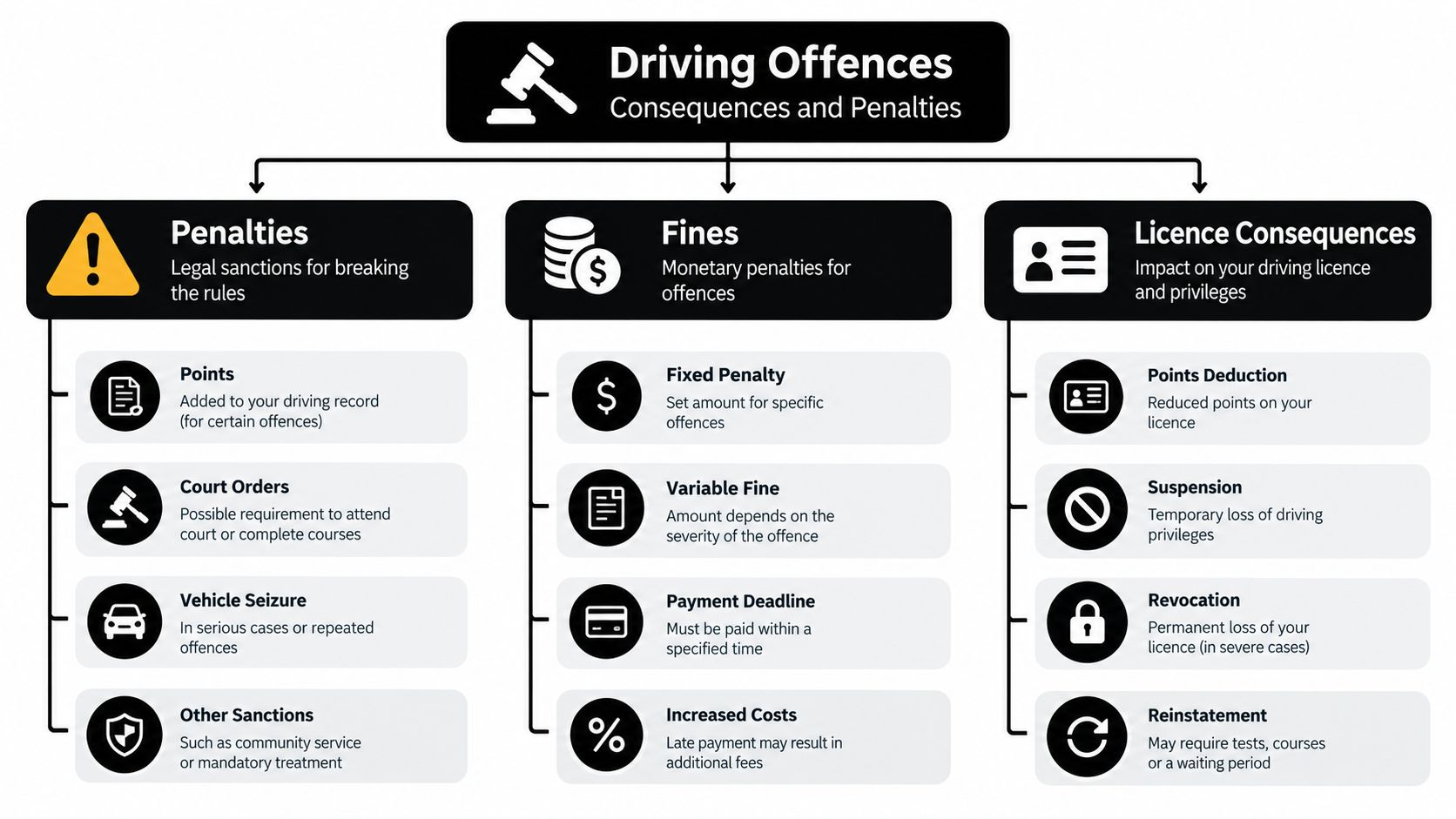
Important distinction: A licence suspension, a criminal fine, a driving prohibition, and an insurance consequence are not the same thing. Solving one issue does not automatically solve the others.
A useful overview of the federal framework is penalties for impaired driving, but individual advice depends on the specific allegations and disclosure.
Possible Criminal Consequences of an Impaired Driving Conviction
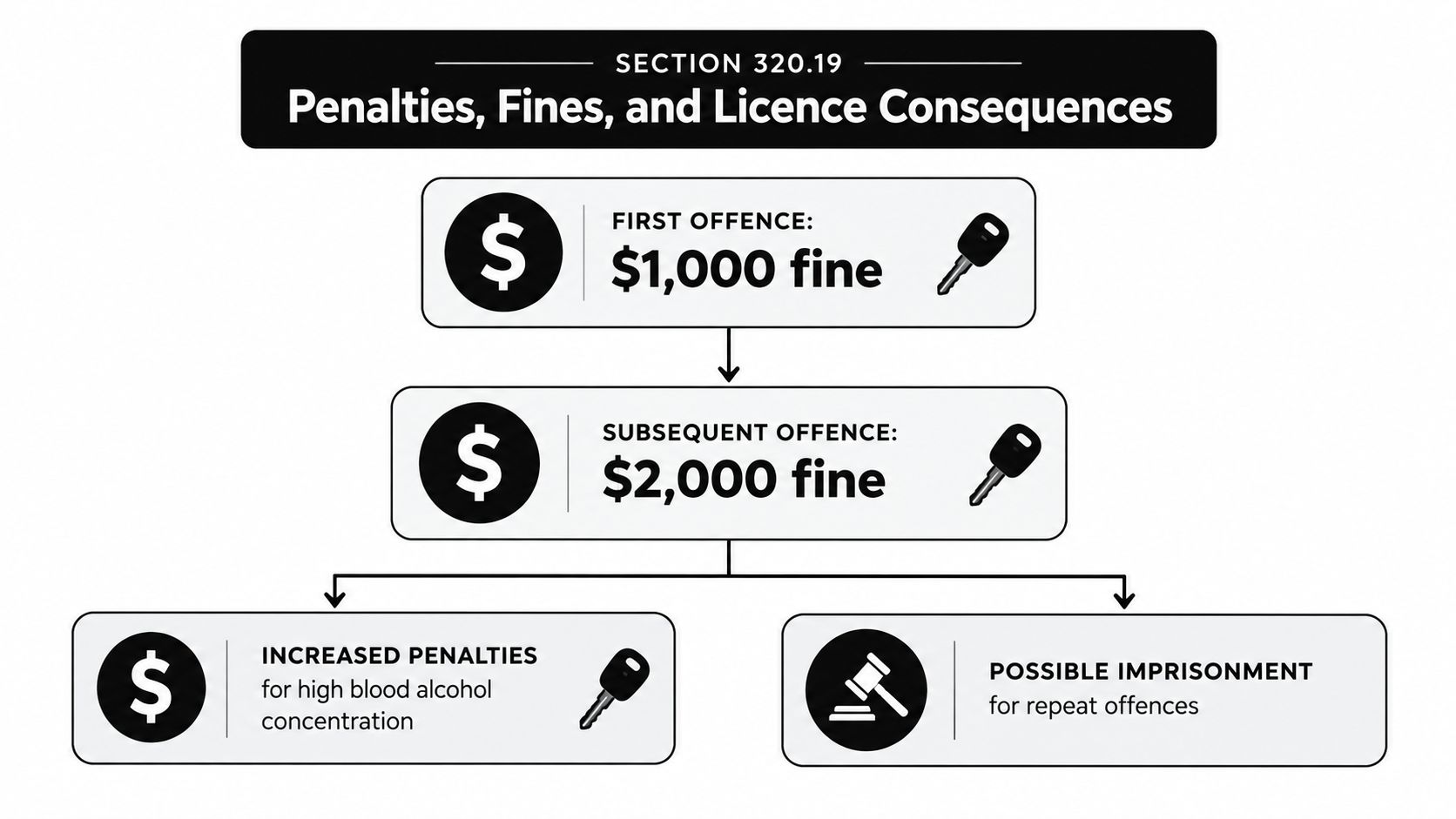
Impaired driving convictions can carry serious criminal penalties. Justice Canada identifies a $1,000 minimum fine for BAC from 80 to 119 mg, a $1,500 minimum for BAC from 120 to 159 mg, and a $2,000 minimum for BAC of 160 mg or more. A first refusal to comply with a lawful demand also carries a $2,000 minimum fine, as explained in the Justice Canada Bill C-46 question-and-answer guidance.
Depending on the charge and the person’s record, additional consequences may include:
-
a criminal record
-
a court-ordered driving prohibition
-
probation in some cases
-
increased penalties for repeat offences
-
possible jail exposure in more serious situations
-
travel, employment, and professional licensing problems
For many people, the criminal record concern is one of the biggest reasons to speak with a Criminal Lawyer Brampton soon after being charged.
What Happens at the First Court Appearance in Brampton?
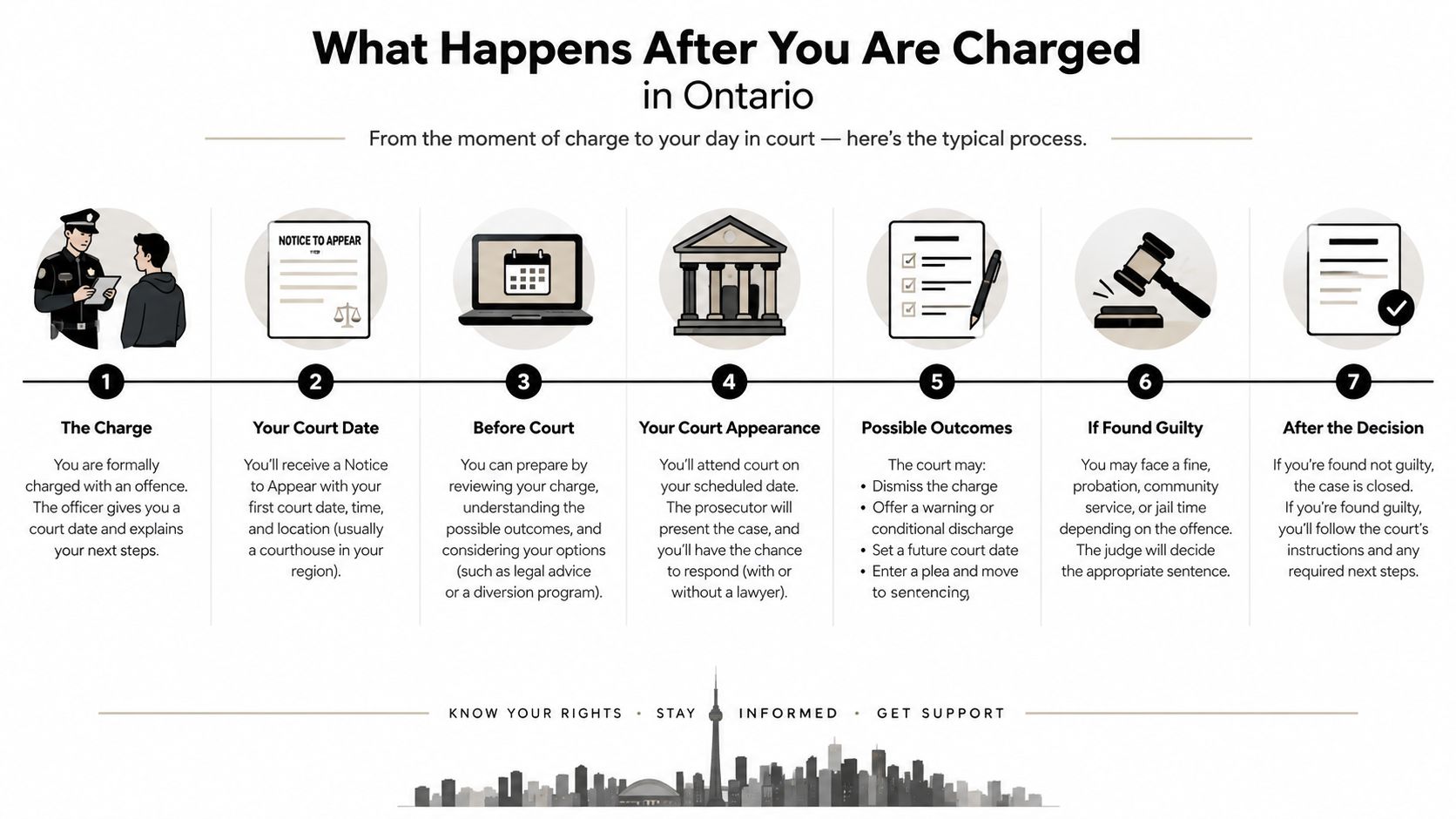
The first court appearance is usually an administrative step, not a trial. If your case is in Brampton, the first date often focuses on the status of disclosure, whether you have a lawyer, and what needs to happen next before the case can move forward.
At this stage, no one should rush into decisions without understanding the evidence. The first appearance is often about organization and planning, not arguing the whole case.
A lawyer may use that appearance to:
-
confirm whether disclosure has been received
-
ask for missing records or videos
-
identify legal issues that need review
-
request time to assess the case properly
-
discuss next procedural steps with the court and Crown
For someone new to the system, this step can feel intimidating. Having a Brampton criminal lawyer involved early can make the process clearer and help avoid unnecessary mistakes.
Why Disclosure Matters in an Impaired Driving Case
Disclosure is the evidence package the Crown provides. In an impaired driving case, it may include:
-
officer notes
-
video from the roadside or police station
-
breath demand wording
-
approved screening device information
-
approved instrument records
-
breath technician documents
-
witness statements
-
booking records and timelines
The disclosure package can show what police observed, what procedures were followed, and whether the allegation is supported by the available evidence.
Why early review matters
A charge alone does not show whether the Crown can prove the case. Disclosure may reveal issues involving the stop, the demand, the timing of samples, the right to counsel, continuity of evidence, or the accuracy of police notes.
A defence lawyer may ask for missing video, calibration or maintenance information, notes from other officers, radio communications, or records relevant to the demand and detention. The lawyer may also review whether the accused received access to counsel, whether the stop was lawful, and whether police delayed or mishandled the investigation.
Why Speak With a Criminal Defence Lawyer Early?
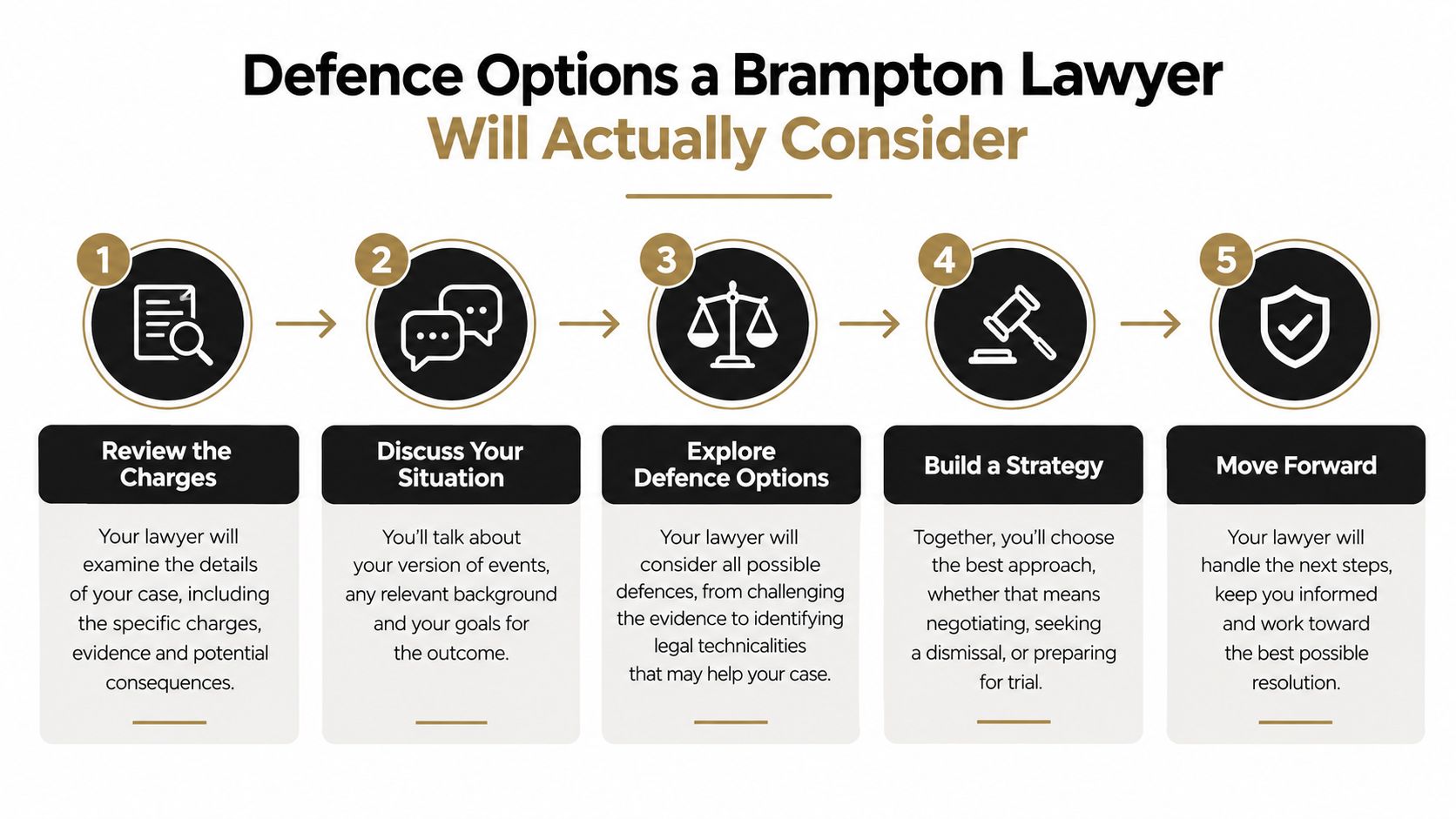
Many people charged with impaired driving wait because they think the first court date is far away or because they hope the matter will be simple. In reality, early legal advice can help you understand the allegation, protect your position, and avoid making assumptions based only on the charge sheet.
A criminal defence lawyer in Brampton can explain:
-
the type of charge you are facing
-
the possible licence and criminal consequences
-
what the first court appearance is for
-
what disclosure may reveal
-
whether there may be Charter issues or evidentiary concerns
-
what realistic legal options may exist
Sections 8, 9, and 10(b) of the Canadian Charter of Rights and Freedoms may become relevant in some cases. Section 8 protects against unreasonable search and seizure. Section 9 protects against arbitrary detention. Section 10(b) protects the right to retain and instruct counsel without delay after arrest or detention.
A lawyer may review questions such as whether the stop was lawful, whether detention was justified, whether access to counsel was meaningful, and whether the breath demand was valid. If a Charter breach occurred, the remedy may involve excluding evidence under section 24(2), although the result depends on the full circumstances.
Mixed-substance cases need particular care. The National Drug Driving Study identified alcohol, THC, and other impairing substances among injured drivers, and combinations can raise different questions about effects, detection windows, and causation. The presence of a substance is not automatically proof that it impaired the person’s ability to drive. The study is available through the National Drug Driving Study report.
A free initial consultation usually covers the charge, release paperwork, the known facts, immediate deadlines, and the next steps for obtaining disclosure. It should not be mistaken for a final opinion before the evidence is reviewed. Readers seeking a Brampton lawyer can learn more about an impaired-driving lawyer in Brampton.
Charged With Impaired Driving in Brampton?
If you have been charged with impaired driving, Over 80, or refusal in Brampton, it is normal to have urgent questions about what the allegation means and what happens next. You may be wondering whether you can drive, when you need to attend court, what evidence the Crown has, and what consequences you could face if the case results in a conviction.
Badesha Law represents clients facing criminal charges in Brampton and helps them understand the allegations, court process, evidence, possible consequences, and legal options. If you need a criminal lawyer in Brampton, or want to speak with a Brampton criminal defence lawyer about an impaired driving allegation, early advice can help you make informed decisions. If your case involves alcohol, drug impairment, Over 80, or refusal allegations, you can also learn more about working with a criminal defence lawyer in Brampton for impaired driving charges.
The goal of an early consultation is not to promise an outcome. It is to help you understand where you stand, what the next steps are, and how the evidence and procedure in your case may affect your options.
Common Misconceptions About Impaired Driving Charges Ontario
“One drink cannot lead to a charge.” There is no universal rule based on drink count. Impairment and alcohol concentration can vary based on body size, food, timing, medication, and many other factors.
“If I seemed fine, I cannot be charged.” That is not always true. A person may still face an Over 80 allegation even if they did not appear obviously impaired.
“Refusing the breath test is safer.” Refusal can lead to a standalone criminal charge if the Crown alleges there was no reasonable excuse.
“A first offence means nothing serious will happen.” Even a first impaired driving allegation can bring immediate licence issues, major insurance consequences, and criminal record exposure if there is a conviction.
“I should wait until court to speak with a lawyer.” Early advice can be useful well before the first appearance, especially when release documents, deadlines, and disclosure issues need attention.
The national picture shows why these cases remain a serious public safety issue. Police-reported impaired-driving incidents in Canada reached 71,602 in 2023, the lowest rate on record, yet impaired driving remained a major public-safety concern. Alcohol was involved in nearly 70% of impaired-driving deaths, while 521 Canadians died in 2022 in crashes involving a drunk driver, compared with 457 in 2021, according to the RCMP’s impaired-driving facts.
Ontario enforcement remains active. The OPP reported 11,142 impaired-driving charges in 2023, an increase from the preceding years. In Peel, police reported 1,023 impaired-driving incidents in 2023, 922 in 2024, and 611 from January 1 to July 31, 2026, as shown in Peel Regional Police crime statistics.
| Metric | Pre-Bill C-46 (2017) | Post-Bill C-46 (2022) |
|---|---|---|
| National enforcement picture | Enforcement existed under the earlier federal framework | Enforcement continues under the broader Bill C-46 framework |
| Substance focus | Alcohol-centred public discussion | Alcohol, cannabis, drugs, and combined substances require separate analysis |
| Court assessment | Evidence depended on the charge and investigation | Disclosure, Charter compliance, testing, and mixed evidence remain central |
Canadian data also show that cannabis and mixed-substance issues require analysis beyond a single BAC reading, as discussed in the MADD Canada impaired-driving statistics overview.
Contact Badesha Law for Guidance After an Impaired Driving Charge
If you are facing an impaired driving allegation in Brampton, do not rely on assumptions or general online summaries. The charge, the disclosure, the testing process, and the court steps all need to be reviewed carefully.
Badesha Law assists people charged with impaired driving and other criminal offences in Brampton. If you want to speak with a DUI Lawyer Brampton, an Impaired Driving Lawyer Brampton, or a Criminal Lawyer Brampton, contact Badesha Law for a confidential consultation to discuss the allegation, the court process, and your next steps. You can visit Badesha Law to request assistance.
No comment