


If you or someone you care about has been arrested in Canada, you're immediately thrown into one of the most critical stages of the criminal justice process: the bail hearing. Officially known as a "judicial interim release hearing," this isn't a trial to decide guilt or innocence. Its sole purpose is to decide if the arrested person can be released back into the community while their case moves through the courts.
Understanding what goes on in a bail hearing is the first step to taking back control. It’s a fast-moving process, and being prepared can make all the difference.
Your First Step After an Arrest
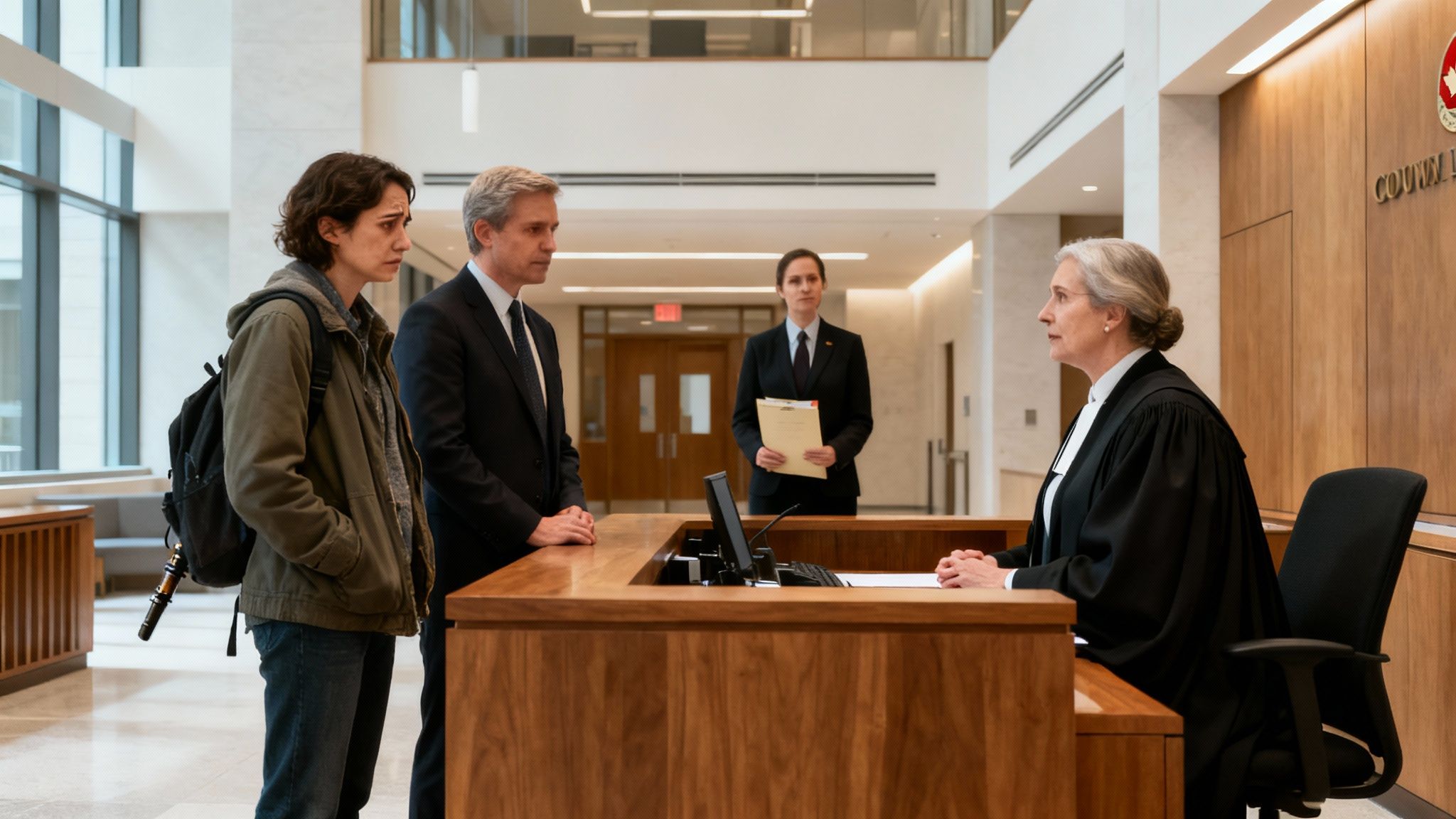
Once an arrest happens, the clock starts ticking. The Criminal Code of Canada is clear: the police must bring the person before a Justice of the Peace or a judge within 24 hours, or as soon as practically possible. This initial court appearance is the bail hearing, and its outcome will shape everything that follows.
Getting released on bail means you can go home, keep your job, and actively help your lawyer prepare your defence. Being held, or "detained," means staying in custody until your trial, which could be weeks or even months away. This makes the bail hearing one of the highest-stakes moments in the entire case.
The Key People in the Courtroom
Walking into a bail hearing can feel overwhelming, but it helps to know who the key players are and what they do. Below is a quick summary of the people you'll encounter and their responsibilities during the bail procedure.
| Participant | Primary Role |
|---|---|
| The Justice of the Peace (or Judge) | The impartial decision-maker. They listen to both sides and apply the law to decide whether to grant or deny bail. |
| The Crown Prosecutor | The government's lawyer. Their job is to argue against your release if they believe it's necessary to ensure you attend court, protect the public, or maintain confidence in the justice system. |
| The Defence Lawyer | Your champion and advocate. Their role is to present a strong "plan of release" and convince the court that your detention is not necessary. |
Each person has a specific job, and understanding these roles helps demystify the process and shows you where your lawyer's work is most critical.
At its heart, the Canadian bail system is built on the right to be presumed innocent until proven guilty. This means the default position is release. The Crown prosecutor has to show compelling reasons why bail should be denied.
Why Immediate Legal Counsel Is Crucial
From the second an arrest is made, the work of securing bail begins. An experienced criminal defence lawyer doesn’t wait around. They immediately start gathering information, reaching out to potential sureties (people who can supervise you), and crafting a strategic release plan that fits your life.
Your lawyer knows the legal tests the Justice of the Peace has to apply and, just as importantly, knows how to anticipate and counter the Crown's arguments. You can get more details on these initial stages by reading about what happens after an arrest and how to prepare.
This proactive approach is everything. Without an expert in your corner, you're at risk of being detained based on an incomplete picture, a situation that has huge consequences for you and your family. Securing your freedom at this first hurdle is always the top priority.
The Three Legal Tests for Bail
At the heart of every bail hearing is a crucial legal framework laid out in Section 515(10) of the Criminal Code of Canada. The decision to release or detain someone isn't based on a gut feeling. Instead, the Crown prosecutor must convince the court that keeping the accused in custody is necessary by proving at least one of three specific legal arguments, known as "grounds."
Think of these grounds as three distinct hurdles the Crown has to clear. If they can’t successfully argue on at least one of these points, the law says the accused person should be released. Understanding these tests is essential to knowing what happens at a bail hearing and what your defence lawyer is fighting against.
The Primary Ground: Ensuring Attendance in Court
The first test, the primary ground, is the most straightforward. It boils down to one simple question: Is there a significant risk that the accused will fail to show up for their future court dates if released? It’s all about ensuring attendance.
To make this argument, the Crown might point to factors suggesting the person is a flight risk.
- Lack of connections: Does the person have weak ties to the community, like no stable job, no family nearby, or no fixed address?
- Past behaviour: Is there a history of missing court dates or breaching court orders?
- Seriousness of the penalty: If the potential sentence is very long, the Crown could argue there's a greater incentive to flee.
Your defence lawyer counters this by presenting a strong "plan of release" that shows you are reliable. This plan demonstrates you have a stable place to live, supportive family, and a job—all things that anchor you to the community and prove you will see your case through to the end.
The Secondary Ground: Protection of the Public
The secondary ground shifts the focus from attendance to public safety. Here, the Crown must show there is a substantial likelihood the accused will commit another criminal offence or interfere with the administration of justice if released. This is a forward-looking test, concerned with preventing future harm.
The court will consider several factors when weighing this risk:
- The nature of the current charge, especially if it involves violence.
- The accused person's criminal record, looking for patterns of similar behaviour.
- Evidence suggesting a risk to specific people, like the alleged victim or witnesses.
For example, in a domestic assault case, the Crown will almost always raise the secondary ground, arguing that releasing the accused poses a risk to the complainant. Your lawyer's job is to propose strict bail conditions—like a no-contact order or a requirement to live away from the alleged victim—to show the court that any potential risk can be managed effectively in the community.
The legal test isn't whether there is any risk, but whether the risk is substantial. A skilled defence lawyer focuses on showing that with the right supervision and conditions, any risk is low and manageable, making detention unnecessary.
The Tertiary Ground: Maintaining Confidence in the Administration of Justice
The final test, the tertiary ground, is the broadest and often the most difficult one to argue. It asks whether detaining the accused is necessary to maintain public confidence in the administration of justice. This isn't about the specific risk the individual poses, but about how the public would perceive their release.
This ground is typically reserved for the most serious alleged offences, such as murder, or cases that have attracted significant public attention. The court considers the strength of the Crown's case, the gravity of the offence, and the potential for a lengthy prison sentence. The release must not be so shocking that a reasonable person would lose faith in the justice system.
The Reverse Onus Situation
In most cases, the Crown has the responsibility—the "onus"—to prove why you should be detained. However, for certain serious offences (like drug trafficking, firearm offences, or committing a crime while already on bail), the script gets flipped. This is called a reverse onus situation.
Here, the law requires you, the accused, to prove why you should be released. This dramatically raises the stakes of the bail hearing. Instead of your lawyer simply poking holes in the Crown's arguments, they must build an overwhelmingly strong case for your release from the ground up. This is a complex legal challenge where understanding the burden of proof in criminal law is critical. Having an experienced lawyer is absolutely essential in these high-pressure scenarios.
Navigating the Bail Hearing Process
From the moment of arrest, a clock starts ticking. Canadian law is clear: a person must be brought before a court for a bail hearing within 24 hours, or as soon as possible. This first court appearance isn't just a formality; it's a critical moment that can set the tone for the entire case.
The courtroom itself can feel overwhelming. It’s a formal, often chaotic environment filled with lawyers, court staff, and other accused individuals waiting for their turn. The job of your defence lawyer is to cut through that noise and make a clear, persuasive case for your release.
Unlike a trial that can unfold over days with live witnesses, a bail hearing moves fast. Evidence is typically presented through submissions from the lawyers, who will summarize the allegations and your personal circumstances for the Justice of the Peace.
Crafting a Winning Plan of Release
The foundation of any successful bail hearing is a solid plan of release. This isn't just a simple promise to show up for your next court date. It's a detailed, practical strategy designed to convince the court that you aren't a flight risk and that any potential concerns about public safety can be properly managed.
A strong plan tackles the court's main worries head-on. It highlights your connections to the community—things like a steady job, a stable home, and supportive family—and proposes specific, realistic conditions to ensure you'll follow the rules while your case is before the courts.
The Role of a Surety
For many people, the most important part of that release plan is a surety. Think of a surety as your community jailer. This is a responsible person, usually a family member or close friend, who pledges to supervise you and make sure you follow every single one of your bail conditions.
A credible surety can be the difference between getting out and staying in. They have to be:
- Credible: A responsible adult with a clean record and some degree of financial stability.
- Authoritative: Someone you respect and who has the influence to enforce the rules.
- Committed: Willing to testify in court and promise—under oath—to call the police if you break your conditions.
The Crown Attorney will almost always cross-examine a potential surety to test their commitment. A well-prepared surety, guided by your lawyer, gives the court the confidence it needs to grant your release. A huge part of what happens at a bail hearing is your lawyer getting this key person ready. You can learn more about the number of chances you get for bail in our guide on how many bail hearings you get.
This flowchart breaks down the three legal tests the Crown uses to argue against bail—the very tests your release plan needs to overcome.
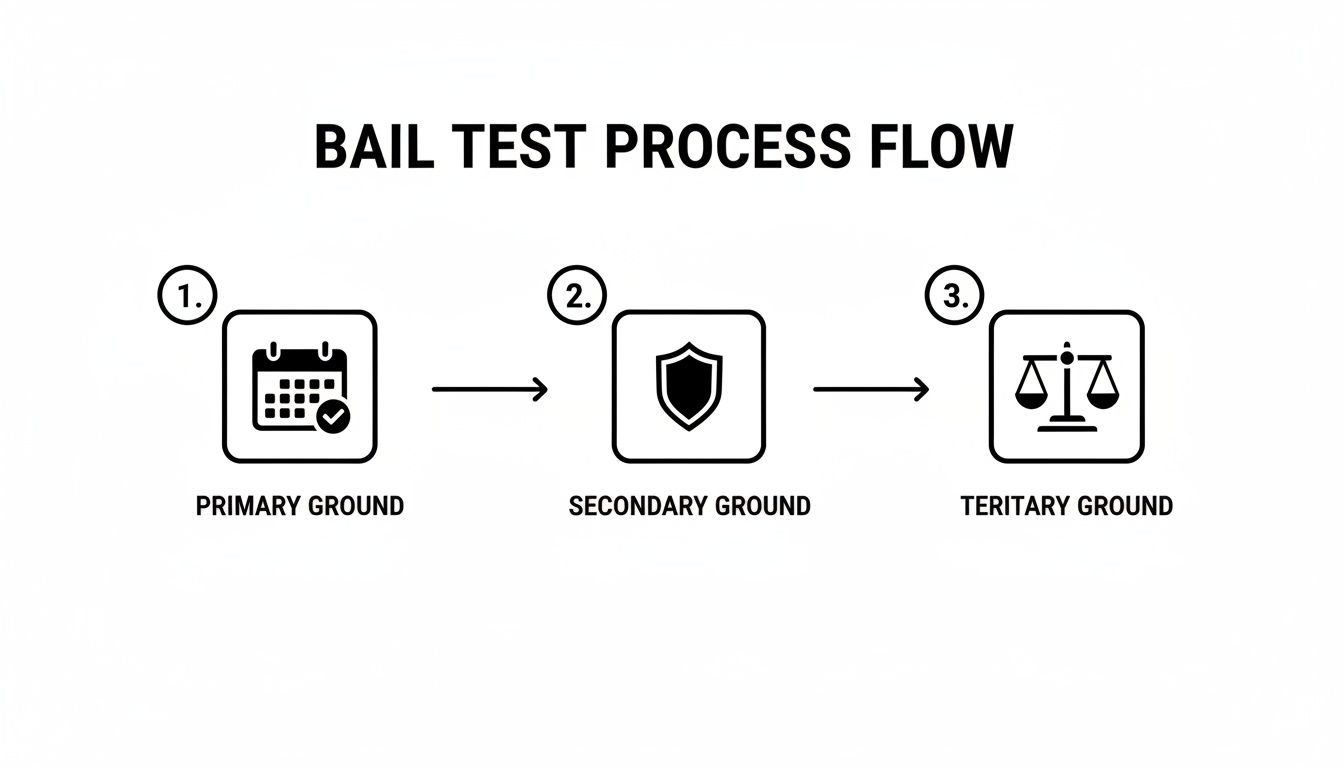
As the infographic shows, the grounds for detention are progressive. The court first considers whether you will show up for court (Primary), then moves to public safety (Secondary), and finally, in the most serious cases, considers whether detention is needed to maintain public confidence in the justice system (Tertiary).
Weekend and Statutory Holiday (WASH) Court
Arrests don't stick to a 9-to-5 schedule. If you or someone you know is arrested on a weekend or a holiday, the bail hearing happens in a special session known as WASH court. These hearings are extremely fast-paced and high-pressure, often held by video from the police station where the person is being held.
In that kind of environment, having a lawyer who is available 24/7 isn't a luxury—it's essential. Without immediate legal help, you could easily be detained until the next business day simply because there was no one available to present a proper release plan. A lawyer can get involved right away, speak with the Crown, and organize a surety even on short notice.
A bail hearing is a rapid-fire legal event where preparation is everything. The goal is to present a clear, trustworthy picture of the accused's life and a solid supervision plan that makes detention seem unnecessary. The strength of this plan directly impacts the outcome.
While Canada’s system leans heavily on sureties and release plans, it's interesting to see how other places handle bail. For example, some jurisdictions in the United States have moved away from traditional cash bail systems. California, for instance, implemented reforms that significantly reduced the use of cash bonds. In misdemeanor cases, cash bond use dropped from over 85% to just 14%. As a result, 90% of people charged with misdemeanors now avoid pretrial detention, compared to less than 40% before the changes. This has been a game-changer for low-level charges. This data, tracked from 2015-2024, shows the reforms cut misdemeanor arrests by nearly 14%, kept repeat arrest rates stable at 23%, and saw dismissals skyrocket from 31% to 74% as guilty pleas fell from 68% to 24%. This data powerfully illustrates how different bail policies can dramatically change case outcomes, and you can read more about these pretrial detention findings on ppic.org.
Understanding Your Release and Bail Conditions

Securing your release at a bail hearing is a massive win, but it’s not the end of the story. In fact, it’s the start of a very strict chapter where you have to follow a precise set of rules until your case is resolved.
This isn't an unconditional release. It comes with a formal court order, known as a recognizance or release order, which lays out the specific conditions you are legally required to follow.
Think of these bail conditions as the non-negotiable rules of a game you absolutely cannot afford to lose. A single slip-up—legally known as a “failure to comply with a release order”—can get you arrested all over again and hit with a fresh criminal charge. This makes understanding and perfectly following your conditions your top priority.
Common Bail Conditions You Might Face
While every bail order is tailored to the specifics of the case, many conditions are standard across Canada. The goal is always the same: to address the primary and secondary grounds by ensuring you show up for court and protecting public safety.
Here are some of the most common conditions the courts impose:
- Report to a Bail Supervisor: This usually means checking in regularly (say, once a week) with a bail supervisor or probation officer, either by phone or in person.
- Reside at a Specific Address: You’ll be required to live at an approved address—often with your surety—and you can’t move without the court’s permission.
- Obey a Curfew: This condition requires you to be inside your residence during specific hours, typically overnight (for example, from 10 p.m. to 6 a.m.).
- Abstain from Alcohol or Drugs: If the charges are related to substance use, it’s almost certain you’ll be ordered not to consume or possess alcohol or non-prescribed drugs.
- No-Contact Orders: In cases like domestic assault, you will be strictly forbidden from communicating, either directly or indirectly, with the alleged victim or other named people.
- Weapons Prohibition: It's standard practice to forbid you from possessing any firearms, ammunition, or other specified weapons.
For more serious charges, the court can clamp down with much stricter conditions, like house arrest (which means you must stay home 24/7 with very limited exceptions) or electronic monitoring using a GPS ankle bracelet. It can also be helpful to learn about other legal tools, like understanding what a peace bond is in Canada, to see how different court orders are used.
Financial Obligations in Bail
A key part of what happens at a bail hearing involves financial commitments, but this isn't usually about handing over cash upfront. The court uses financial terms to create a powerful incentive for you to follow the rules.
The purpose of a financial pledge is not to punish you, but to ensure accountability. It's a promise to the court, backed by a potential financial loss, that you will take your obligations seriously.
There are two main types of financial conditions you’ll see in Canadian bail:
- Recognizance Without Deposit: This is the most common form. You and your surety pledge a certain amount of money to the court (for instance, $2,000) but you don't actually have to pay it. That money is only forfeited if you breach your bail conditions.
- Recognizance With a Cash Deposit: In more serious cases, or if you're seen as a flight risk, the court might order cash bail. This means you or your surety must deposit a specific amount of money with the court. The cash is returned at the end of your case, but only if you've followed every single one of your conditions.
Recent changes to Canadian bail laws have emphasized that cash deposits should be a last resort, used only when less restrictive financial conditions are not enough to address the specific risks of a case.
What to Do If Bail Is Denied
Hearing that bail has been denied is a devastating blow. It’s a moment filled with shock and fear, both for the person in custody and their loved ones. But it’s critical to understand that this is not the end of the road. It’s simply the end of the first round in a longer fight.
The immediate result of a denial is that the accused person will be moved from the courthouse cells to a provincial detention centre. There, they will have to wait while their case makes its way through the system, which can take months. This is a tough reality, but it’s also the point where a new legal strategy begins.
The Next Step: A Bail Review
A bail denial is not permanent. The Canadian Criminal Code provides a clear path to challenge the decision: a bail review. This is a formal application made to a judge at a higher court—in Ontario, that’s the Superior Court of Justice—asking them to take a second look and overturn the original order.
Think of it as an appeal of the bail decision. Your lawyer will get the transcript from the first hearing and go through it with a fine-tooth comb, searching for legal errors to build a case for your release. This isn’t a simple do-over; a bail review requires a specific and powerful legal argument to have any chance of success.
A bail review is your legal right to a second look. The higher court's role is to determine if the initial decision was correct in law and if your continued detention is truly justified.
Grounds for a Successful Bail Review
To win a bail review, your defence lawyer must convince the Superior Court judge of one of two things:
There was a legal error in the original hearing. This means showing the Justice of the Peace made a mistake applying the law. For example, maybe they misunderstood the legal tests for bail, ignored important evidence, or based their decision on a flawed legal principle.
There has been a material change in circumstances. This argument is all about new information that wasn't available at the first hearing. Perhaps a stronger, more suitable surety has come forward. Maybe you’ve been accepted into a residential treatment program, or new evidence has surfaced that weakens the Crown’s case against you.
This is a complex process that demands deep legal knowledge. Successfully arguing that an error was made or that circumstances have changed enough to justify a different outcome is a significant challenge. If you find yourself in this situation, the most critical next step is to explore your options with the best criminal attorney near you.
An experienced lawyer can analyze the original hearing for errors and help gather the evidence needed to present a compelling case for a bail review, continuing the fight for your freedom.
Common Questions About Bail Hearings in Canada
When an arrest happens, a flood of questions hits you all at once, and it's easy to feel overwhelmed. Getting straight answers about what actually goes on at a bail hearing can bring some much-needed clarity during an incredibly stressful time. Here are some of the most common questions people ask about the bail process in Canada.
How Long Does a Bail Hearing Take in Canada?
This is a tough one, because the answer can be anything from a few minutes to several hours—or even days. It all boils down to whether your lawyer and the Crown prosecutor can come to an agreement on your release.
If they can reach a deal, it's called a 'consent release'. This is the best-case scenario. The process in the courtroom is quick, sometimes over in minutes. Your lawyer simply tells the Justice of the Peace about the agreed-upon plan, the conditions are confirmed, and the release order is signed.
But if the Crown is determined to keep you in jail, the hearing becomes a 'contested' bail hearing. This is a much longer, more complicated affair. A contested hearing can take hours as both sides make arguments, present evidence, and your surety might have to testify and be cross-examined. In busy courthouses like Brampton's, a contested hearing can easily get pushed to the next day, meaning more time in custody.
This is exactly why having an experienced lawyer from the get-go is so critical. They can start negotiating with the Crown immediately, working toward that consent release to get you out as fast as possible.
What Is a Surety and Who Can Be One?
Aside from you and the lawyers, the surety is probably the most important person in a contested bail hearing. A surety is someone who makes a promise to the court that they will supervise you while you're out on bail and make sure you follow every single one of your conditions.
This isn't just a character reference. A surety effectively acts as your 'community jailer'. They become legally responsible for you.
To be a good surety, a person needs to be:
- A responsible adult, usually over 18, with no criminal record of their own.
- Financially stable, though they don't have to be wealthy.
- Someone who has real authority and influence over you.
- Prepared and willing to call the police if you break your bail conditions.
The Crown prosecutor will almost always question the proposed surety in court. They want to test their understanding of the role and see if they have the strength to enforce the rules. One of your defence lawyer’s most important jobs is preparing your surety for this questioning so they come across as a credible and reliable choice for the court.
Can I Get Bail Without a Lawyer?
While you technically have the right to represent yourself, it's an incredibly risky move. A bail hearing is a formal court proceeding with complex rules of evidence and procedure laid out in the Criminal Code.
The Crown prosecutor is a trained professional whose entire job is to argue against your release. Going up against them without an expert in your corner puts you at a massive disadvantage.
An unrepresented person won't know how to properly structure a release plan, challenge the Crown’s arguments, or address the three legal grounds for detention. One simple mistake can easily result in your bail being denied.
Hiring an experienced criminal defence lawyer doesn't just dramatically increase your chances of getting out. They also fight to get you the most reasonable and least restrictive conditions possible, protecting your freedom while your case makes its way through the system.
What Happens at a Bail Hearing for a Youth?
Bail hearings for young people—anyone between 12 and 17—work under a completely different set of rules found in the Youth Criminal Justice Act (YCJA). The entire philosophy is different from the adult system.
The law starts with a strong presumption that a young person should be released. Keeping a youth in custody is seen as an absolute last resort, only to be used when there are no other reasonable options.
While the legal tests are similar to the adult system (ensuring court attendance, protecting public safety), they are applied through the lens of the youth’s specific situation. The court has to consider the young person's age, maturity, and what kind of support is available from parents or guardians.
Parents are almost always central to the process. They usually act as the surety and are the foundation of the release plan, promising the court they will supervise the youth and help them follow any conditions. A youth bail hearing requires a lawyer who has specific expertise in the YCJA to make sure the young person’s rights are fully protected.
If you or a loved one needs immediate help with a bail hearing in Brampton or the Peel Region, don't wait. The first few hours after an arrest are critical. Contact Badesha Law for a free, confidential consultation. We are available 24/7 to protect your rights and fight for your release. Visit us at https://criminallawyerinbrampton.com to get the urgent legal help you need.
No comment