


When you or a loved one has been arrested in Brampton, the first question that flashes through your mind is usually, “how many chances do I get to be released?” Understanding the answer to how many bail hearings do you get is critical, because in Ontario, your first shot at bail—which must happen within 24 hours of arrest—is by far your most important one.
This guide explains what happens in the Brampton court process, the difference between a consent release and a contested hearing, and how an experienced criminal defence lawyer can fight for your freedom. Badesha Law, a criminal defence law firm in Brampton, has extensive experience securing release for clients facing all types of charges.
Your First and Best Chance: The Initial Bail Hearing
The time right after an arrest is a whirlwind of confusion and anxiety. Thankfully, the Canadian legal system has a built-in protection: anyone taken into custody has to be brought before a Justice of the Peace for their first court appearance without unreasonable delay. This usually means within 24 hours.
It’s crucial to understand that this first appearance isn’t a trial. Its only purpose is to decide one thing: whether you can be released from custody while your case moves through the courts.
At this pivotal moment, the road splits. The ideal outcome is what’s called a “consent release.” This is where your defence lawyer and the Crown prosecutor agree on the terms of your release without a lengthy argument in court. It’s the fastest way home. Having an experienced criminal lawyer in your corner is absolutely critical here, as we can often negotiate a consent release by proactively presenting the Crown with a strong, credible release plan.
This flowchart shows the two paths your bail can take right after an arrest.
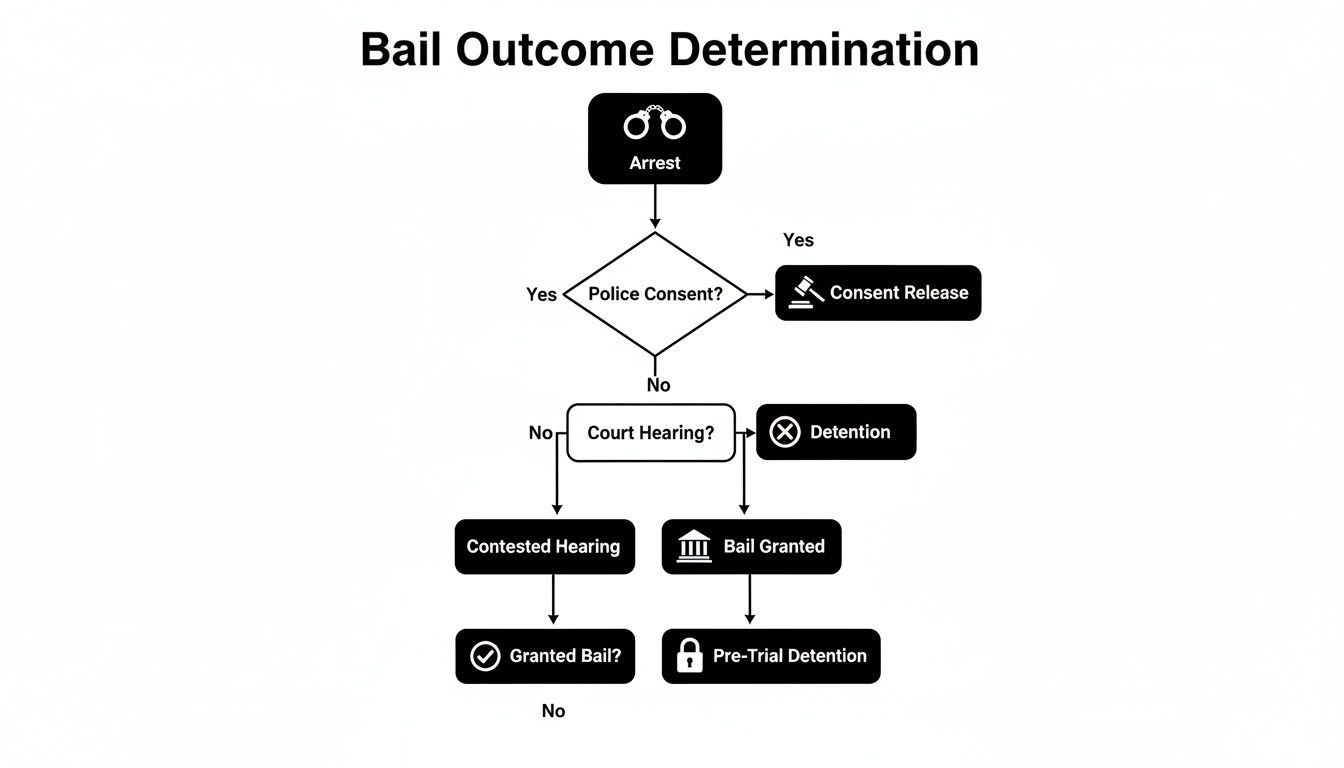
As you can see, a consent release is the most direct route back to your life, sidestepping the stress and uncertainty of a contested hearing.
Consent Release vs Contested Bail Hearing At a Glance
So, what’s the real difference between the Crown agreeing to your release versus having to fight for it in court? This table breaks it down.
| Aspect | Consent Release | Contested Bail Hearing (Show Cause) |
|---|---|---|
| Process | A negotiation between your lawyer and the Crown prosecutor outside of the formal courtroom setting. | A formal court hearing where both sides present arguments and evidence to a Justice of the Peace. |
| Key Players | Defence Lawyer & Crown Attorney | Defence Lawyer, Crown Attorney & Justice of the Peace |
| Speed | Much faster. Can often be resolved on the first appearance, sometimes within hours. | Slower. Can take several hours or even be adjourned to another day, meaning more time in custody. |
| Outcome | Release is guaranteed once terms are agreed upon. | Release is uncertain and depends entirely on the Justice of the Peace’s decision. |
| Goal | To quickly agree on reasonable conditions (e.g., no-contact orders, curfew) to secure your release. | To “show cause” (prove) why your detention is not justified under the Criminal Code. |
Ultimately, a consent release is always the preferred route, saving time, stress, and the risk of being detained. The team at Badesha Law always prioritizes negotiating a consent release first.
Who Decides Your Freedom in a Contested Hearing?
If the Crown won’t consent to your release, the matter moves to a full-blown contested hearing, officially called a “show cause hearing.” This is where your lawyer has to formally argue for your freedom. The key decision-makers in the room are:
- The Justice of the Peace: This is the impartial decision-maker. They listen to the arguments from both the Crown and your defence lawyer and apply the law to decide if keeping you in jail is legally necessary.
- The Crown Attorney: As the state’s prosecutor, their job is to argue for your detention if they believe you pose a flight risk, are a danger to the public, or that your release would shake the public’s confidence in the justice system.
- Your Defence Lawyer: This is your champion. Your lawyer’s role is to dismantle the Crown’s arguments, present compelling evidence of your ties to the community (like a job, family, or home), and put forward a solid, supervised plan for your release.
Getting a clear picture of these roles and what to expect is vital. You can get a deeper look by reading our guide on what happens at a bail hearing. The preparation, evidence, and arguments presented at this first hearing lay the groundwork for your entire case. Making that first chance count is the single most effective strategy for securing your freedom.
The Show Cause Hearing: Making the Case for Your Release
If the Crown prosecutor decides not to agree to your release, things move to a contested bail hearing. In Ontario, we call this a “show cause” hearing, and it’s your first and most critical opportunity to argue for your freedom. This is the moment where the question “how many bail hearings do you get?” feels most real, because the outcome here can shape the entire direction of your case.
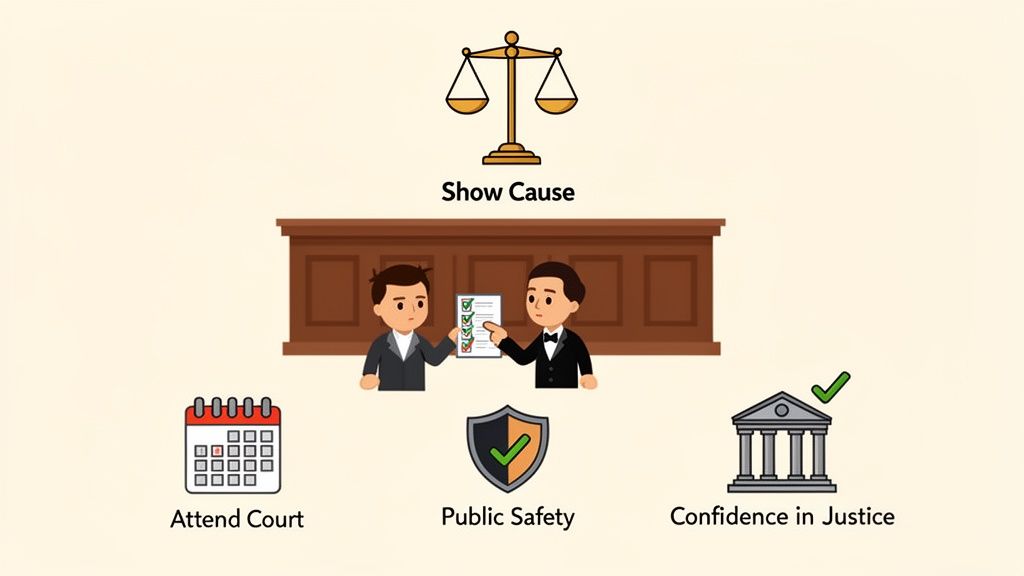
The name “show cause” is quite literal: the Crown prosecutor must stand up in court and “show cause”—or in plain English, provide a valid legal reason—why keeping you in jail is necessary. A defence lawyer’s job is to anticipate and dismantle every argument the Crown makes, which almost always fall into one of three specific categories.
The Three Grounds for Detention
To hold you in custody, the Crown has to convince the Justice of the Peace of at least one of these points:
- The Primary Ground (Flight Risk): This is the Crown’s way of saying they don’t believe you’ll show up for your court dates. They might point to a history of missed appearances or argue you don’t have strong ties to the community, making it easy for you to disappear.
- The Secondary Ground (Public Safety): Here, the concern is that you pose a risk to the public if released. The Crown will argue that your detention is necessary to prevent you from committing other offences or from interfering with witnesses or the investigation.
- The Tertiary Ground (Confidence in Justice): This one is a bit more abstract. The Crown argues that releasing you—given the seriousness of the charge and the apparent strength of their evidence—would make the public lose faith in the justice system.
A criminal lawyer at Badesha Law builds a strategy around proving these concerns are unfounded. We do this by presenting a well-thought-out, supervised release plan that directly counters each potential argument the Crown might raise.
What Happens in a “Reverse Onus” Situation?
Now, in most bail hearings, the ball is in the Crown’s court. They have the burden of proving why you shouldn’t be released. But for certain very serious charges—like murder, major drug trafficking, or offences allegedly committed while you were already out on bail—the tables are turned. This is called a “reverse onus” situation.
In a reverse onus bail hearing, the legal burden flips entirely. It’s no longer the Crown’s job to argue for your detention; it’s your job to prove why you should be released. The stakes are instantly higher, and having an experienced criminal defence lawyer is absolutely essential.
The Make-or-Break Role of a Surety
One of the most effective tools for winning a contested bail hearing is a strong surety. A surety is someone you can count on—usually a family member or a close friend—who comes to court and essentially vouches for you. They agree to supervise you while you’re out on bail and promise a certain amount of money to the court, which they would forfeit if you breach your conditions.
So, what does a good surety look like to a Brampton court? They are typically people who:
- Have no criminal record themselves.
- Are financially stable.
- Can realistically supervise you and make sure you follow every single one of your bail conditions.
- Come across as credible, responsible, and trustworthy to the Justice of the Peace.
A huge part of our job is preparing your surety so they know exactly what to expect. We make sure they understand their duties and can answer the Crown’s questions with confidence. A well-prepared surety can transform a stressful hearing into a powerful argument for your release. To get a deeper understanding of the entire procedure, you can find more on our posts covering the bail hearing process.
What Happens When Bail Is Denied: The Bail Review
Getting a detention order from the Justice of the Peace can feel devastating, like the door to freedom has just slammed shut. But it’s crucial to understand that this isn’t necessarily the final word. This is where the question “how many bail hearings do you get?” gets a bit more complex. While you don’t get endless do-overs, Ontario’s justice system provides a critical pathway forward: the bail review.
A bail review isn’t just a second kick at the can, hoping for a different outcome by making the same arguments to a new judge. It’s a formal appeal of the detention order, and it moves up the ladder to a higher court—the Superior Court of Justice. The bar is set much higher here, and getting a release requires a sharp and precise legal strategy.
The Path to a Bail Review
To have any chance of winning a bail review, your defence lawyer has to prove one of two very specific things to the Superior Court judge. You can’t just recycle the plan and evidence from your first hearing and hope for the best.
The only two grounds for a successful bail review are:
- A Legal Error: We have to show the original Justice of the Peace made a clear mistake in applying the law. This could be anything from misjudging the grounds for detention to incorrectly putting the “reverse onus” on you to prove why you should be released.
- A Material Change in Circumstances: We need to prove that something significant and directly relevant to your release has changed since the first hearing concluded.
This is a technical, legalistic process. It’s won with compelling legal arguments, not emotional pleas. Our team at Badesha Law has extensive experience preparing the intricate court filings and building the persuasive case needed to succeed at this demanding level.
What Is a Material Change in Circumstances?
The most common way to win a bail review is by proving a “material change.” This change has to be substantial enough to make the Superior Court judge think the original decision might have gone the other way if this new information had been on the table.
A “material change” isn’t a minor tweak to your release plan. It’s a significant development that fundamentally alters how the court views your risk if released. We need to show that the very foundation of the original detention order is now unstable because of this new fact.
Here are a few real-world examples of what a Brampton court might consider a material change:
- A New and Stronger Surety: Maybe your first proposed surety wasn’t seen as credible or strong enough. If you’ve since found a more suitable person with deep community roots and solid financial standing, that’s a big deal.
- Weakening of the Crown’s Case: Sometimes, new evidence surfaces that pokes holes in the prosecution’s case, making a conviction look far less certain.
- Key Charges Are Withdrawn: If the Crown decides to drop the most serious charges, the entire dynamic of the case shifts, which directly impacts the assessment of public safety.
- Securing a Spot in a Treatment Program: Getting accepted into a residential treatment program for addiction or mental health offers a structured, supervised plan that wasn’t available at the time of the first hearing.
Successfully navigating a bail review demands a deep understanding of appellate court procedures and the specific rules governing bail conditions in Ontario. The lawyers at Badesha Law will meticulously review the transcript from your first hearing to hunt for legal errors and help you identify any material changes that can become the cornerstone of a powerful and successful appeal for your release.
How a Brampton Defence Lawyer Makes the Difference
Trying to navigate the bail system on your own is a massive gamble, and the stakes couldn’t be higher. Whether you go home to your family or wait months for your trial behind bars often boils down to one thing: the experience and preparation of your defence lawyer. This is exactly where having a seasoned Brampton criminal lawyer in your corner can completely change the outcome.
The moment you hire us at Badesha Law, we get to work. We don’t just wait for the court date to show up. Our very first move is usually to get on the phone with the Crown Attorney and start negotiating a consent release. The goal is simple: get you out of custody as quickly as possible, without the stress and uncertainty of a formal, contested hearing.
Building a Bulletproof Release Plan
At its core, a successful bail hearing is about trust. We need to convince the Justice of the Peace that you can be safely released back into the community. To do that, we build a rock-solid, credible release plan from the ground up.
This means we meticulously prepare you and your proposed sureties, running through every possible question the Crown could throw at you. We also gather all the paperwork that proves your stability and deep ties to Brampton and the Peel Region, such as:
- Letters of employment or recent pay stubs
- Proof of residence, like a lease or mortgage documents
- Letters of support from family, friends, or community leaders
Putting this all together paints a clear picture of a responsible person with strong community roots, making it incredibly difficult for the Crown to argue you should be held in jail. A confident, well-prepared surety is often the most convincing part of any bail hearing.
Having a plan is one thing; having a plan that is respected by the local judiciary is another. Our deep familiarity with the Brampton courthouse, local Crown Attorneys, and judges gives us a crucial advantage. We know what arguments are most effective in this specific jurisdiction.
Finding Weaknesses in the Crown’s Case
Our job isn’t just about building your release plan; it’s also about taking a hard look at the case against you. Right from the start, we dig into the police evidence, analyzing the allegations and initial reports to find weaknesses, inconsistencies, or any potential violations of your Charter rights. Bringing these issues to light early can seriously undermine the Crown’s position and make a consent release much more likely.
While Ontario law has its own specific avenues for bail, it’s interesting to see how other places handle it. For instance, California’s system often gives several chances for a hearing if someone can’t afford the high bail amounts. You can read more about these findings from UCLA Law. Our system in Peel Region puts the emphasis on getting it right the first time.
Ultimately, getting through the bail process demands immediate, strategic action. By hiring an experienced criminal lawyer in Brampton, you’re not just getting a representative—you’re getting an advocate whose entire focus is on one goal: getting you out.
Applying for Bail a Second Time
So, you’ve been ordered detained, and even a bail review didn’t work out. What happens next? How many more chances do you get?
That’s a tough question, and the answer isn’t what most people expect. In Ontario, you can’t just keep applying for bail over and over, hoping a different judge sees things your way. The system is designed to prevent that. To get another shot, you need to prove there’s been a “material change in circumstances.”
This isn’t just a legal phrase; it’s a very high hurdle. It means something new and truly significant has come up since your last day in court. Think of it as a game-changer—something that completely alters the picture the first judge saw. This strict rule is precisely why we always say your first bail hearing is, by far, your most important one.
What Is a Material Change in Circumstances?
Judges in Brampton and across the Peel Region need to see a real, tangible development. It can’t be a minor tweak to your release plan or a slightly stronger argument you thought of later. It has to be something so fundamental that, if it had been known at the first hearing, it could have realistically resulted in your release.
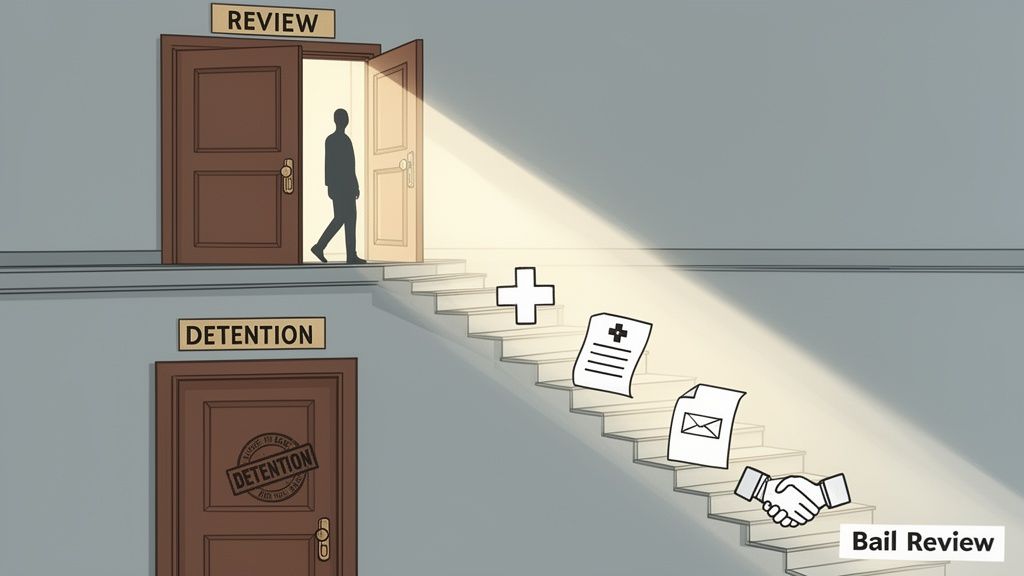
So, what actually counts? Here are a few real-world examples that a court might consider a material change:
- Serious Charges Are Dropped: If the Crown withdraws the main charges, the entire risk calculation for your release is turned on its head.
- A Key Witness Takes Back Their Story: When a crucial witness recants their testimony or their credibility collapses, the Crown’s case might suddenly look much weaker.
- Major, Unexpected Trial Delays: If your trial gets pushed back for an unreasonably long time—and it’s not your fault—a judge might agree that keeping you in custody is no longer fair.
- A New and Serious Medical Diagnosis: The development of a severe health condition that can’t be properly managed inside a jail could qualify.
- Getting into a Residential Treatment Program: If you secure a guaranteed spot at a respected facility for addiction or mental health, this presents a brand-new supervision plan that didn’t exist before.
The High Bar for Another Hearing
Even with one of these developments, getting another hearing isn’t guaranteed. It’s a two-step process. First, your lawyer has to formally apply and convince a judge that a “material change” has actually happened. Only after you win that argument do you get to make your case for release all over again.
This is why the exhaustive preparation we put into your first bail hearing is so vital for securing your judicial interim release. We treat it like it’s your only shot, because in many ways, it is.
FAQ: Common Questions About Bail Hearings in Ontario
When a loved one is arrested, the first questions are always urgent and wrapped in anxiety. It’s a confusing, stressful time, but getting clear, straight answers is the first step toward getting through it. Here are some of the most common questions we hear from families in Brampton and the Peel Region.
How long does it take to get a bail hearing in Ontario?
By law, an arrested person must be brought before a Justice of the Peace within 24 hours. If the Crown opposes release, the actual contested bail hearing should ideally happen within a few days. However, backlogs in a busy courthouse like Brampton can cause delays. A proactive defence lawyer at Badesha Law will push to have your hearing scheduled immediately and can argue for your release if delays become unreasonable.
What is a surety and who can be one in Brampton?
A surety is a responsible person who promises the court they will supervise you while you are on bail. They also pledge a certain amount of money, which they risk losing if you breach your conditions. To be a surety in Ontario, a person must generally be a Canadian citizen or permanent resident over 18, have no criminal record, and be seen as credible by the court. Our role is to help you find the right person and prepare them for court.
Can I get bail if I have a criminal record?
Yes, but it is more difficult. The Crown will use a prior record to argue you are a risk to the public. This often creates a “reverse onus” situation where you must prove why you should be released, instead of the Crown proving why you should be detained. In these cases, a skilled lawyer and a very strong release plan are essential. For legal advice on your specific situation, contact Badesha Law.
What happens after I get out on bail?
Release is not unconditional. You must sign a legal document outlining your specific bail conditions, which are non-negotiable rules you must follow. Common conditions include a curfew, residing at a specific address, reporting to police, and having no contact with the alleged victim. Breaking any condition is a new criminal offence that will likely result in being re-arrested and denied bail a second time.
Understanding how many bail hearings you get is about recognizing the immense importance of your first appearance. It is your best and sometimes only chance to secure your freedom. If you or someone you care about needs help with a bail hearing in Brampton or anywhere in the Peel Region, the team at Badesha Law is ready to help 24/7. We are here to protect your rights and fight for your freedom. Contact us for a free, confidential consultation.
No comment