


If you are facing domestic harassment charges in Brampton, you are likely feeling overwhelmed and uncertain about what comes next. This is a serious criminal law problem, often connected to allegations of domestic violence. In the eyes of Ontario law, this isn’t about a single argument; it’s about a pattern of repeated, unwanted conduct aimed at a partner, ex-partner, or family member that makes them fear for their safety. This guide will explain the charges, the court process in Peel Region, and how a criminal defence lawyer can protect your rights.
At Badesha Law, a criminal defence law firm in Brampton, we understand the person behind the charge. We know the stress this situation brings. Our first job is to cut through the legal jargon and explain exactly what the Crown prosecutor must prove to secure a conviction for criminal harassment.
Understanding Criminal Harassment Charges in Ontario
When you are charged with criminal harassment, it means the Crown believes they have enough evidence to prove beyond a reasonable doubt that your actions fit the legal definition under Section 264 of the Criminal Code. The justice system in Peel Region treats these domestic allegations with extreme gravity.
For the Crown to succeed, they must prove several specific components of the offence. Understanding these elements is the first step in building an effective defence.
Key Elements of a Criminal Harassment Charge
| Component | Explanation |
|---|---|
| Repeated Conduct | This isn’t about a one-off argument. The prosecution must show a pattern of behaviour or a series of actions over time. |
| Unwanted Communication | The actions, whether phone calls, texts, emails, or showing up at a location, must be unwelcome and without the other person’s consent. |
| Reasonable Fear | This is crucial. The complainant must have felt a genuine and reasonable fear for their safety or the safety of someone they know as a direct result of your conduct. |
| Harassing Intent | The Crown must prove you knowingly or recklessly engaged in the conduct, causing the person to feel harassed. |
Each of these elements presents an opportunity for a skilled lawyer at Badesha Law to challenge the Crown’s case. From the moment of arrest, you need a clear strategy. Key factors that will immediately impact your life include the specific allegations, the police evidence, and your bail conditions, which will almost certainly include a strict no-contact order.
These charges are often tied to broader accusations of domestic violence. This guide will walk you through potential consequences and defence strategies, showing how Badesha Law can stand with you to protect your future.
What Legally Constitutes Criminal Harassment?
Knowing where the law draws the line between a personal dispute and a criminal offence is critical when facing domestic harassment charges. Section 264 of the Criminal Code defines what kind of behaviour is illegal. The Crown must prove a pattern of conduct, not a single, regrettable message.
The Legal Test: Was the Fear Reasonable?
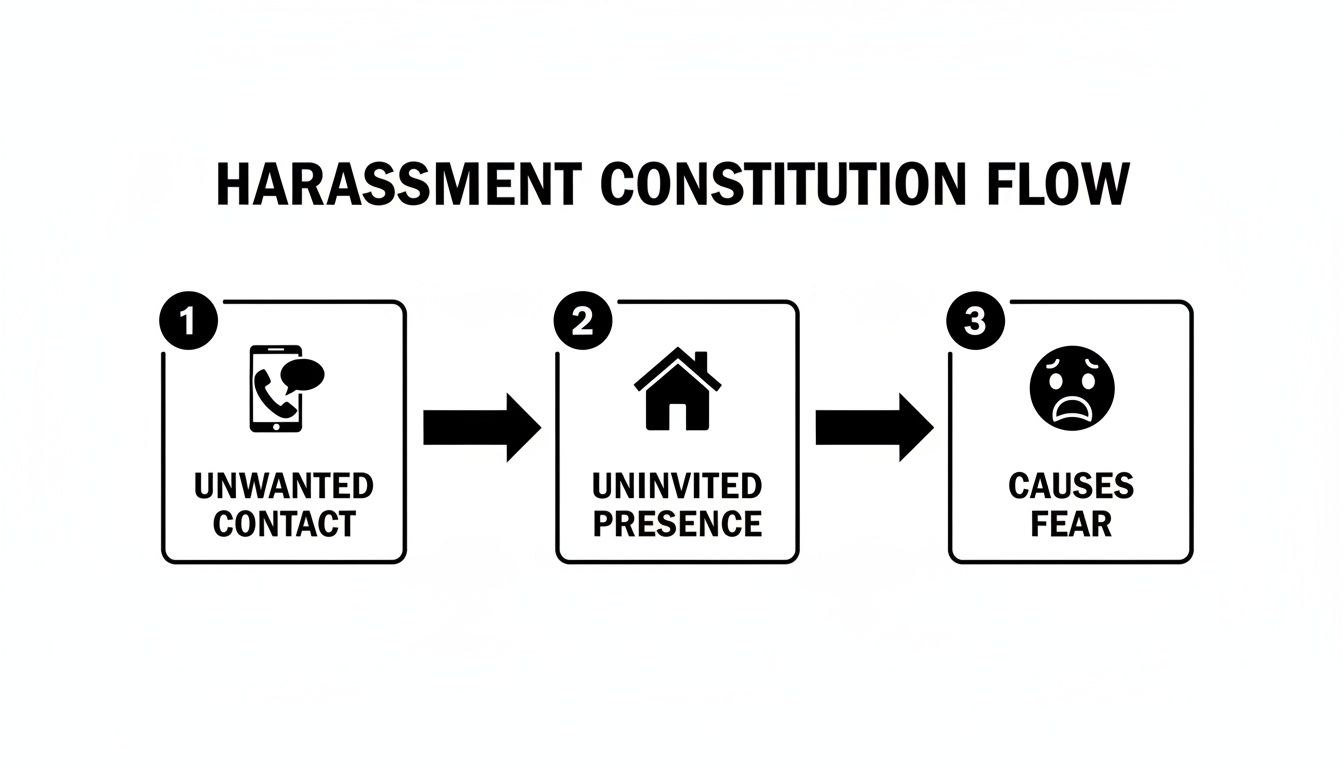
At the heart of any criminal harassment charge is the impact of the behaviour. For a conviction, the prosecution must prove your actions made the complainant genuinely and reasonably fear for their safety. The fear could be for their physical or psychological well-being.
A single angry text or unwanted phone call almost never meets this high legal standard. It is the cumulative effect—the persistent nature of the conduct—that builds the foundation for a charge. A strong defence often involves demonstrating that the complainant’s fear was not “reasonable” given all the circumstances.
Examples of Harassing Conduct in Peel Region
In Brampton and across Peel, police investigate and lay charges based on repeated, unwanted conduct. Common examples include:
- Persistent Communication: Relentlessly sending texts, emails, or social media messages after being told to stop.
- Unwanted Presence: Repeatedly showing up at a person’s home, workplace, or school without a legitimate reason.
- Watching and Following: “Besetting or watching” someone’s home or place of work, creating an unnerving sense of being monitored.
- Threatening Conduct: Behaviour aimed at the person or their family that suggests harm. This can overlap with other charges, a topic covered by our uttering threats lawyer in Brampton.
Law enforcement takes these allegations seriously. Broader trends show that even when total reported domestic incidents decline, the severity of those incidents can increase.
Navigating the Brampton Court Process
The court process for a domestic harassment charge in Brampton can be intimidating. Knowing what to expect is the first step in mounting a solid defence.
It starts with the bail hearing, where a Justice of the Peace decides if you can be released from custody. In domestic cases in Ontario, the Crown will almost always seek strict conditions, including a ‘no-contact’ order that can bar you from your home. Having an experienced lawyer from Badesha Law argue for your release is vital. To learn more, it’s helpful to understand what happens at a bail hearing.
Key Stages After Bail
Once released, your case moves through the court system. Each stage is an opportunity for your lawyer to protect your rights.
- First Appearance: A brief administrative court date to inform the court you have a lawyer and schedule the next step.
- Receiving Disclosure: This is the Crown’s complete file, including police notes, witness statements, and any digital evidence. At Badesha Law, we meticulously review this material for weaknesses in the Crown’s case.
- Crown Pre-Trial: A closed-door meeting between your lawyer and the Crown Attorney. This is a critical negotiation where we point out problems in their case and argue for the charges to be withdrawn, perhaps in exchange for a peace bond, or explore other resolutions without a trial.
Ontario has specialized domestic violence courts, and the system in Peel Region has its own procedures. You need a lawyer who knows the local courthouse, prosecutors, and judges.
Potential Penalties and Long-Term Consequences
A conviction for domestic harassment in Ontario carries consequences that extend far beyond a court sentence, potentially impacting your life for years. Penalties range from fines and probation to a maximum of 10 years in prison for an indictable offence.
However, the judge’s sentence is often just the beginning. A conviction results in a permanent criminal record, a label that can be difficult to overcome.
The Hidden Penalties of a Criminal Record
A criminal record can have devastating real-world consequences:
- Employment Barriers: Many employers in Brampton conduct background checks. A domestic violence conviction can prevent you from getting a job and advancing your career.
- Travel Restrictions: You will likely be barred from entering the United States and many other countries, limiting personal and professional opportunities.
- Immigration & Housing Hurdles: A conviction can complicate renting an apartment, applying for citizenship, or sponsoring family members to come to Canada.
These are significant life changes. Law enforcement agencies field hundreds of thousands of domestic-related calls annually, highlighting how seriously these matters are taken.
A domestic violence conviction can also severely impact your family life, being used against you in custody and access disputes, potentially damaging your relationship with your children.
Understanding what is at stake is crucial. You need a skilled Brampton criminal lawyer fighting for you. At Badesha Law, we know what’s on the line and begin building your defence immediately to protect your future.
How a Criminal Defence Lawyer Builds Your Case
Being charged does not mean you will be convicted. The Crown prosecutor has the burden of proving every element of the charge beyond a reasonable doubt. Our approach at Badesha Law begins by deconstructing the Crown’s case to find weaknesses, inconsistencies, and any violations of your rights.

We start by diving deep into the evidence. Police often present digital communications, like text messages, selectively. Our job is to obtain the full context. Do your replies show a two-way argument rather than one-way harassment?
From there, we challenge the core of the charge. Was the complainant’s fear for their safety legally reasonable? A skilled criminal defence lawyer in Brampton can effectively argue that while the complainant may have been upset, their alleged fear does not meet the strict standard required for a criminal conviction.
Common Defence Strategies
A solid defence is a multi-layered strategy. We explore every possible angle, often focusing on key areas where the Crown’s case is likely to fail.
- Challenging Witness Credibility: We meticulously review statements from the complainant and other witnesses for contradictions or motives that could undermine their testimony.
- Lack of Corroborating Evidence: We highlight when a case comes down to one person’s word against another, with no independent, objective evidence.
- Violations of Charter Rights: Did police search your phone without a warrant? Did they fail to inform you of your right to a lawyer? Any violation of your constitutional rights could lead to key evidence being excluded from court.
A strong defence is about holding the justice system to its high standards. We scrutinize every piece of evidence and police procedure to ensure your rights are protected.
At Badesha Law, we craft a robust defence tailored to the specific facts of your case, fighting for the best possible outcome.
Why Choose Badesha Law for Domestic Harassment Charges?
When facing a domestic harassment charge, you need a local advocate who knows the Peel Region court system inside and out. That is what you get with Badesha Law, a Brampton-based criminal defence firm dedicated to protecting you.
Our direct, strategic approach begins with a deep dive into the Crown’s evidence. We meticulously search for weaknesses and potential Charter violations. From our first meeting, we provide clear, straightforward legal advice so you are never in the dark.
Our Brampton Courtroom Advantage
Our daily experience at the Brampton courthouse gives us a distinct advantage. We know the local Crown Attorneys and what they prioritize, which is crucial for effective negotiation. This local knowledge often allows us to achieve outcomes that protect our clients’ futures, such as:
- Getting charges withdrawn completely.
- Negotiating a peace bond to avoid a criminal record.
- Securing resolutions that do not jeopardize your immigration status or career.
If your case proceeds to trial, we are prepared to fight vigorously in court. The stakes are too high to face this alone. Don’t wait to get the help you need. Contact Badesha Law for a confidential consultation and let us start building your defence today.
Frequently Asked Questions (FAQ)
Facing a domestic harassment charge raises many questions. Here are answers to some common concerns we hear from clients in the Brampton area. This is for general information and is not a substitute for legal advice on your specific situation.
Will I go to jail for a domestic harassment charge in Ontario?
While jail time is a possibility, especially for serious cases or if you have a prior record, it is not a certainty. An experienced criminal defence lawyer can explore many other resolutions. We often negotiate for charges to be withdrawn. Other potential outcomes include a peace bond (which is not a criminal conviction) or probation. The outcome depends on the specifics of your case and the strength of your legal defence.
What is a no-contact order and can it be changed?
A no-contact order is a standard bail condition in nearly all domestic cases in Ontario. It strictly forbids any communication, direct or indirect, with the complainant. Breaching this order, even with a simple text message, can lead to new criminal charges. While these orders are rigid, a lawyer can apply to the court to vary the conditions, for instance, to allow for child access or to retrieve personal belongings. This requires a formal legal process.
Can the complainant just drop the charges?
This is a common misconception. In Ontario, the answer is no. Once police lay charges, the Crown Attorney—not the complainant—controls the case. Even if the person who called the police later wishes to “drop the charges,” the prosecutor has the final say. The Crown will proceed if they believe there is enough evidence and it is in the public interest to do so. Badesha Law can provide specific advice on how the complainant’s position may impact your case.
No comment